







In 2015, Yale students confronted Nicholas Christakis, a professor at the university, over an email his wife had sent encouraging them to embrace, rather than fear, offensive Halloween costumes. A number of students were crying and one student told Christakis that a university “is not about creating an intellectual space.…It is about creating a home here.” In 2019, a Gallup survey of more than three thousand college students found that large majorities favored restricting racial slurs and stereotypical costumes. Clearly, our understanding of free speech is changing. Campus speech codes, “cancel culture,” and renewed calls – often from within the academy – to regulate social media for promoting “hate speech” and violence have contributed to that reconsideration.
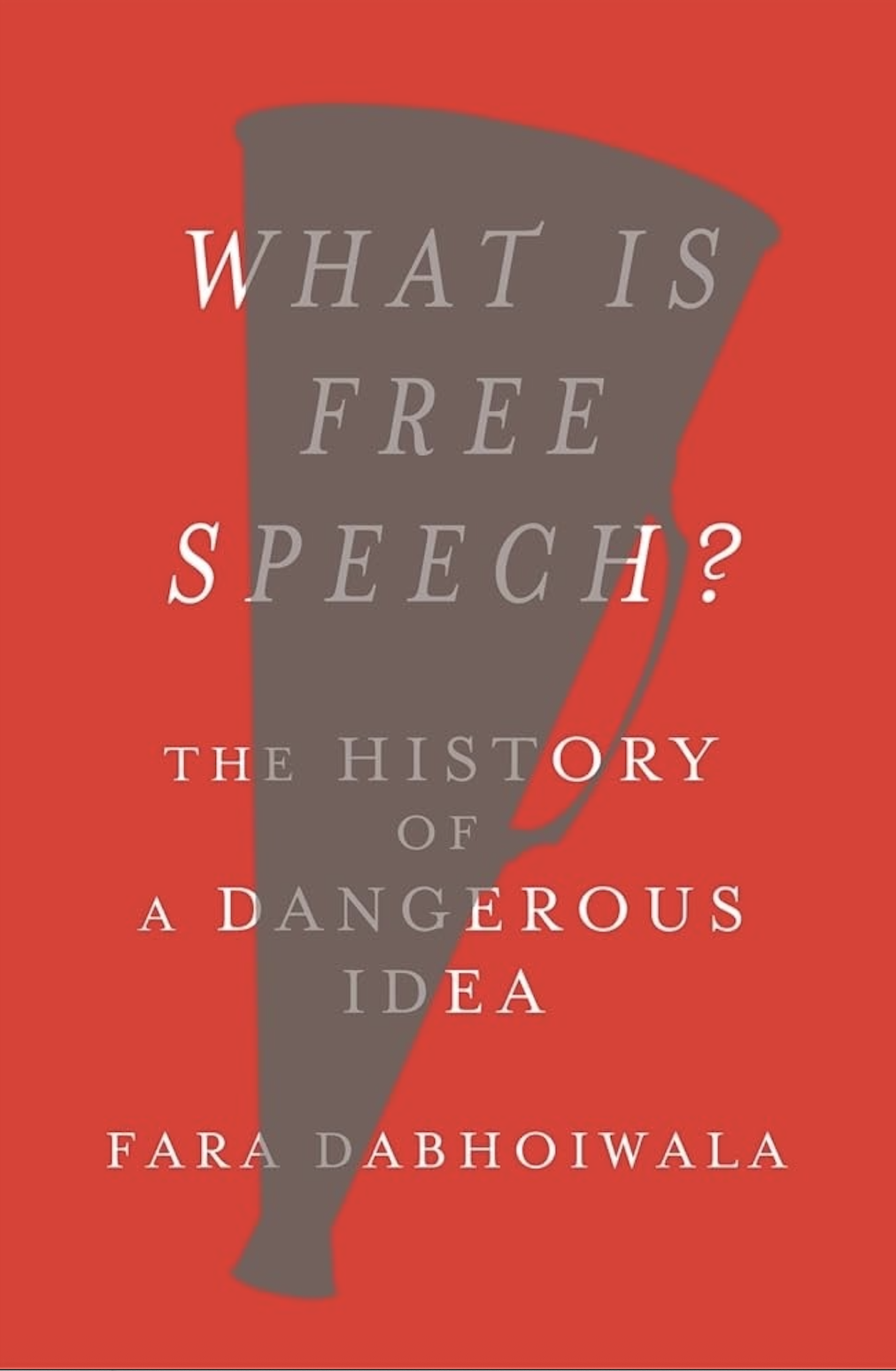
Despite what looks like an obvious trend toward the regulation of speech, most books on free speech fall somewhere between near-absolute civil libertarianism and arguments for stronger limits on harmful or misleading speech. Fara Dabhoiwala’s What Is Free Speech? is another contribution to this contested landscape. Dabhoiwalatreats free speech not as a hard-won liberal achievement but as a concept that is deeply entangled with imperial power, colonial domination, and elite self-interest. Rather than justifying regulation in terms of democratic deliberation, equality, or social harm, the book’s central project is to expose what Dabhoiwala sees as the deep and persistent connection between the liberal defense of free speech and the history of empire.
Dabhoiwala correctly associates the liberal defense of free speech with John Stuart Mill’s On Liberty(1859), which he calls the “urtext of modern western liberal thought.” But David Hume and James Mill also enter the narrative, less as philosophers of liberalism than as intellectuals whose “personal prejudices” helped construct a speech tradition that claimed freedom for some while denying it to others. Dabhoiwala’s ambition is to wrest the history of free speech away from Hume, both Mills, and their liberal heirs to undermine the idea that more speechnecessarily produces more truth.
For Dabhoiwala, what makes free speech dangerous is the hypocrisy of its advocates, most famously John Stuart Mill. In On Liberty, Mill defended liberty of thought and discussion in universal terms, yet he limited that principle to “civilized” societies, permitting despotism toward “barbarians.” For Dabhoiwala, this civilizational exception reveals how universalist rhetoric allows “the powerful, the malicious and the self-interested…[to] subvert the truth.” The British imposed laws against religious intolerance across Africa and Asia, as well as in New Zealand, Australia, and Canada – measures that appear less concerned with autonomy than with managing imperial order. Dabhoiwala faults this censorship for elevating “subjective personal sentiments” and “hijack[ing] state power.” By contrast, he defends contemporary European hate speech laws as grounded in dignity and respect. The distinction is less stable than Dabhoiwala suggests. Contemporary British, German, and French practices likewise risk mobilizing state power to enforce contested moral judgments. The continuity complicates Dabhoiwala’s effort to confine hypocrisy to the imperial past.
Classical liberal theory treats the public good as the contingent product of private interests converging in open debate. Dabhoiwala rejects this view – “A profit-driven media marketplace is not the best determinant of truth.” Perhaps, but he never specifies how a government-regulated marketplace would protect or encourage speech better than a private one. Nor does he address how his notion of truth can be distinguished from competing moral and political claims, whose adherents are equally convinced that they are right and opponents wrong. Instead, he resorts to ad hominem arguments, characterizing defenders of the “marketplace of ideas” as colonialists, imperialists, and settlers – or at least apologists for those activities.
What Is Free Speech? draws on a broadly Foucauldian approach that treats ideas as instruments of domination. Dabhoiwala seeks to uncover the “unequal distribution of power” that, in his telling, makes the liberal ideal of free speech appear neutral and universal when it is in fact politically interested and historically contingent. Although it easily slips into debunking, this approach can yield genuine insights. Dabhoiwala treats free speech as a global concept rather than a purely Anglo-American one and presses readers to consider how legal principles travel across borders, empires, and social hierarchies. The book’s willingness to unsettle familiar narratives and to place liberal thought in a wider geopolitical frame is one of its strengths.
The book opens with early-modern societies, which Dabhoiwala regards with a mixture of sympathy and unease. He admires their regulation of “uncivil” speech, seeing in these practices an analogue to modern hate speech laws designed to protect “the whole community.” At the same time, he acknowledges that such norms were often patriarchal and gendered, limiting his willingness to endorse them outright.
Modern free speech theory comes in for far harsher treatment. Dabhoiwala regards On Liberty as “profoundly imperialist and intellectually flawed.” Yet rather than engaging Mill’s arguments on their own terms, Dabhoiwala situates Mill’s work primarily within the context of nineteenth-century British imperialism. “As On Liberty was first being read in London and Calcutta,” he writes, “thousands of British and French troops were looting and destroying Beijing’s Imperial Summer Palace” – a juxtaposition meant to collapse philosophical argument into imperial violence. The historical context is illuminating, but association does not substitute for sustained analysis of On Liberty’s strengths and weaknesses. Dabhoiwala’s intention is to show that Mill’s liberalism encouraged the worst aspects of imperial rule. Yet the tension he identifies may be less a defect unique to Mill than a structural feature of liberal universalism under empire. Instead of confronting that tension within the liberal tradition itself, Dabhoiwala treats it as disqualifying – a move that prepares the ground for a more collectivist resolution.
That unresolved tension becomes less troubling to Dabhoiwala when he turns to “Marxist ideals of free speech.” He claims that the Soviet Union, like pre-modern societies, “restricted expression…to benefit the public good.” He acknowledges that both the USSR and Communist China appear uncomfortably close to Orwell’s Big Brother, but quickly pivots to the Soviet Union’s role in advancing international prohibitions on racial superiority and capitalist control of the press. “Between 1946 and 1966,” he writes, the Soviet Union and its allies “consistently urged the prohibition” of racial superiority in international agreements, while in the United States, Mississippi prevented speech in favor of racial integration.
A scholar working in the critical perspective that Dabhoiwala applies to liberalism might treat Soviet endorsement of free speech as a Cold War tactic designed to disguise repression. Yet Dabhoiwala emphasizes the Soviet constitution’s formal promise to free print from reliance on capital and its rhetorical commitment to popular control of media. What receives far less attention is the institutional reality that made dissent in the Soviet system so perilous. Dabhoiwala notes that Lenin exiled and Stalin killed the anti-Bolshevik Marxist Gavril Myasnikov, but Dabhoiwala does not explain why. He highlights “a few, brave Russians” who took constitutional guarantees of speech seriously, without describing what they were dissenting against or the risks they faced. Dabhoiwala’sassessment of power turns out to be as selective as the free speech theorists he criticizes for justifying imperialism.It foregrounds international critiques of Western liberalism while bracketing the realities of totalitarian governance.
Yet Dabhoiwala is right to insist that speech has limits. The First Amendment does not protect libel, slander, pornography, or obscenity. And the republican tradition of free speech has long emphasized self-restraint and civic responsibility. But his emphasis on subjective perspectives and systemic inequalities risks transforming free speech into a matter of protected identities rather than shared inquiry. As the Supreme Court expanded the First Amendment’s speech clause to include “the freedom of expression,” speech became less about interpersonal communication and deliberation and more about “selves” saying and doing whatever they believe is most authentic to them. It is this development, not capitalism, that provides students with the power to prevent speakers from appearing on campus.
In 2018, Christina Hoff Sommers, a critic of certain strands of feminism, had a talk she was giving at Lewis & Clark Law School interrupted by students shouting, “No platform for fascists, no platform at all. We will fight for justice until Christina’s gone.” That the Hoff Summers incident did not involve a clear-cut rights violation does not mean free thought and free speech did not suffer a blow. Dabhoiwala’s emphasis on ostensible differences of powerposes the danger that free speech becomes less about defending ideas we despise and more about managing the emotional and political boundaries of groups.
Dabhoiwala aims for a wider audience than academics. But his narrative is thick with historical references that blur differences among countries and customs. His search for a free speech doctrine unsullied by Mill’s influence and global capitalism likewise burdens the book’s historical investigations and conclusions. What Is Free Speech?, however, raises a serious question for general readers and contemporary scholarship: how should we evaluate histories of free speech that double as arguments for its retrenchment, especially as the cultural and political moment that produced them begins to recede? Many will agree with Dabhoiwala’s provocative challenge to liberal self-confidence. But others might wonder what will become of a political culture defined by concerns over subjective perspectives and structural inequalities.
About The Author
