


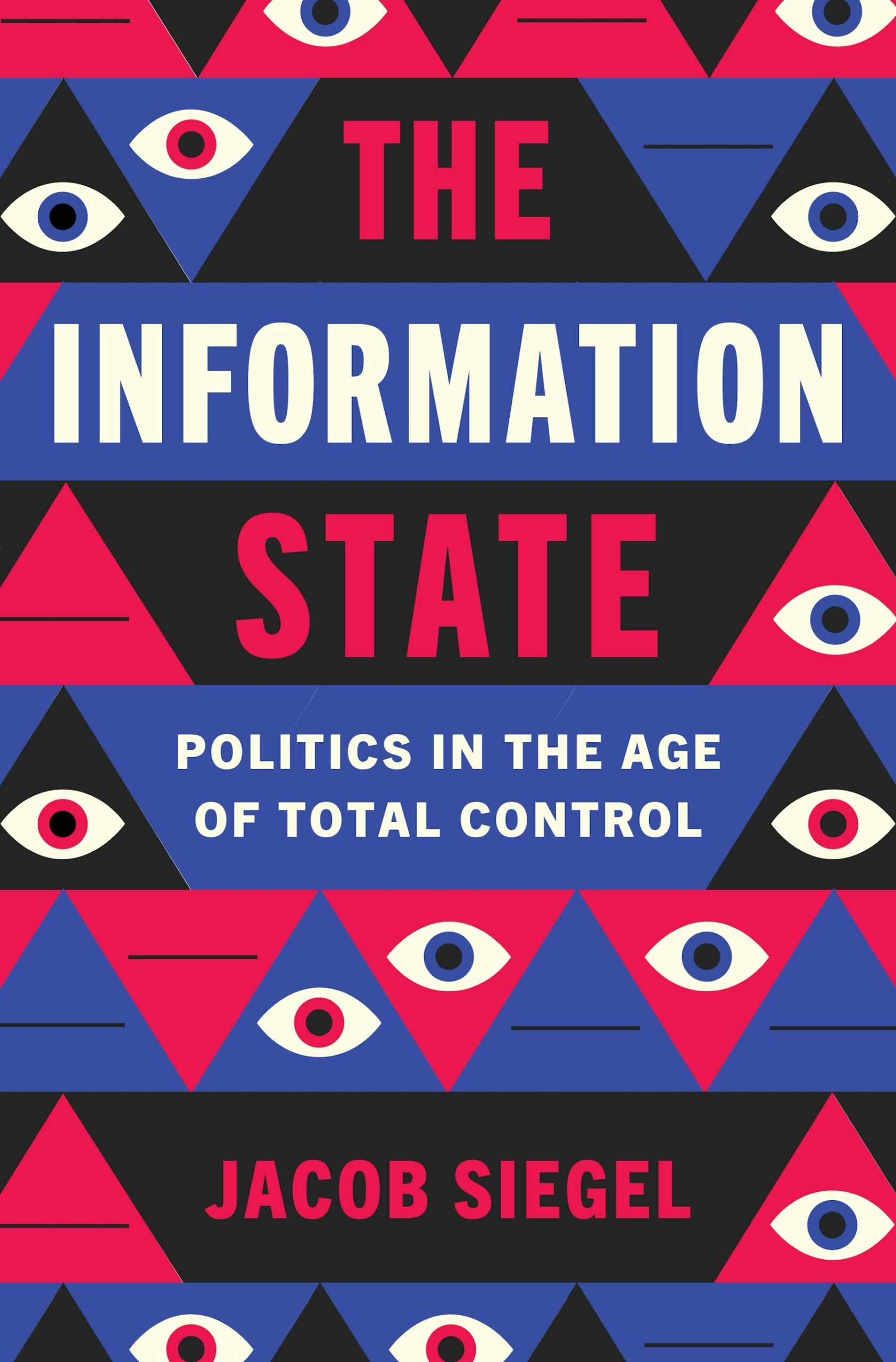


The idea of the information state—and the corresponding suspicion that unseen technological forces shape our beliefs about politics, culture, and even reality—pervades modern culture. But how should we really understand the digital instruments of power that govern today’s world? In The Information State: Politics in the Age of Total Control, author Jacob Siegel traces the origins of the information state and its effects on political life. As technological development continues, questions about the information state’s effects on individual autonomy and democratic consent will only grow more urgent. Whether the system contains the seeds of its own destruction or will merely continue to adapt and expand remains an open question. This conversation explores the information state’s emergence from the technological and political transformations of the 20th century, its power conslidation following 9/11, and the unique personalities and ideologies that have shaped—and continue to shape—its trajectory.
—Anneka Lupinek
This conversation has been edited for brevity and clarity.
Jacob Bruggeman: You call the information state a “third regime”—distinct from both authoritarian control and democratic consent—that governs by shaping how its citizens see the world. What is the information state and when did it emerge?
Jacob Siegel: At its most fundamental, the information state is simply the form of government suited to the conditions created by the internet. The digital medium tends to devalue the notion of participatory consent—think of the 40-page user agreements everyone signs without reading. Yet no one is forced to sign such agreements, or to post the latest ideological slogan to their social media pages, as they would be in an authoritarian regime. Instead, they are enticed by the promises of convenience, efficiency, choice, and social connection, as well as more opaque forms of algorithmic manipulation.
Once a sufficiently powerful technology transforms a society’s economy, its political order is often next. That’s what Karl Marx meant when he observed that “the windmill gives you society with the feudal lord; the steam mill, society with the industrial capitalist.” Political power in the feudal and industrial eras was based on control over land and physical capital. In the information age, it rests on the accumulation of databases, authority over critical algorithms, and control of the internet platforms where public life takes place and monetary value is exchanged. Political sovereignty is exercised through flows of information. Those flows determine what information people are free to access (which can pertain to politics, medical events, or their own bank accounts) and what will be imposed on them without their choosing. Constitutional rights operate downstream of access to information.
Bruggeman: Your book locates the information state’s origins in episodes scattered across history, from the early modern European state to WWI in America. Some important examples include Bacon’s scientific method, Colbert’s archival state, and in what you called Woodrow Wilson’s “first great technology of political control.” When did the information state actually cohere as a recognizable regime? Is it the product of a continuous thousand-year arc, or was its arrival a step change with what came before?
Siegel: The information state became a distinct, recognizable regime in the years after 2001. Its basic infrastructure had been developing for decades through the construction of a global information network, but it was only after 9/11 when the US government turned to it as a primary means of prosecuting wars and maintaining public order. Leading officials in Washington believed the internet had become the key terrain of strategic conflict in the 21st century. More immediately, they saw it as a crucial tool for keeping tabs on global jihadist movements and preventing further terrorist attacks. Mass surveillance initially expanded online to counter the threat of Islamist terrorism. By 2010 it had become a routine feature of the digital environment, acting as the profit engine of commercial websites like Google and Facebook. Governments exercised power by using the same tools.
To be clear, I don’t see the information state as the product of any one malign ideology or political decision. The historical story my book tells is not a fable about bad actors conspiring to destroy freedom.
I start the book in the 16th century with Francis Bacon to emphasize that the information state, like the internet itself, arose out of the Western Enlightenment tradition’s loftiest ideas about scientific progress and the expansion of human understanding. It advanced in the name of eminently justifiable causes, like the fights against the Soviet Union and Islamic terrorism.
Bruggeman: Progressive Era America is a key period in your telling of the information state’s ascent. Wilson, Croly, Lippmann, and the Committee on Public Information (CPI) are all central actors. But I’d like to push on the contingency here. Was the American version of the information state only possible given the specifically progressive fusion of expertise, moralism, and the administrative ambition embodied by Wilson and the propaganda machine created by the CPI? Could a different political tradition—say, the Madisonian “cool and deliberate sense” you invoke—have produced an alternative trajectory for the same technological capacities?
Siegel: All political ideologies justify granting power to certain groups at the exclusion of others. Progressivism empowered a class of technical experts to administer American society, and justified this by invoking the very real crises created by the Industrial Revolution. Even without the progressives becoming dominant, advances in the power of information technologies would likely still have led to some kind of information state emerging in the US. But an alternative model could have operated on a different distribution of authority between social classes—and without granting a mandate of heaven to a generic class of administrative experts.
The “cool and deliberate” Madisonian tradition would certainly have been more resistant to employing mass propaganda and censorship as tools of government, as Wilson did when he created the CPI to suppress anti-war sentiment in WWI.
Bruggeman: I want to focus on the chapters where you cover counterinsurgency doctrine and the Obama-era public-private fusion. Your story moves largely from the top of American political order: Wilson, J.C.R. Licklider at ARPA, Obama at Google, John Brennan at the CIA. But a sizable recent literature—including my own work on how phone phreaks and the hacker underground co-opted the the Bell System—recovers a different pattern: that the architectures of surveillance and “total information awareness” are often shaped by adversarial actors who probe their weaknesses or leak information about their existence to the public. Does a top-down analysis risk giving the state and its technocrats giving too much agency? Does it risk the adverse effect of reifying the information state as an institution beyond the control of any normal person reading the book?
Siegel: I love reading about the phone phreaks and other rogues who use technology to rebel against centralized, technocratic control. The rebels illuminate important potentials that may one day add up to something more than a romantic alternative. For now, however, their impact is negligible compared to that of the architectures of surveillance and “total information awareness,” which have shaped the society that some 340 million Americans experience daily. Ignoring their history would be cynical and self-limiting as it would blind us to the possibilities for our own future. But ascribing a significance beyond their achievements comes at the expense of confronting the reality of our situation.
Bruggeman: Let’s continue these themes with Obama, whom you describe as the “Silicon President.” The chapter leans heavily on Obama’s individual qualities—his “special connection” to the Valley, his deeply felt epiphany during a Google visit. I wonder if personalizing this story risks understating how much of the apparatus for high-tech politics was already in place from Bush-era homeland security, Clinton-era “reinventing government,” and even earlier episodes. How much of the “Silicon President” story is about Obama the man, and how much is about a structural transformation that would have found a vessel whoever won in 2008?
Siegel: My sense of history is that it moves both through vast impersonal forces and the particular characteristics of significant individuals. It’s not a moral question of heroes and villains but a matter of how certain people, for reasons known to their creator, are suited to actualize a potential course of history. Obama was absolutely that kind of leader. For one thing, Obama was simply sharper and more politically talented than his contemporaries. His vision was greater than theirs.
As I detail in the book, Obama received an unprecedented level of support from Silicon Valley early in his first presidential campaign, when he was virtually unknown on the national stage. If we are looking at an exclusively “structural” transformation, why did leading tech giants like Google’s CEO Eric Schmidt and Netscape founder Marc Andreessen choose to back the political novice Obama in 2007 instead of the far better-known Hillary Clinton? The answer, as they explained at the time, is that they saw a synergy between their own approach to the world and the one he represented. Obama was the unique kind of person, Andreessen said in 2008, “who saw the world and the status quo as malleable.” An article from the same year in The Atlantic Monthly titled, “the year’s hottest startup” describes Obama’s appeal to the tech industry in terms that explicitly invoke a special connection. “More than any policy, the idea of Obama and the world he speaks for seemed to excite something deep within the limbic system of the Valley brain, that manifested itself through the early and continuing financial support that was crucial to launching Obama’s campaign.” Rather than avoiding mention of Obama’s unique appeal for fear of personalizing the narrative, I thought it more worthwhile to probe what it was about him that aroused the Valley brain.
Bruggeman: A recurring feature of your argument is that the information state’s greatest vulnerability is that it must assert control over the truth even when evidence doesn’t stack up on its side. You pull examples from the COVID-19 era of American politics (the lab leak, the efficacy of masking, Biden’s decline) to show that when the information state’s claims unravel, its entire apparatus loses credibility. How does the information state stand today?
Siegel: Yes, I see this as a cause for hope and optimism because the informational system consistently oversells its power to control the environment before crashing into the hard limits of reality. Likewise, in America especially, it overestimates its capacity to alter the beliefs of people who remain stubbornly attached to making up their own minds.
Bruggeman: Isn’t this itself an optimistic story about the self-correcting power of reality—of physical events that “defied informational control,” as you write of Trump at Butler? If that’s right, then the information state contains the seeds of its own undoing. But a less optimistic reading would be that each cycle of exposure simply trains the next regime—or its algorithms—to be more adept. Which reading do you believe in?
Siegel: Yes, I agree with the less optimistic reading as well. Despite failing to live up to its promises or to accomplish its own purported goals of winning wars and elections, the information system grows inexorably more powerful. It seems to grow larger from setback to setback, acquiring ever-greater numbers of people who are enmeshed in its dependencies. It doesn’t do what it claims, or what we want, but we can’t live without it.
Bruggeman: You end the book on a striking note: the technical infrastructure of the information state, even in its dormant state after 2024, remains “fundamentally intact,” and the AI race is already reconstituting it in a new form. If the information state’s first century was Wilsonian—bureaucratic, party-based, technocratic—and its second phase emerged in the public-private fusion of the Obama era, what is the character of the regime now taking shape around generative AI and a populist executive?
Siegel: I suspect that the Trumpian fusion of digital Caesarism, open graft, and overt corporate intervention in politics (as in Elon Musk’s role in DOGE) will be short lived. Following this brief but eventful blip, the Democrats will likely return to power in 2028. Having learned some lessons from the backlash engendered by excessive Biden-era informational control, a future administration may be more sophisticated at exercising extra-constitutional regulatory powers through avenues like “AI safety” protocols.
Meanwhile, the discrediting of traditional media sources has not led to a flowering of better news sources. Many people feel that social media, and X in particular, have become wastelands of nonstop information operations and AI slop. That sentiment will tilt public support away from opposition to censorship and back toward a demand for more regulation online.
On a longer horizon, the technocratic era is coming to an end this century. Human expertise and control over rational machines, on which technocracy rests, look like childish illusions in the face of super-powerful AIs whose programmers cannot understand their own creations. Deterministic rationalism is being swept away by inscrutable decision-making machines that operate at speeds beyond human reckoning. What comes next will be more like myth than enlightenment. We may yet see a return to the forms of idol worship that preoccupied the sages of the Hebrew bible.
About The Author
