





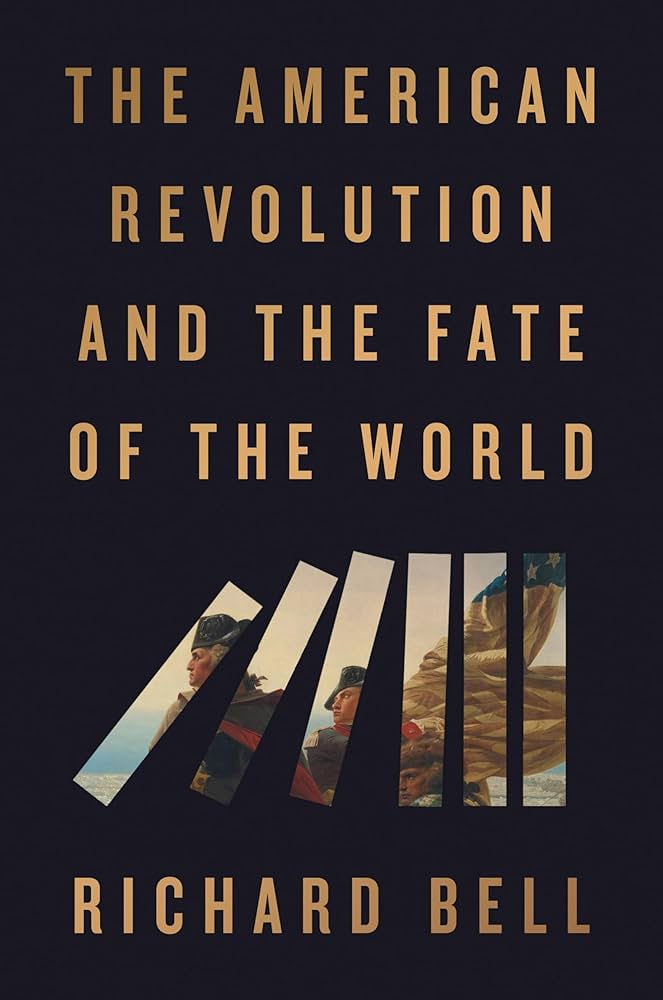


The American Revolution and the Fate of the World, by Richard Bell (Penguin Random House, 416 pp., $35.00)
Ralph Waldo Emerson, dean of the American transcendentalist poets, famously called the first shot of the American Revolution the “shot heard round the world” in his hymn for the Battle of Concord. The phrase has echoed through the ages as one of the most iconic in American history. Indeed, the entire world would come to hear the shots of the American Revolution. Not only in Concord and Yorktown, but from Gibraltar to Madras. Yet, we Americans have typically heard little of the global dimensions of our struggle for freedom. Richard Bell’s The American Revolution and the Fate of the World offers an opportunity to remember the global significance of our Founding in its 250th anniversary. Bell is a professor of history at the University of Maryland, an author of four prior works on Early America, and himself possesses a global story as a British immigrant to the United States.
Bell persistently refers to the Revolution as “civil war within the empire” and describes the book as advancing seven arguments. First, that the Revolution stirred mass migration globally. Second, that the war was catastrophic for populations affected. Third, that the Patriot victory was contingent, not inevitable. Fourth, that naval power was crucial to the outcome. Fifth, that trade was power. Sixth, that the success of American independence drove a suppression of the liberties of other colonies the world over. Seventh and finally, that “this was a conflict in which the call for liberty rang around the world as never before.” Personal stories illustrate the horrors of war, often glossed over for tales of glory alone, while others illustrate the importance of trade and war on the high seas. Privateers roamed from Normandy to West Africa in ships with names like Tyrannicide. Washington and John Paul Jones dismissed them as mere mercenaries, but they often believed in the continental cause as much as money. Privateers died en masse in British captivity and faced beatings for celebrating the 4th of July.
The struggle for American independence is a forgotten “creation story in the making of our modern world” throughout the book, once that set in motion the events that made the world we know. Bell notes that “the Revolution was never confined to the Thirteen Colonies seeking independence.” He takes the story of the Revolution to horizons most readers might expect, such as Canada or France, and also to more surprising frontiers. On the steppes of the Peruvian Andes, Spanish imperial authorities found themselves stretched thin by their war against the British. Incan royal Tupac Amaru unsuccessfully rose in the New World’s second-largest revolt seeking the liberties of Peru. In other corners, events are less inspiring. Tribes sided with the Americans and British, but neither decision had much impact in the long term. The pro-Patriot Stockbridge and Oneida lost their lands as quickly as had the pro-British Mohawk.
Slaveowners in Jamaica blamed their debates on the American Revolution for sparking rebellion in 1776, mere weeks after the 4th of July. To the Caribbean, British troops were the only guarantee of slave society. The British defeat opened the door for abolitionism, with British abolitionist Thomas Clarkson celebrating that “as long as America was ours, there was no chance that a minister would have attended to the groans of the sons and daughters of Africa.” The loss of the American colonies pulled the rug out from under the British pro-slavery lobby, opening the door to William Wilberforce’s anti-slavery crusade.
In 1780, the Islamic Kingdom of Mysore sent 80,000 men to besiege British Madras, a force “nearly ten times” the size of Washington’s at Yorktown a year later. As a result, Bell puts the final shots of the conflict that began with Lexington Minutemen in 1775 to cannon fire in 1783 in Southern India. The Mysorean Islamic King Tipu Sultan used a novel design of rocket to rain fire upon British lines. The British found themselves inspired by his designs to build their own. Years later during the War of 1812, they unsuccessfully deployed them against American forces. One observer and poet, Francis Scott Key, was so struck by the assault that he put pen to paper to write of “the rockets’ red glare…”
Bell’s tales of global migrations caused by the Revolution are some of the most stark. In many ways, the Revolution built the British Empire as much as it damaged it. The outflow of Loyalists secured British rule over Jamaica, the Bahamas, Canada, and Australia. The British Empire into which Benedict Arnold’s children stepped was “nearly unrecognizable” compared to the one in which he was born. White Loyalists fled America and formed the foundation of Canada while Black Loyalists formed the foundation of Sierra Leone. The latter story is told through the eyes of Harry Washington, a slave of George Washington’s. John Murray, the Earl of Dunmore and Governor of Virginia, offered freedom to any slave willing to fight for the British against rebel masters. In truth, he assumed the declaration would dissuade white slave owners rather than bring any blacks to his lines. In practice, it inspired thousands of enslaved men, women, and children like Harry to cross enemy lines for liberty under the Union Jack. One man even renamed himself British Freedom after fleeing the Patriots.
Harry spent most of the war in Redcoat ranks, to be joined by fifteen others from Mount Vernon by 1783. Lady Britannia proved to be a venal mistress. They left their black soldiers behind at every inconvenience. Harry and his fellow black Tories were only able to secure passage to Nova Scotia at the last minute. There, British authorities denied them land and white Canadians descended upon them in racial violence. British anti-slavery societies sponsored their migration to found a freedmen’s colony in Sierra Leone, but the black Tories found themselves sounding like their old enemies as they rebelled against British taxation without representation at the turn of the nineteenth century. The rebellion failed and its leaders, including the man still named British Freedom, ended their lives in exile.
The Revolution also paved the way for the conception of Australia. Thousands of British convicts had been sent to the American colonies since 1700. The hapless Mid-Atlantic colonies, the main recipients, protested the decision in the lead-up to the Revolution as polluting their land with characters unfit for self-government. With American independence, British jails began to overflow. Tales of overcrowded prisons snowballed into a decade of political scandals. Other European nations refused secret requests to transfer British convicts to their colonies. Faced with no other choice, the British government accepted a hare-brained proposal backed by a certain Lord Sydney to dump their convicts on the other side of the Earth. Thus, an unmapped continent known only to a handful of adventurers and nationalists became the home to thousands of British convicts that would once have been bound for America.
Others might be surprised to learn that the indefatigable Baron Von Steuben’s credentials were faked. Back in Europe, he was not a Lieutenant General as claimed but rather a Captain. Benjamin Franklin’s letter of recommendation even claimed he had been Prussian King Frederick the Great’s Aide-de-Camp. Nonetheless, he and his other European colleagues from across Germany and Poland sought to transform frontiersmen into gentlemen. Von Steuben believed in a much more humane leadership than many officers of his time and sought to share in the suffering of his men. Arguing that “love, not fear” was the secret to an officer’s success. This turned rag-tag rebels into soldiers at Valley Forge and nodded approvingly when soldiers belted out “for the war” in response to the question of how long their term of service lasted.
The Revolution’s unique religious dimensions are explored throughout. Few Americans realize their depth. If religion is discussed at all, it in the context of Americans being “the Protestants of Protestants” in the words of Edmund Burke, descendants of a long tadition of religious dissent. However, after the entry of Catholic France and Spain into the War, King George cast himself as “defender of the Protestant faith” against Catholic France and Spain. After all, “fighting France had long been the national pastime.” Meanwhile, American Catholics and Jews broadly rallied to support Washington. In response to the revolution in America, “God Save the King” replaced “Rule Britannia” as first among British national songs. Meanwhile, American soldiers at Valley Forge saw themselves as crusaders for religious liberty, not partisan Protestants, and eagerly shouted “long live the King of France!”
However, Bell argues that Spain, not France, was the most tenacious ally of the United States, or at least opponent of the British. Over twice as many Spanish soldiers fought the British as French. The Spanish would not ally with Protestant anti-imperialists as brazenly as the French, however, fearing for their own American colonies. While they fought the British, they never once gave John Jay, the US Minister to Spain, an audience with Spanish leadership. Accordingly, Jay delighted in sidelining Spanish claims while negotiating peace in 1783. Readers will be surprised to learn that George III reacted to the American victory by retiring to his study and drafted a letter of abdication. It was not to be. George III’s distaste for his own son kept him on the throne for four decades more even as his mind decayed into madness.
Bell walks readers through the revolution’s tie to its most famous offspring as a French Empire bankrupted by their American adventurism fell into a revolution of its own. Americans initially cheered the 1789 uprising in France, the Gazette of the United States heralded “THE TRUE ERA OF FREEDOM—OF UNIVERSAL LIBERTY.” The Gazette soon turned on the French Revolution, writing that “In America, no barbarities were perpetrated. No men’s heads were struck upon poles…the Americans did not, at discretion…roast their generals unjustly alive.” Bell throws water on the notion that the Revolution in France was the product of American ideation. Veterans of the Revolution in America were nowhere to be found on the forefront of the French struggle. Most French servicemen had come from rural areas, not the revolutionary hotbed of Paris. A few officers of Rochambeau’s joined the early fight for a constitutional monarchy, but they sought asylum abroad by 1791. Admiral d’Estaing, who sent the first French fleet to American shores, was among those guillotined in the Terror.
The Marquis de Lafayette remains the quintessential French hero of the American story. Bell notes that he was far from the most important, but that the role of higher ranking Frenchmen such as General Rochambeau was often intentionally forgotten. Americans disassociated their national memory from their French allies as the French disassociated themselves from American ideals with the progress of the French Revolution. Lafayette enshrined himself in the American memory with his return to the young nation for a national tour in 1824. He is remembered almost above all for his distinctly non-French qualities; his closeness to Washington and his advocacy for American-style government against the Jacobins. Little is said of French debates on American principles themselves. French Revolutionaries sent men such as the moderate and Amerophilic Girondins to the guillotines explicitly for the crime of federalism in contrast to Jacobin centralism.
Bell’s tilt to the left is consistent but rarely to the point of an objectionable bias. However, he unfairly characterizes Pennsylvanian Founding Father John Dickinson as a racist for thanking God that Americans were “British subjects…born to liberty, who know its worth, and who prize it high.” Such a statement is not a statement of racial superiority. Rather, Dickinson was fairly noting that American culture, in a tradition of British liberty, cultivated men fit to be citizens. This culture promoted personal responsibility, education, property ownership, and independence for their community institutions.
The book’s primary drawback is its lack of focus on the ideological dimensions of the Revolution. The French Revolution is often presented in the context of global ideology, its ripples spreading nationalism, socialism, and republicanism throughout the long nineteenth century. A similar treatment is rarely given to the American Revolution and Bell’s work does little to assuage that. We are told that copies of the Declaration travelled to Europe on the first ship bound east post-July 4. The book does not delve into the reaction to the immortal words that set a foundation for all future American political thought. Some discussion is given of British sympathizers with the Patriots such as Edmund Burke, but the Revolution’s inspiration reached far beyond. French Girondins such as the Marquis de Cordorcet and Asian communists such as Ho Chi Minh and Mao Zedong regarded the Patriots as personal heroes. In turn, the book does not extend far beyond the Revolutionary era itself.
Looking forward to the 250th anniversary of this nation’s independence, The American Revolution and the Fate of the World gives a worthwhile reminder that our struggle had global implications. As my friend Rabbi Meir Soloveichik often argues, the declarations of independence for most nations have little relevance beyond their borders, while that of America asserts claims of universal relevance. Few other works better explore the impact of the revolution on the world, even if readers in search of global perspective on the foundational ideas of America would be best served to look elsewhere.
About The Author
