





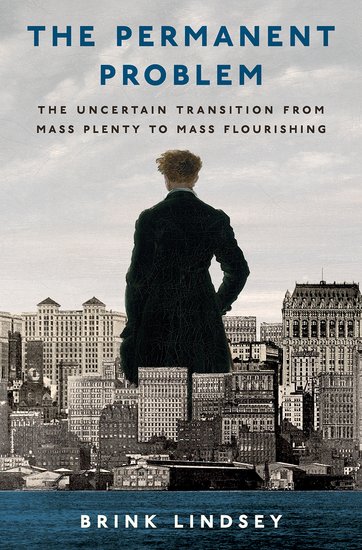


The Permanent Problem: The Uncertain Transition from Mass Plenty to Mass Flourishing, by Brink Lindsey (Oxford University Press, 248 pp., $29.99)
In The Permanent Problem: The Uncertain Transition from Mass Plenty to Mass Flourishing (2026), Brink Lindsey offers an intriguing, deeply philosophical analysis of America’s political scene. Unlike radical socialists or “post-liberal” conservatives, Lindsey—the “liberaltarian” vice president of the Niskanen Center—critiques liberal capitalism with an eye for reform as opposed to revolution. American capitalism and liberal democracy are in crisis. Our system has become a victim of its own success. Unprecedented wealth sits at the root of the discontent and depression that afflicts American society. Like a toddler that has outgrown its crib, America has reached a national income threshold where it has outgrown its current systems. The obvious solution is to renovate the crib, not to turn the crib into kindling.
In the US, since the post-WWII wealth boom, we have fallen into a “middle flourishing trap.” Like a family rising from poverty forced to tolerate reduced welfare checks, America has reached a level of wealth where we must endure a period of painful systemic restructuring to come out even more prosperous on the other side. America’s current systems are good at producing economic profit and material plenty, objectives of historical precedence. Now, however, mass affluence has reshaped America. Most Americans want more out of life than a steady paycheck. This is a positive development, reflecting hard-won gains in education and leisure time. But it means that our systems must play catch-up, refocusing themselves to match Americans’ new preferences. And, with support for illiberal populism, radical socialism, and nihilism on the rise, the legitimacy of liberal democracy and capitalism may hinge on their successful re-founding.
Beginning at the end of World War II, the advent of mass affluence revolutionized Americans’ life priorities. In the post-war decades, expanded higher education and abundant leisure time laid the groundwork for a sort of mass philosophizing: more Americans than ever before had the time to ponder the question, “What constitutes a truly good and fulfilling life?” The result of this change was the “postmaterial” shift in sociocultural values documented by Ronald Inglehart in his World Values Survey. Increased education and leisure time heightened awareness that fulfillment in life requires more than just material safety and comfort. By setting people on a quest for that “something more,” mass affluence pushed people to question the grounds of the very system that created it. In other words, the moderns’ own success pulled back the veil of the Enlightenment project from America’s eyes.
At the same time, by creating an economy of unprecedented scope and complexity, the United States’ postwar affluence also precipitated a crisis of community. Economic growth led businesses and civil society organizations, such as nonprofits or interest groups, to consolidate into larger bureaucratic entities. These supersized entities necessitated ever more complex and impersonal management systems. In this way, individuals were forced to move from reliance on persons, like a boss-proprietor or priest, to reliance on systems, such as HR departments and the welfare state. Moreover, as companies grew and communications technology developed, firms purposefully advocated for the commercialization of leisure time. This paved the way for the twenty-first century attention economy, abetting the dissolution of face-to-face relationships in the private sphere.
In sum, as Lindsey tells it, the advent of material plenty created an unprecedented appetite for social fulfillment and spiritual purpose while simultaneously constraining opportunities for personal connection. These two contradictory impulses of modern life are the ingredients of the animosity and despondence encircling American culture. To fix our current crisis of politics, we must begin by re-rooting capitalism and reducing atomization. But if Lindsey’s diagnosis is correct, what kept us from course correcting sooner?
The problem, according to Lindsey, is that we have been blinded by a particular fallacy: the belief in the inherent goodness of the unconstrained individual precipitated by the “romantic heresy.” The “romantic heresy” is, roughly, contemporary culture’s interpretation of Jean-Jacques Rousseau’s philosophic writings. Idolizing the individual completely unchained from societal norms, the “romantic heresy” exalts a life spent unburdened by obligations to others, declaring this life the most fulfilling and best life for all human beings. Freedom from convention, the heresy claims, will enable humans to become genuinely virtuous through the discovery of their authentic selves. This newfound goodness, in turn, promises to make humanity capable of coexisting in an idealized community.
Of course, Lindsey notes, the “romantic heresy” may be a false prophecy. Immanuel Kant’s concept of humanity’s “unsocial sociability” teaches us that, by nature, humans are selfish creatures. We will never become true “species beings” à la Marx. Nevertheless, Lindsey and Kant reflect, humans also seem to require meaningful relationships, or at least devotion to something greater than ourselves, to achieve true fulfillment. Yes, there is a part of us that wants to flee from the obligations of society. But we are also somehow attracted to society’s ability to make us part of something greater. Thus, as Lindsey astutely observes, we must stop running away from conventional obligation. Human beings will become fulfilled “not by diving inward in search of a nonexistent pure and authentic self, but rather by extending ourselves outward” towards others.
Romantic notions of hyper-individualism were marginal, in Lindsey’s telling, until the 1960s. It was only then, with the rise of the New Left and the broader Counterculture, that the “romantic heresy” exploded into the mainstream. Traces of this individualistic and idealistic philosophy have lingered ever since. Hyper-individualism lived on in the “Me Decade” of the 1970s, the triumph of therapeutic culture, and the rise of personalized consumerism. Today, the individualism of the “romantic heresy” is most visible on social media, in the form of selfies and algorithmic self-actualization.
The idealism of the “romantic heresy” also survives today. It takes the form of an “adversary culture” that feels justified in critiquing America’s institutional ideals themselves, rather than just their imperfect realization. Lindsey sees the manifestation of this “adversary culture” in the general narrative that America is irredeemably “the land of white supremacy…structural racism and patriarchy, the perpetrator of indigenous displacement and genocide, [and] the world’s biggest polluter.” Striving for social justice is good, Lindsey clarifies. It is the search for those mythical institutions unblemished by any specks of injustice that is the fool’s errand here.
Together, Lindsey argues, this “romantic heresy” and the overgrowth of an atomizing economic system have fostered the development of restless, discontented individuals. These people generally fall into two distinct, polarized camps. On the political right, there are the working-class individuals who are attracted to illiberal populism. And, on the political left, there are the (frequently upper-class) revolutionary socialists and “degrowthers.” These individuals all share the common assumption that capitalism and liberal democracy are the irreparable sources of the misery in their lives. As a critic from within liberalism itself, Lindsey sets out to redeem our current systems by re-founding them.
The major objective of Lindsey’s re-founding is to rebuild face-to-face communities of purpose. Currently, as a consequence of the “romantic heresy,” American culture has become hostile towards itself, eating away at its own bedrock institutions of organized religion and civic duty. In lieu of civic and religious virtue, hubristic credentialism has come to rule America with an iron fist. The combination of this warped outlook on life with the effects of mass affluence serves as the conception point for the “new class divide” that underlies much of our current polarization.
As Lindsey tells it, the “new class divide” emerged when many American politicians adopted an economic agenda that prioritized globalization, embraced a service-oriented economy, and compensated the new system’s economic “losers” rather than seeking to offer them high-quality jobs. By dividing our society into “winners” and “losers,” this agenda enabled Donald Trump to frame each election as a battle between “us, the people,” and “them, the corrupt elite.” For Lindsey, however, the distinguishing feature of this “new class divide” is not unequal wage increases, but unequal ways of life. To understand how Trump’s illiberal persona gained credibility with the working class, we must look to not just how much the average worker is earning, but also how they are earning it.
The transition from an industrial economy to a service economy, a transition hastened by post-Cold War globalization, marginalized the working class economically, socially, and culturally, robbing their lives of fulfilling moral purpose in the process. The majority of working-class jobs (78%) are now service sector jobs: think Walmart cashiers, warehouse workers, and home health aides. Lindsey argues that these new jobs are less “meaningful” than the old. Service sector jobs clearly come with less social prestige, decreased political sway, and more factors that inhibit familial stability.
Our society’s lack of respect for work distant from the forefront of technological innovation served as strike one for liberal democracy’s legitimacy in the eyes of many workers; strike two was the simultaneous marginalization of authentic working-class voices from politics. Strike three, in Lindsey’s account, comes from the way in which the new service jobs’ inconsistent scheduling, combined with the decline of organized religion, makes it challenging for working class Americans to start and maintain stable families. In these ways, America’s working class has become unmoored from the various communities (associations, marriage, family, nation) that help individuals achieve fulfilling, socially embedded lives.
On the other side of the “new class divide,” America’s white-collar workers have doubled down on family (two words: helicopter parents), continued to join civic associations, and are showered with praise and cultural capital for their career success by our credential-loving society. “The people” lead lives filled with bleak discontent, while “the elites” lead lives wrapped in notions of accomplishment, purpose, and fulfillment. One group will be deeply moved by a campaign to “Make America Great Again.” The other group will look upon its fellow Americans with shock and disbelief, remaining blissfully unacquainted with this dark side of American economic and cultural life.
Now, well-to-do meritocrats are not immune to the problems of mass affluence. Meritocrats’ discontent simply presents itself through different symptoms.
The clearest example of this phenomenon might be the portrait of the elite college student who finds herself with endless career opportunities but cannot see herself finding fulfillment through any of them, driving her towards burnout, depression, and disillusionment with the liberal-capitalist order. For such upper-class individuals, material plenty has arrived in full, but fulfillment remains elusive.
For the rich and poor man alike, humanity’s permanent problem persists: how should Americans use their material wealth to build truly fulfilling lives? In the absence of an answer, Lindsey implies, support for illiberalism will continue to rise. With the stakes set thus, Lindsey’s book concludes with suggestions on how one might re-found the current system.
While Lindsey’s diagnosis of America’s problems is compelling, his proposed solutions miss an area of fundamental importance. Near the end of the book, Lindsey transforms into a modern Jeffersonian. He argues that the revival of the communal, can-do pioneer spirit, infused with environmental consciousness, may be the solution to America’s sickness. The quest to tame nature in new ways—paired with the reclamation of capacity for local self-sufficiency from the atomizing systems of the global market and national bureaucracy—will remedy our cultural and communal fragmentation, making us happier and more fulfilled. Furthermore, a byproduct of this return to the primacy of the local will be the partial alleviation of America’s cost of living crisis and allegedly declining economic dynamism. Our current state incapacity and excessive proceduralism are the results of declining returns to complexity. Excessively complex systems regain functionality through simplification and the delegation of authority to smaller, autonomous units. In this way, a rebalancing of power toward the primacy of the local will strengthen both community and long-run economic productivity.
While a return to local self-sufficiency may remedy America’s atomization and economic problems, I remain skeptical that a “frontier mentality of questing ambition” will be enough to remedy America’s anomie. Our level of wealth and technological capabilities will ensure that the frontier mentality and the virtue of self-sufficiency are forever less necessary and important than they were in the past. Before, the frontier mentality was both respectable and necessary for survival and success. Now, it is just something respectable that one can opt into, if one so prefers—another type of consumer choice, if you will. People will crave a deeper meaning to their lives than a feeling of self-sufficiency and the ability to manipulate nature in advanced ways. They will want the sense that they are leading good lives.
Historically, this assurance was provided by religious faith. In our era of religious decline, I would argue that for many, such assurance can now come from only one source. Liberal education (which need not be a college-based education) is the best tool for attacking the root of the permanent problem; by introducing one to a selection of the best arguments made about the nature of the good life across time, a liberal education teaches the individual how to reason about the good life for themselves.
Engaging in liberal education brings together Lindsey’s three avenues of flourishing: experiences, projects, and relationships. Reading the insightful writings of humanity’s best thinkers can be a powerful experience. Furthermore, the project of reflecting on these authors’ thoughts and forming your own opinions about the good life can be deeply rewarding, while also opening up countless opportunities for building strong relationships with others through discussion. Seeing how much liberal education aligns with Lindsey’s avenues of flourishing, I was surprised he did not suggest the promotion of liberal education as one of his solutions.
Additionally, while Lindsey’s deep consideration of how to resolve the problem of atomization is admirable, his solutions are not without flaws. Lindsey’s laser-like focus on the virtues of increased freedom from “the system” causes him to leave some questions brought up by our “crisis of politics” unanswered. If Lindsey’s “economic independence movement” succeeds, and many people retreat into self-sufficient micro-communities, why should these people care for the health of our national institutions? What prevents them from becoming separatists?
To ensure the stability of our nation, any renewed emphasis on the virtues of community and self-sufficiency must be accompanied by a renewed program of civic education. Even Milton Friedman acknowledged the necessity of basic civic education in maintaining the stability of the regime by forming tolerant and engaged democratic citizens. It is civic education, by emphasizing the importance of constructive political speech, that will renew what commentator Jonathan Rauch terms our constitution of knowledge. Our growing incapacity to institutionalize debates over facts is a fundamental component of our decaying social trust. To change trajectory, we must remind Americans of the principles that brought them together in the first place, especially the belief that rational argument can lead to consensus on action, even if ideological disagreement remains. In this way, Lindsey’s list of solutions becomes workable only with the addition of civic and liberal education.
One might think that accurately diagnosing and outlining a comprehensive list of solutions to the problems of liberal democracy, all in just shy of two hundred pages, would be an impossible undertaking. With The Permanent Problem, however, Brink Lindsey comes quite close to success. Whether you end up agreeing or disagreeing with his arguments, Lindsey’s thoughtful writing is certain to get you to thinking deeply in new ways about the problems facing American democracy today.
About The Author
