





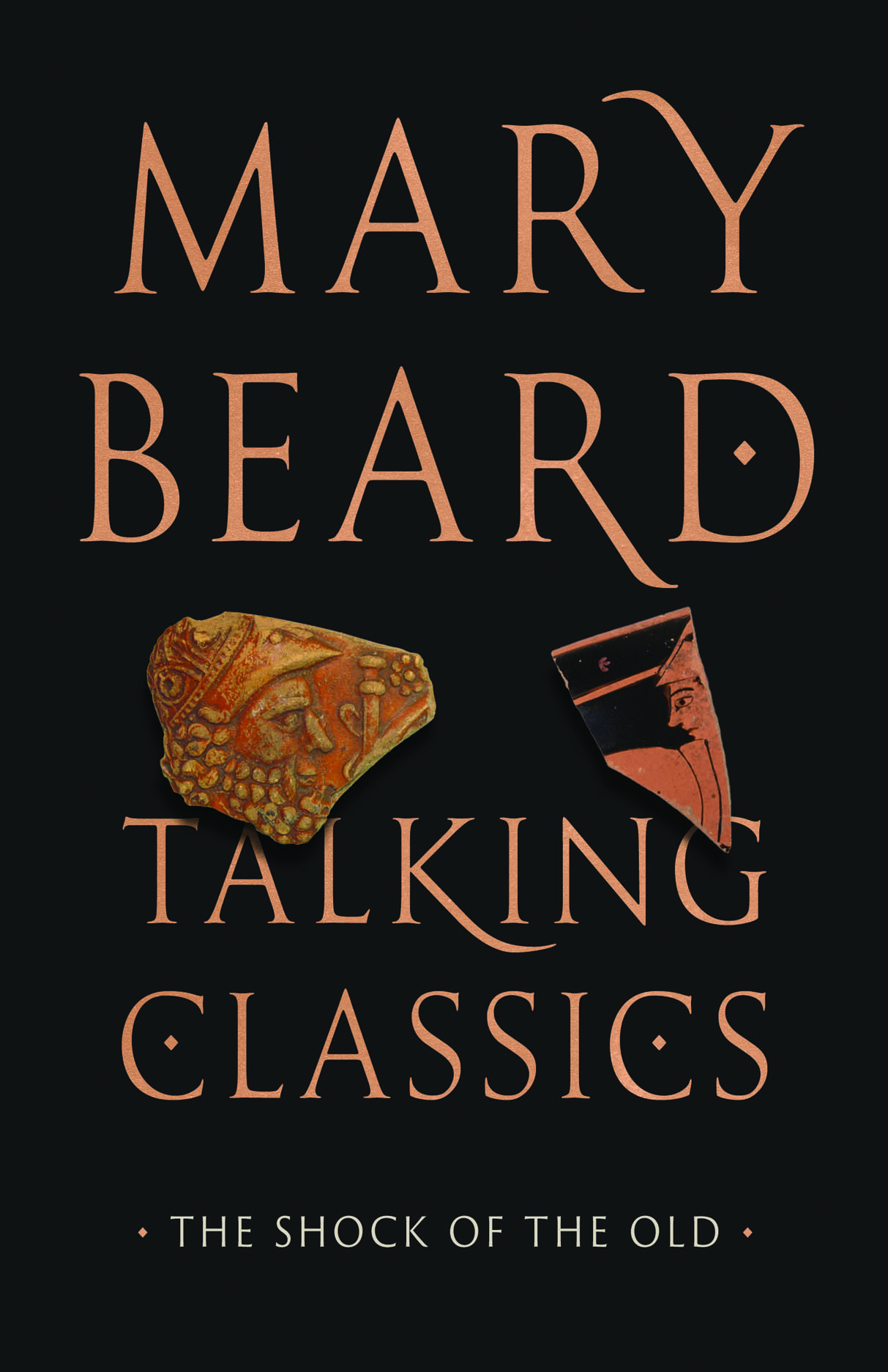


Talking Classics: The Shock of the Old, by Mary Beard (The University of Chicago Press, 208 pp., $22.50)
Just like comic book superheroes and villains, every classics scholar has an origin story. I am speaking of that moment of amazement when a slightly awkward young nerd possessing high-prescription eyewear and lacking all fashion sense realizes that he wants to study something normal people blissfully ignore—maybe Roman legionary brick stamps, the Greek optative mood, or the work of a little-known ancient poet—for the rest of his life. Maybe he visited a striking museum exhibit and saw a papyrus up close. Maybe he took an introductory Roman Empire course in college and got hooked.
For me, it all began with a book—a collection of Greek and Roman myths, translated from Hungarian into Russian, shelved invitingly in my family’s apartment. Enthralled with the stories of gods, heroes, and transformations, I endeavored to read more and more about these strange people who lived, thought, and wrote in other languages, in other lands, a very long time ago. A few years later, halfway across the world as a newly-arrived immigrant in America, I was able to immerse myself in the study of these languages, first in high school and then in college and graduate school. This year marks three decades since I started my study of Latin. All these years later, I’m even more captivated by the Greco-Roman classics than before.
For Mary Beard, one of the foremost classicists today, it all began with a piece of 4,000-year-old Egyptian bread. Visiting a museum as a young child, she couldn’t see the bread up close, but a kind docent took it out of the case and brought it down to her eye level, allowing the child to experience amazement of the sort we can’t quite express in English. But in Greek, there is a word for it: thauma. It is a wonder of an all-engulfing, transcendent sort—the sort of awe that won’t let go of those who have experienced it.
In her new book, Talking Classics: The Shock of the Old, Beard wistfully reflects: Why do the classics still matter? And to whom do they matter? Recently retired from her professorship at Cambridge, such reflection on the meaning of her work would be natural for anyone at her stage of life and career. But there is a complicating factor. Over her four decades in academia, the field of classics, once obligatory for all aspiring to any measure of greatness, has morphed from highly respected to downright controversial.
Gone are the days when U.S. Presidents held toga parties, as FDR did in 1934 to usher his fifty-second birthday in style. Boris Johnson’s Eton and Oxford classics credentials earned him more mockery than admiration. The classics now are repeatedly accused of being too elitist, too exclusionary, not only by those looking at the field from the outside but also by many who find themselves within the ever-shrinking circle of the profession.
Beard seems deeply conflicted about these changes. She loves her field, yet she remains unsure if it really is anything special. She has repeatedly found herself enthralled with the ordinariness of ancient daily lives, which inspired her work on Pompeii: “The dirty, ordinary, wondrous things of Pompeii, from bars to stepping stones, overturn the sanitized version of history symbolized by those surgical-style blue gloves with which we are now supposed to handle even the humblest remains from antiquity (as if the past was not ours to touch and feel, as if it always needed protection from the contamination of the present).” She notes likewise her delight over “moments when suddenly, even in one of the traditional classic texts, the recognizable ordinariness of life in the ancient world unexpectedly breaks through”—such as when a character in Plato’s Symposium gets a case of the hiccups.
People are people, whatever the civilization, the place, the period, the language. There is much that unites us in our shared humanity. So why are the classics special? Scholars of the ancient world fall into two categories. On the one side are those who emphasize the parallels and similarities between then and now. Those parallels lead us to understand ourselves better through the study of antiquity. On the other side are those who deny that any meaningful parallels can be drawn. While delighting in common human experiences, Beard is ultimately in the second camp. And so, over the course of the book, she presents common tropes about the field only to dispel one after the next.
You thought studying ancient politics, law, government, and history would help you understand your own constitution, law, and social mores? Not so, Beard contends: “The ancient and modern world orders are impossibly different.” Want to find meaningful advice for your own life from ancient philosophy? Well, look again: Marcus Aurelius won’t teach you ethics. Are you a struggling classics department trying to justify your existence by telling prospective students that they will be better prepared for medical school or law school from their studies? Downright silly. Oh, you thought antiquity was just beauty and elegance, worth beholding for its aesthetic delights? My friend, have you read Frontinus on the aqueducts or other authors who might put you to sleep? What about the conviction that the very study of ancient languages is beneficial? “I have no desire whatsoever to return to the often pointless language fetish of the past,” Beard retorts. Ouch.
Beard has made a career in scholarship by challenging facile interpretations of antiquity. I have greatly benefited from her work on these topics. She brings the same incisive thinking to the larger meaning of her profession. The problem is that she undercuts every broad justification for the study of the ancient world. There seems to be no reason to think about the ancient world except personal preference—which is not to be imposed on others.
Why do the classics still matter, then? It seems that for the vast majority of classicists today, the answer is that they don’t. No wonder classics departments in the UK and the US alike are going the way of the dinosaurs. The recent announcement that the Classics major at Syracuse University will be canceled is hardly extraordinary anymore. It’s just another week in higher education.
And yet, I see glimmers of hope. The recent two-volume magnum opus from James Hankins and Allen Guelzo, The Golden Thread, presents the most powerful narrative of the significance of Western Civilization I have seen in a long time. Within this story, the classics have a foundational significance—they are that without which nothing else makes sense. The classics matter, in other words, because they really are more important for Americans or Europeans than the study of any other ancient civilizations. We may not live in the Roman Empire or Christendom anymore, but we are indelibly shaped by them. To say this requires making precisely the sort of value judgment that is so uncomfortable for too many in the pluralistic framework of mainstream academia today.
So how might we encourage that thauma and delight in all things old? Perhaps by doing something controversial in its simplicity: leave politics out of it and teach the classics as they were taught fifty years ago. By this I mean: universities should teach Ancient Greek and Latin rigorously and offer thoughtful classes in reading the classics in translation alongside courses in ancient history, art, archaeology, and more. As Christian Classical schools’ explosive growth of late shows, there is a greater desire to study great books and beautiful literature than professional classicists seem to think. When it comes to classics right now, the flourishing of these disciplines in a few colleges proves the mantra: if you build it, they will come.
Besides, don’t let anyone tell you otherwise. To read Vergil in Latin really is great fun.
About The Author
