





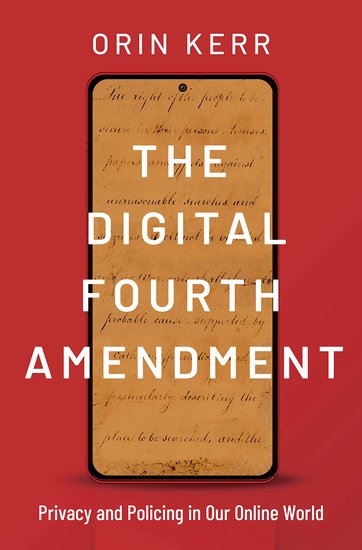


The Digital Fourth Amendment: Privacy and Policing in Our Online World, by Oren Kerr (Oxford University Press, 264 pp., $34.95)
The most basic business of governance, after enacting laws, is enforcing them: sending policemen to arrest suspected criminals, seating them before a judge and jury, and, upon conviction, depositing them in prison. Today, “everything-to-all-people” governments in Washington, D.C. and many state capitals propound regulations and dispense subsidies in the attempt to “make you smarter, taller, richer, and remove the crabgrass on your lawn,” in P.J. O’Rourke’s phrase, distracting from the essential function for which they were created. But these sprawling governments—which Americans know, often hate, and in many cases refuse to do anything about by way of substantial reform—still retain their essential character as instruments of collective force, which act upon the governed to ensure compliance with the law.
If Americans do not think often about the workings of their criminal justice system, they ought to. “It is on the excellence of the criminal laws, says the celebrated Montesquieu, that the liberty of the citizens principally depends,” stated James Wilson, the foremost legal theorist of the Founding, in his Lectures on Law. In an age that is, increasingly and irreversibly, turning digital, the Fourth Amendment—which secures citizens against the unreasonable prying of their government—veritably calls out for special attention and consideration.
Such treatment is given in The Digital Fourth Amendment: Privacy and Policing in Our Online World, by law professor and Fourth Amendment aficionado Oren Kerr. “Like cars did in the 1920s, computers today raise a major challenge for interpreting the Fourth Amendment,” Kerr writes. “Digital policing is very different from its physical predecessor…the digital world contains so much data, and its collection is so divorced from the physical principles governing existing rules, that applying those rules threatens to dramatically expand government power.” Therein the central dilemma of Kerr’s book can be found: How can centuries-old principles (whose antiquity is noted as a recommendation) faithfully be applied to revolutionarily novel technologies, whose capabilities have few analogues, if any, in previous generations of innovation? Put differently, Kerr sets for himself the task of probing how Americans might retain their traditionally enjoyed liberties in the wake of technologies that render many of the standards of pre-internet constitutional jurisprudence an insufficient bulwark against digital intrusions.
And old principles these are: they are inherited from the English common law. “That the house of everyone is to him as his Castle and Fortress as well for defense against injury and violence, as for his repose,” Sir Edward Coke wrote in his report on Semayne’s Case (1604). “The poorest man may, in his cottage, bid defiance to all the forces of the Crown,” William Pitt the Elder would declare a century and a half on. Kerr’s historical narrative begins with John Entick, a schoolmaster, author, and acerbic critic of royal ministers in the pages of a new weekly political paper, The Monitor. Angered by Entick’s “gross and scandalous reflections and invectives upon his majesty’s government, and upon both houses of parliament,” George Montagu Dunk, the second Earl of Halifax, signed a warrant authorizing a search of the whole of Entick’s home. Litigation ensued, and in Entick v. Carrington (1765), the warrant was ruled unlawful. “By the laws of England, every invasion of private property, be it ever so minute, is a trespass,” Lord Camden, chief justice of the Common Pleas, wrote in his decision.
The American colonists took a profound interest in these proceedings, looking on with horror at the abuses perpetrated in the mother country and celebrating the legal victories of the abused. The year 1776 would bring, along with the Declaration of Independence, a prohibition of general warrants in the Virginia Bill of Rights; in 1791, the 54 words of the Fourth Amendment became a part of the Constitution of the United States.
Those words alone can convey only so much information. At ratification, the Fourth Amendment—and, consequently, the substance of the constitutional protections it enshrines—was pregnant with principles passed down from English common law. Those principles have received further definition and content as courts have liquidated constitutional text in the intervening 230-odd years. Many guarantees of the Bill of Rights can be thought of as unfinished portraits: although the original artists outlined the figures and major features, judges must, as they confront the particulars of discrete cases and controversies, paint the exact contour of the jaw, the sparkle of the eyes, the shadows falling across the face. A good judge will take up his brush faithfully—an impressionist painting should not be finished in the style of Picasso. But as the title of the office suggests, judgment is inherent in the application of old principles to new circumstances.
As Kerr notes, technological developments have often instigated developments in jurisprudence. For example, in Carroll v. United States (1925), the emergence of the automobile drove the Supreme Court to adjust Fourth Amendment standards to allow officers of the law to search cars without first obtaining a warrant. However, the new questions digital technologies raise are far more comprehensive. “The way the technology works happens to expand government power under existing rules,” Kerr argues. “The physicality of the old rules treats a search of a small space as a small search—an assumption that no longer holds.”
Physically small portals to the digital world—such as cellphones or laptops—can facilitate colossal breaches of privacy. The old rules “would suggest that [with a warrant] forensic experts can look through every nook and cranny on every digital device and then use all the evidence they find,” Kerr notes. “When the government executes a digital warrant, responsive data is likely to be just a tiny fraction of the data seized,” he later writes, adding: “That tiny opening [of a limited search warrant], based on the need to find the 0.0001 percent, ends up exposing the person’s entire digital world to potential prosecution.” Behold the resurrection, in effect, of the general warrants condemned by Lord Camden in Entick v. Carrington and forbidden by the Fourth Amendment—unless, that is, a new rule is developed.
Other uncertainties created by digital technologies include, inter alia: what protections attach to a user’s information stored in the databases of technology companies, whether copying data from a device constitutes a seizure, and whether ordinary data and metadata should receive different treatment. Courts—both state and federal—have begun to resolve some of these uncertainties, but often only partially and, not infrequently, contradictorily.
“The goal should be to craft a Fourth Amendment for digital evidence that recreates in that setting the same kinds of limits that exist for physical evidence in the physical world,” Kerr writes. To that end, he proposes that courts adopt the method of “equilibrium-adjustment,” by which judges reconfigure past rules for a new digital era in order to conserve “the function of the old rule.” Kerr says his theory springs from the temperament of the likes of Edmund Burke and Michael Oakeshott: the preservation of an order requires reform as new problems emerge. Moreover, he adds, the judiciary has employed equilibrium-adjustments in the face of such previous innovations as the automobile, the telephone, and sense-enhancing devices.
At root, the theory of equilibrium-adjustment is, in this writer’s view, unassailable—particularly with respect to Fourth Amendment jurisprudence. I cannot say, however, that I agree with all of Kerr’s applications of the theory, though I agree with many (and where I dissent from the eminent professor, I do so with trepidation). This is to be expected. The Fourth Amendment codifies principles born of common law, principles whose faithful application may shift as times and technologies change. As Justice Ketanji Brown Jackson wrote in a 2023 concurrence, “Other cases presenting different allegations and different records may lead to different conclusions.” Difficult cases with intricate fact patterns and involving novel circumstances rarely command full unanimity.
The proper question is one of specificity—of how narrowly or broadly to interpret the meaning of the text of statutes. Like Odysseus, it would be disastrous for us to stray too far in either direction. On the left side of the ship of state is Scylla: the temptation to discard the text with the sole aim of discovering novel principles of law, morality, and right. On the right side is Charybdis, a limiting of all constitutional protections to their narrowest applications at the time of ratification (e.g., “The Second Amendment protects muskets, not AR-15s!”). The Fourth Amendment in anno Domini 2025 requires a middle course to be charted. The original principles embedded in its text must be applied to the digital world, but without changing the character of those principles in the attempt to ameliorate newfound privacy-related dangers. The details are subject to deliberation and litigation.
Debates over how the internet ought to be regulated are invigorating, not least because they require the interlocutors once more to consider the fundamentals of the American political order. The old arguments for—among others—free speech, free exchange, and mediating institutions obtain, mutatis mutandis, in the digital world. But apparent and real differences abound between online and offline life, and these differences require the old arguments to be carefully reexamined, retailored, and reinvigorated for our time. The Digital Fourth Amendment is a learned and masterful work that does just that.
About The Author
