





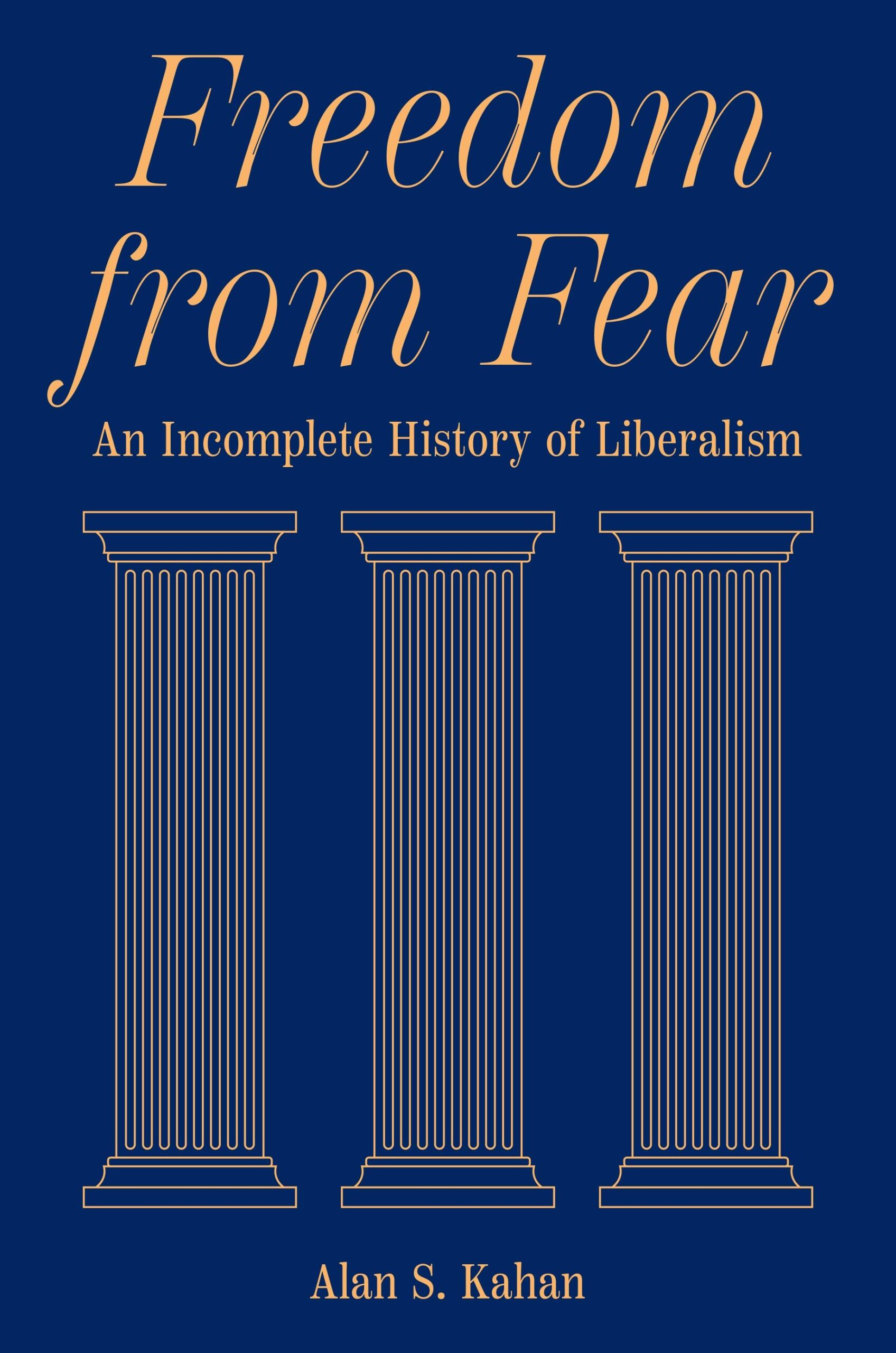


Freedom from Fear: An Incomplete History of Liberalism, by Alan S. Kahan (Princeton University Press, 528 pp., $29.95)
Neither the coterie of right-wing intellectuals who dub themselves postliberals nor many of the defenders of the liberal tradition in its 21st century hour of need can agree on what, exactly, liberalism is. Many so-called postliberals understand liberalism as bereft of moral claims, a definition accepted by many who embrace the term today. Both sides operate on the consensus that liberalism is the brainchild of John Locke. Alan S. Kahan, an intellectual historian at the Université de Versailles, seeks to dispel both claims in his Freedom from Fear: An Incomplete History of Liberalism, beginning with the audacious assertion that liberalism is “the search for a society in which no one needs to be afraid.”
Freedom from Fear takes aim at the oft-told tale of liberalism as an amoral ideology birthed by John Locke’s Second Treatise. Instead, Kahan’s liberalism is borne of Montesquieu, raised by Adam Smith, and defined by the three complementary pillars: freedom, markets, and morals. This order, he argues, is imperiled by those that seek to build liberal projects without all three legs of the stool. Contra the amoral definitions of liberalism given by Rawls and his successors, Kahan vindicates a liberal tradition with a diverse but strong set of opinions about the kinds of lives that people should lead. In Kahan’s eyes, liberalism has evolved since it arose to combat the fear of religious war, but “each new form of liberalism is the result of a new fear that has called for a new response.” This thesis drives Freedom from Fear, offering a timely rethinking of the nature of liberalism in this moment of its crisis. Throughout, Kahan lends legitimacy to various forms of the ephemeral ideology on the grounds that liberalism “grows by accretion” like an oyster, with no new layer ever entirely covering its predecessor.
Kahan traces the evolution of liberalism through four fears. What he calls proto-liberalism arose in dread of the religious fanaticism that soaked Europe with blood for two centuries. Following the French Revolution, liberalism as a coherent movement arose in response to the twin fears of Jacobin terror and ancien régime authoritarianism. As liberalism rose to power, liberals began to fear poverty, both as a limit on man’s freedom and a tinderbox for the flames of demagoguery. In response, modern liberalism called for a state to alleviate poverty. Classical liberalism arose in fear of this expansive state, and 20th-century liberalism arose as an alliance of the two—both fearing the twin totalitarianisms of communism and fascism. In turn, liberalism paired each fear with hope for change. Kahan sees this as the essential factor setting liberalism apart from conservatism and its natural pessimism toward mankind’s sin. Liberalism, even when defined by moderation, “has always been utopian.” Although Kahan brands himself a liberal with pride, he argues that this definition succeeds because it is the most comprehensive account of the liberal tradition, rather than a political theorist’s preferred vision of what history ought to be.
Beyond toppling Locke from his paternal role in liberal historiography, Kahan questions his very liberal credentials. Nineteenth-century British liberals avoided citing Locke, except as a “superannuated and bygone” fossil of a pre-liberal era. There was no American edition of Locke’s Two Treatises until 1917. The exclusion of Locke also allows Kahan to deftly avoid including a century of Lockean defenses of slavery in the liberal tradition. In Locke’s place, Kahan argues that the foundations of liberalism were set by Baron Montesquieu and Adam Smith. As a British historian situated in the French academy, Kahan is at his best in the book’s sections on Montesquieu and Smith.
For Kahan, Montesquieu’s framework for interpreting government on a scale of moderate to immoderate anticipated later liberal responses to the French Revolution, where freedom itself was seen as an insufficient basis for government—and one that could ultimately lead to tyranny. Instead, liberals have defined themselves since the age of revolutions by securing freedom through moderation in conduct. Montesquieu recognized pluralism, observing that “opinion was meant to be divided because society was meant to be divided,” and used this to set the foundation for a system of checks and balances lest “the common liberty” be the people’s “enslavement.” Montesquieu recognized republics as governments of virtue and monarchies as governments of honor. Each fell into despotism without their associated moral foundation. Only a “continual preference of the public interest over one’s own” could make democratic republics function.
How would this virtue be protected? Montesquieu laid the foundation for liberalism’s market pillar by dissenting from the classical consensus and arguing that commerce encourages virtue, such as frugality and work ethic, rather than discouraging it. In short, Montesquieu combined virtue and moderation as guardians of a state free from the fears of despotism or religious war. Montesquieu thus anchors Kahan’s argument that the contrast between freedom-centered liberalism and virtue-centered republicanism is largely an “imaginary battle” between complementary visions. The three liberal pillars of markets, morals, and freedom shine through Montesquieu’s writings. As the Baron himself wrote in The Spirit of the Laws, England’s free government was defined by “religion, commerce, and liberty.”
Adam Smith is Kahan’s next proto-liberal founding father. Kahan highlights Smith’s staunch moralism, which recognized that a wealthy commercial society could lift the “torpor” of workers’ minds. Smith sought to show that commercial society could be “morally great”—because markets would reward the good we see in others—and a source of happiness—because the wealthy’s purchases would enrich the poor who made them. Smith, like traditional liberalism, was not morally neutral. He separated himself from contemporaries such as Jeremy Bentham, father of utilitarianism, by recognizing that “not all pleasures were equal.” He even sought to expand the state’s moral role through universal education and military service. These liberal foundations were laid in works where Smith simultaneously mocks social contract theory and its hypothetical state of nature, so often upheld as the true root of the liberal tradition.
Yet, for all his admiration, Kahan sees Smith and Montesquieu only as proto-liberals. The principles they set forth were synthesized by the next generation as it confronted the horrors of revolutionaries and tyranny of reactionaries. To headline this next generation, Kahan offers James Madison, Benjamin Constant, and Immanuel Kant. His account of Kant is the weakest link but nonetheless an apt summary of the foundations of German liberalism—though this tradition is given comparative neglect relative to its French and English siblings. Hegel, for example, receives little attention, though Kahan argues briefly that modern liberals take after Hegel in their preference for the state over the classical liberal veneration of civil society. Nevertheless, much remains to be said on the radically different understandings of the moral pillar of liberalism that sprouted from the soil of Kantian metaphysics.
His case for Madison’s role is more compelling. Madison’s view that “liberty may be endangered by the abuses of liberty” proved the element of post-Revolutionary liberalism that most delineated it from the radical tradition. Though Kahan steps away from Hegel, his usage of Madison here may square best with Hegel’s profoundly liberal use of his dialectical method in The Phenomenology of Spirit. Hegel argues that the ideal of absolute liberty became its very opposite through the process of the French Revolution. Meanwhile, Madison’s classic defense of faction in Federalist 10 extended Montesquieu’s defense of pluralism while foreseeing another cornerstone of liberalism. His recognition that tyranny could come from legislatures, embodied in the Patriot struggle against Parliament, set Madison apart from the proto-liberals whose fears of absolutism centered on monarchy alone.
Madison and Kant are outdone by their profoundly underrecognized French contemporary, Benjamin Constant. Kahan presents Constant, who coined the phrase “liberal” to describe his moderate revolutionary platform, as the beau ideal of a statesman and theorist in the liberal tradition. Constant, most famous for his definition of modern liberty vis a vis the ancients, stood on all three liberal pillars. In defining himself against Rousseau and his political disciple Robespierre, Constant placed individual rights over the utility of the common good. He offered defenses for markets against depredations from Robespierre, Napoleon, and the ancien régime alike. Unlike virtually all French liberals prior to Tocqueville, Constant also appreciated religion and its diversity, arguing that religious sects would compete to outdo one another in cultivating the Christian morality necessary for the vitality of a free republic.
Opposing the classical “long nineteenth century” stretching from the French Revolution until World War I, Kahan argues for a “short nineteenth century” (1815-1873) of united liberalism defined by a quest for constitutionally guaranteed rights. Kahan’s summaries of the wide variety of associated thinkers shorten as their numbers grow. Following Constant, the next generation brings Macaulay the optimist, Tocqueville the pessimist, and Mill the realist. Kahan’s account of Tocqueville is standard, despite inaccurately identifying the great Frenchman as a deist. He also highlights the once wildly famous, but now rarely read, Whig parliamentarian Thomas Macaulay. The focus on Macaulay exemplifies one of Freedom from Fear’s greatest strengths: a willingness to analyze ideology through the most cited thinkers of the day rather than the preferences of modern academics. Macaulay defended liberalism by recognizing that “since the modern world was a middle-class world, it would be a liberal world.” Meanwhile, Tocqueville’s greatest achievement was to recognize that the middle class could also be a threat to liberalism. Kahan’s account of John Stuart Mill is standard but excellent, emphasizing Mill’s willingness to see society’s antagonism against itself as essential for progress and his skepticism for the endless increase in wealth. Kahan defends Mill as a liberal of all three pillars for affirming virtue, if not religion. Yet, Mill prefigured the worst tendencies of modern liberalism by reserving lawmaking for bureaucratic experts even as he called for expanding the suffrage.
Though the tradition was ephemeral, Kahan connects 19th century liberals who “spoke the same language” even if they “came to different conclusions.” By John Stuart Mill’s death in 1873, this had changed. Kahan delineates a new “thin liberalism” unconcerned with morals and, often, history. Frederic Bastiat, Herbert Spencer, and Jeremy Bentham fall into this thin amoral tradition apart from mainstream moral liberalism. For example, though Bastiat held on to his personal faith in Catholicism, he did not regard religion as necessary to government in the manner of his contemporary Tocqueville. Decades later, Herbert Spencer pioneered English thin liberalism, using biological racism to set the bounds of civic participation. While liberals with a moral project feared rule by the Vatican or the mob, thin liberals focused their fear on the biologically poor. Nonetheless, Kahan avoids caricaturing Spencer, noting that he was a Lamarckian rather than a Darwinist and a vocal altruist who sought a society “for the complete manifestation of every one’s individuality”—a rare endorsement of positive freedom in the tradition of classical liberalism.
Kahan adopts the common periodization of 1873 until the Great War in 1914 as the “fin de siècle.” This age of decadence, coinciding with the American Gilded Age, saw the first widespread wave of decay and division in liberalism. “Modern liberals” began to fear poverty as much as despotism, and promised to wield the tools of the state to solve it. However, classical liberals saw these very tools as old authoritarian wolves in sheep’s clothing. This division between modern and classical liberals illustrated the extent of liberalism’s success—it was rapidly becoming a broad adjective modifier. Modern liberals eventually came to reject the market pillar en masse, while many classical liberals divorced themselves from morality. Modern liberal morality was often at odds with that of an Adam Smith or Alexis de Tocqueville. Even French secularism, or laïcité, was envisioned by its evangelist Jules Ferry as more of an alternative religion to Catholicism than a merely atheistic program. The Third Republic’s first handbooks taught divinity, revealed by reason, as a student’s “first allegiance.”
Kahan thoughtfully considers the relationship between liberalism and nationalism. Nationalism began as liberalism’s partner in defining state and social institutions for liberty (and in fighting the universalizing Medieval spirit of Catholicism). By the end of the nineteenth century, it was off its leash and growing into liberalism’s most potent foe. In the wake of nationalism, modern liberalism became a far more provincial affair than its classical counterpart. Kahan’s analysis jumps from American Progressives to French Solidarists. He selects Jane Addams from the American fold to highlight the reformer’s overlooked role as a pragmatist thinker and defender of the notion that diversity was concomitant with industrial society. Meanwhile, ironically named Léon Bourgeois coined “liberal socialism” in France. Britain’s L.T. Hobhouse delineated a modern liberalism dependent on the state freeing the poor, but his liberalism stood intact in his quest for “the moral effect of redistribution” rather than the intrinsic good of redistribution itself.
The aftermath of the First World War threw liberalism into crisis. Liberal parties collapsed across the West, falling on their own swords. Political thought turned from the traditional liberal domain of civil society to the state. Liberals even found themselves on the wrong side of debates over women’s suffrage in France. For decades the French left and modern liberals scuttled suffrage bills over fears that the Catholic Church would control the feminine masses and raise “the tombstone of the republic.” It fell to nationalists to secure the greatest democratic reform in French history—empowering the conservative mothers and widows of those perishing on the front lines as “a vote for the dead.” Classical liberalism was left in the dust, while interwar liberals such as Walter Lippmann’s 1925 The Phantom Public and Jose Ortega y Gasset’s 1929 Revolt of the Masses joined in the tradition of Tocqueville by skewering liberalism in the process of reviving it.
Kahan’s willingness to challenge the dogma of today’s academy stands out in his defense of the German movement known as Ordoliberalism. West Germany’s Ordoliberals rebuilt the nation in 1945, fearing the communism that ruled in the East and the Nazism that had wrought ruin upon their nation. They were almost invariably devout Protestants with as much concern for the moral universe as for the laws of supply and demand. The social market avoided socialism, merged modern liberalism with robust capitalism, and promoted moral goodness all in one. The leading ordoliberal theorists, Walter Eucken and Wilhelm Röpke, united modern liberalism, classical liberalism, and post-Rerum Novarum Christian social thought into a resilient model. Neither believed bureaucrats should fine-tune the economy, but their opposition to the concentration of economic power in the state extended to a willingness to restrict monopoly. Their passion for rebuilding Germany was driven by their experiences under the horrific rule of Nazism, which drove Walter Eucken to believe that “liberalism declined because it lost its metaphysical and religious content.” One can hardly imagine an economist today uttering these words.
South of the ordoliberal project, Catholic Austria offered Friedrich Hayek, who Kahan recognizes as far more than the libertarian crank of myth. Hayek had participated in the forgotten Colloque Lippmann of 1938. This global conference of economists and philosophers renovated a moral and moderate liberalism they coined “neoliberalism;” however, their term bears practically no resemblance to the boogeyman now carried through every corner of academia. Along with the more statist American journalist Walter Lippmann, Hayek defined this neoliberalism to the world. In The Road to Serfdom and The Constitution of Liberty, published as World War II shook the foundations of Western civilization, Hayek vociferously defended man’s capacity to grasp the good life. Yet, Hayek also emphasized the need for “Americanization” to produce the social cohesion liberal civil societies required. Hayek’s call for liberal self-improvement stood in contrast to the softer call Kahan sees as offered by Isaiah Berlin to modern liberalism. Berlin’s skepticism of cosmopolitanism and fearful pessimism was soon swept away by a view that discarded morality altogether. Though classical liberals like Hayek still feared communism, the end of the Second World War marked a turning point in the modern crisis of liberalism. Self-assured liberals turned away from the “fanaticism” of ideology and came to insist on an amoral conception of the state and society. In contrast, Kahan holds that liberals do best when pessimistic about their chances of success. Even good men like the French-Jewish philosopher Raymond Aron ended up undermining liberalism’s moral pillar by falsely insisting that it could not possess such a thing.
Welfare-state politics dominated most of the West from 1945 until the malaise of the 1970s. Even as welfare-state policies decayed, John Rawls’ A Theory of Justice burst onto the scene in 1971 to philosophically incarnate egalitarian liberalism. Rawls stripped the moral call of liberalism to the barebones of tolerance. In response, Robert Nozick, Rawls’ first academic interlocutor, produced a desiccated “one pillar liberalism” based on a purely negative morality. Though Nozick and his libertarian contemporaries opposed Rawls on policy, they accepted his premise of an amoral liberalism. A century after liberal principles had driven millions of Americans into a crusade against slavery, Nozick dedicated the shortest portion of Anarchy, State, and Utopia to the desire to “thrill or inspire people to struggle or sacrifice.” In economics, Milton Friedman echoed this sentiment, arguing that “freedom has nothing to say about what an individual does with his freedom.” Kahan nonetheless defends Rawls as a true liberal by emphasizing the overlooked “most liberal” dimension of Rawlsian liberalism, the importance of convincing erstwhile illiberals to participate in liberalism.
Although a classical liberal, Kahan holds up modern liberals Bernard Williams and Judith Shklar—whose famous 1989 essay “The Liberalism of Fear” influenced his work—as liberal stalwarts, unlike Rawls and Nozick. Williams and Shklar clung to a fearful liberalism with more than negative freedom. Shklar venerated Montesquieu as liberalism’s essential forefather—a stark contrast with Rawls’ adoration for Kant and Nozick’s respect for Locke. In the words of Bernard Williams, these thinkers held that liberals “could not avoid presenting another ‘sectarian doctrine’” about what life should be.
Kahan closes by identifying 21st-century liberalism as locked in a struggle with populism. His account of populism is perhaps as interesting, but far less convincing, than his history of liberalism, falling into the trap of caricaturing populism as the “rejection of pluralism, diversity, and difference.” Kahan’s imagined populist tradition would include Napoleon Bonaparte, Andrew Jackson, Adolf Hitler, Huey Long, Viktor Orban, and Evo Morales. He concedes that little ties this tradition together in practical policy. If one accepts Kahan’s historical claim, I would posit that the term “populist” is best understood as an identifier that can be attached to most any other ideological term. Many in the history of liberalism, from Giuseppe Mazzini to Hubert Humphrey, could accurately be dubbed populist in their rhetoric and promises. Kahan associates populism with nationalism, but has established that liberalism, too, can hold this affiliation. The common denominator of this tent appears to be rhetorical style rather than ideological substance. A healthier definition of populism might classify it as a particular rhetorical flavor in politics rather than the 21st-century alternative to liberal democracy.
Quibbling over the nature of populism aside, Kahan aptly diagnoses the problem facing liberalism today by admitting historian Christopher Lasch’s critique that the 20th-century revolution in elite mores, combined with the globalization of the economy, has left the masses culturally alienated from liberalism. Those on the economic left who see this problem as solvable through the expansion of the welfare state are misguided, for “cultural alienation cannot be overcome with cash.” Populists have made a “moral rejection” of liberalism in a moment when liberals themselves refuse to respond with any moral claims at all. The solution, Kahan recognizes, lies in “politically including populists” in the liberal project by reinvigorating liberalism’s moral and religious pillar. Liberals must abandon their ivory towers and operate on the moral front, ignoring Nozick’s dismissal of the need to inspire sacrifice.
Kahan closes with optimism, believing liberals should hold dear our hope for the future even as we fear the return of tyranny—even if “liberalism could die.” As Americans, the liberal tradition that defined Madison and Tocqueville is our political birthright. If we, custodians of this tradition, refuse to sacrifice for the moral foundations of freedom, liberalism will die. We will have no one to blame but ourselves.
About The Author
