





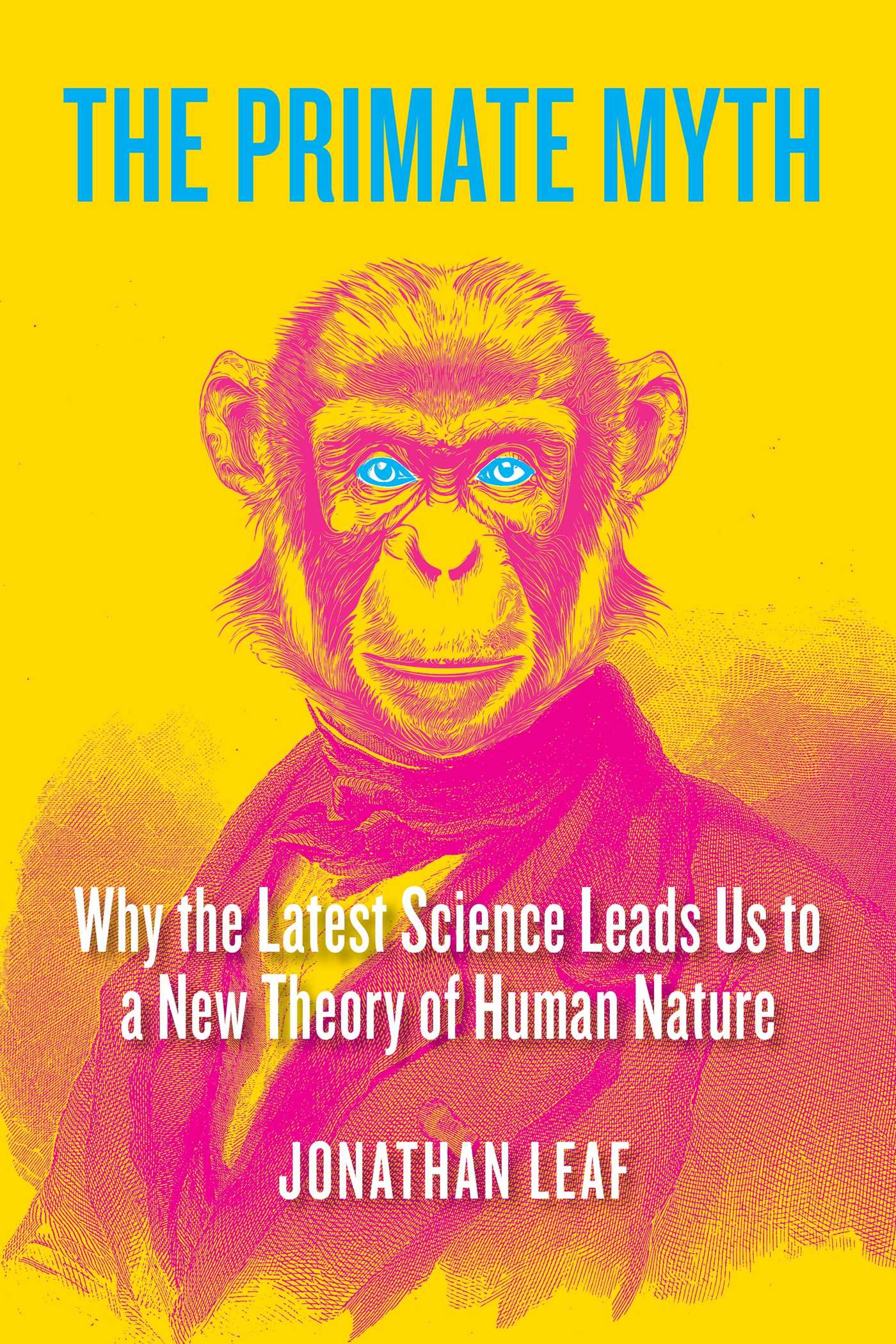


For generations, we’ve gazed into the eyes of chimpanzees and seen ourselves reflected back—a comforting mirror that suggested our nature was written in their behavior. But what if we’ve been looking at the wrong animal all along? In The Primate Myth, the author Jonathan Leaf dismantles one of modern science’s most cherished assumptions: that studying our closest genetic relatives reveals the essence of human nature. The stakes extend far beyond academic taxonomy. How we understand ourselves shapes everything from war and peace to family structure and democratic governance. If we’re less like territorial apes and more like cooperative wolves or communicative dolphins, the implications ripple through policy, ethics, and our understanding of what drives human conflict and cooperation. This conversation explores why a scientific error persists, what comparative biology actually reveals about humanity, and how correcting our self-image might reshape debates on sexuality, warfare, and social organization.
This conversation has been edited for brevity and clarity.
Jacob Bruggeman: Your book opens with the story of Theophilus Painter and the long-standing error about human chromosome counts. Why begin there? What did that episode reveal to you about scientific dogma—and about our willingness to accept mistaken ideas for generations?
Jonathan Leaf: There are many famous stories about scientists being told by the establishment that their evidence ought to be ignored because experts and established thinking “proved” that they were wrong. One of the most notable is the story of Ignaz Semelweiss. In 1848, Semelweiss published conclusive research showing that babies birthed by doctors who washed their hands had one-ninth the rate of infant death. Yet Semelweiss was scorned, had a mental breakdown, and died in an insane asylum. Decades later Pasteur’s work on germs led to a re-evaluation of Semelweiss’s findings and belated acceptance of his ideas. I actually wrote a draft of the book that began with that.
But, when I learned about Theophilus Painter, I thought it was better as it fits in with the story of how anthropology started off and how our impulses toward herd thinking were present in the field right at its beginning. Painter’s claim that humans have 48 chromosomes was based on pictures that did not clearly show 24 pairs of chromosomes. Rather, it was founded on the assumption that it must be the case that the images showed this since we are supposed to be close relatives of chimps and gorillas, and they have 48 chromosomes. His pictures were in textbooks seen by millions of students over three decades, but no one pointed out the mistake. It’s a classic example of the problem of how our beliefs are based on group assumptions and the desire not to question widely held views and then face the consequences of being at odds with accepted thinking.
Jacob: A central claim of The Primate Myth is that humans are not meaningfully “primates” in behavioral or evolutionary terms. What convinced you that the foundational premise of primatology—that chimpanzees reveal human nature—is fundamentally wrong?
Jonathan: There are so many reasons. One of particular importance was learning about the 2006 experiment performed by four British primatologists in which they created a contraption that allowed a chimp to either pull a rope to obtain a meal for himself or another rope which offered a meal for himself and another chimp. The researchers discovered that the chimps didn’t care at all about helping other chimps – even when it cost them nothing. That’s not like the behavior of humans. No one on earth can make something as simple as a pencil. Its manufacture requires many people with specialized knowledge and skills working together. Obviously, people can be very selfish. But our survival is entirely dependent on our ability to cooperate and that requires a high degree of awareness of others and – at a minimum – acute concern for how they perceive us.
Then, when I started researching the book, I learned how different the parts of our brains are that provide us with feelings of empathy – like the amygdala and the anterior cingulate gyrus – from the corresponding regions in chimps, which aren’t designed to produce much empathy or fellow-feeling. And, of course, there’s the data that Jane Goodall and her aides provided on how astonishingly murderous chimps are and of their proclivity for filial cannibalism: eating their young.
There’s also the matter of speech. Language is integral to our nature and our survival, but chimps are far worse than dogs at learning words. That raises many questions, as does their poor performance when compared with many other animals on basic tests of intelligence and the ability to follow simple directions.
On top of all this, there’s the awareness that the requirements evolution set forth for our survival are fundamentally different from those of chimps. Chimps only receive 1-3% of their caloric consumption from meat. Mostly, they eat fruit, tree leaves, bark and nuts. Pre-historic humans received most of their nutrition from hunting. Yet we are without a carnivore’s tools of predation: big canine teeth, speed, superior balance and agility, and a keen sense of smell. Even so, we were able to bring down woolly mammoths – animals more than one hundred times our size – with primitive weapons like pikes, weapons that are useless in the hands of solitary individuals. We accomplished this by evolving into a species with the gift of speech and the instinct to band together. These are fundamental changes.
The ancestors of cetaceans once lived on land and were herbivores. They’re related to hippos. But we don’t assume that by studying hippos we can learn about the behavior of dolphins as the change in their environment and diet has transformed them. Our anatomy remains much closer to chimps, but the changes in our habitat and diet are almost as great – and they may have changed us almost as much.
Jacob: Much of the book challenges the cultural authority of figures like Jane Goodall and Frans de Waal. Why do you think the view of humans as “third chimpanzees” became so culturally attractive, and what important questions does that perspective obscure?
Jonathan: I have a whole, admittedly short, chapter at the end of the book about this. It points to many causes. But I think two of them are most important. The first is the long-held but now disproven claim that we’re 98.6% the same genetically as chimps. The most recent research shows that this is false. In fact, we’re something like nine, or even ten, times further genetically from chimps than was previously supposed.
The other critical reason is a proof of the book’s main contention: humans are in some large measure a herd or pack animal. We are naturally obedient, and in general we tend, fairly uncritically, to accept beliefs that are widely held. This plays into our need for acceptance and identity and being part of the group. To question de Waal and Goodall has been an invitation to ridicule and censure. Painter’s erroneous claims about the number of our chromosomes exemplified this problem.
I would like to say though that I have enormous admiration for Goodall. Her research is hugely important. To me, she was a bit like Columbus. They were both exceptionally capable people whose audacious actions changed the world. The question is whether they entirely understood their work and their achievements.
Jacob: You argue that humans share far more with wolves, dolphins, elephants, and dogs and other cooperative hunters than with chimps. In fact, you relate how a personal moment of insight came while watching how dogs relate to humans. What does comparative study of these species reveal about how humans organize, communicate, and empathize? How does looking outside the primate family alter our understanding of traits like altruism, pair-bonding, and collective suicide?
Jonathan: During pre-history, we had to ward together to avoid attack from predators and to assist one another when we hunted and reared our young. That mix of herd and pack behavior is part of our essential endowment. We want to be part of the group. We readily follow leaders. These are traits that are observable in other relatively tame, cooperative hunting species like wolves, dogs and dolphins.
Chimps have no knowledge of paternity. Wolves, by contrast, pair-bond. They also co-breed. This is to say that the females of the pack work together in raising the brood. They’re fairly docile, too, and the males hunt together. What’s more, as we know from dogs, small changes in the wolf genome allowed their closely related descendants to become quick studies of human vocabulary and capable of living alongside us in our homes.
In dolphins and whales, you observe both individual and collective patterns of stranding: suicidal action. Worldwide many more humans die by suicide than homicide, and many people will join cults, even sacrificing their lives for them. Yet there’s not a single documented case of suicide by a primate. Nor do chimps and gorillas leave home to take up with new troops and bands that ask blind obedience of them. If humans were really all that much like apes, would primates never kill themselves? Would humans devote themselves to cults?
Suicide is the behavior of an animal that’s preoccupied with how others in its group see it – or that feels outcast. It’s also the action of an animal that struggles with questions of identity and fitting in. Cults appeal to people seeking an identity. We also try to gain this from following sports teams and through political affiliation. Primate models of humanity push us away from seeing all this and from grasping who we are.
Jacob: Which of these traits or behaviors do you think is the most revealing window into what makes us uniquely human, and why?
Jonathan: Let me step aside from that question for a moment to make another point. When I was born, there were six families of primates. Then primatologists removed tree shrews from the order, and created a new order for them called scandentia. They did this because primates are defined by two traits: possession of prehensile feet and flat nails. That posed a problem as tree shrews have claws, not flat nails.
Now, please notice something here: humans also don’t meet the definitional requirements of the order as we lack prehensile feet. These are feet that are basically another set of hands and are used for climbing trees. So, we are literally not primates, but, unlike the tree shrews, we’re still classed as primates. In addition, computer tests indicate that the anatomical differences between humans and chimps are greater than those between frogs and toads, and those creatures are in different orders.
But, getting back to your question: the changes in our skeletal structure are small compared to those that are found in our brains. Those shifts made us a domesticated animal. I would suggest that if you want to understand the behavior and psychology of a domesticated animal you would do best to study the behavior and psychology of domesticated animals: dolphins, elephants, wolves, even goats. People who have studied goats have discovered that the goats who rank lowest in the herd tend to be the best at recognizing threats to the herd. Might that be true also of humans: outsiders are better at seeing danger than influencers?
As we’re a cooperative hunter and we use language, you ought also to examine cooperative hunters and animals that use language to communicate. Dolphins and elephants use some amount of language with one another, and they have very large brains. That’s true both in absolute terms and relative to body size – much bigger brains than chimps and gorillas possess. And their behavior is a lot more like ours than chimp behavior is. They can arrange treks of vast distances with great accuracy. They co-breed. They can learn tricks and will work together easily and well. Dolphins have defended humans when we are in danger from sharks just as we have defended other animals when they are in danger. Dolphins also work together in hunting, and they have a meat-based diet. Are you noticing any patterns?
Jacob: The book discusses how misreadings of human nature have shaped political decisions from economic policy to theories of war. Where do you think misunderstandings of primate behavior have done the most real-world damage? And if the public begins to accept your argument that humans are fundamentally not primates in any meaningful behavioral sense, how might that change debates about ethics, AI, war, and social policy?
Jonathan: We should especially focus on two subjects: war and sexuality.
Primatologists have promoted the idea that our wars reflect primate impulses towards aggression. So, here’s a conundrum: No bona fides democracy in which women have the vote has ever gone to war with any other, and most don’t even bother keeping troops on their shared borders. (Think of how France and Germany stand in relation to each other today as against how they once were.) Also, the animals we use in wars – like camels, pigeons, horses and elephants – are domesticated. In addition, as de Waal himself acknowledged, the most war-like of animals is the most supremely obedient of creatures, the ant.
All this suggests that wars are not primarily a consequence of our aggressiveness but our obedience. Autocrats harness that by persuading impressionable young men who lack a strong sense of identity to put on a uniform and grab a bayonet. This means that we need to think of war principally in terms of the risks presented to democracies by dictators and authoritarian societies. We need to stop engaging in self-flagellation and blaming ourselves for wars, and instead acknowledge the obvious fact that the future danger of armed conflict comes from the Xis, Putins and Khamaneis of the world. We also need to see that the U.N. isn’t staffed by a uniform cadre of dedicated wise men who seek to prevent armed conflict but a mix of honest civil servants from the democracies and servile henchmen working for the autocrats and, potentially, on behalf of war and fighting.
Regarding our sexuality, we need to recognize that we aren’t apes, and polyamory won’t work for us. Our patterns of monogamous sexuality seem to have been established about 300,000 years ago. We know that because our level of sexual dimorphism – differences in male and female body size – emerged at that time, and it’s consistent with a relatively monogamous animal. We can also see that in the fact that no well-functioning society anywhere in the world has a normative view of polygamy, and children raised without two engaged, caring parents are far more likely go astray or to be molested. We’re not chimps or bonobos, and using them as models for human sexuality is foolhardy.
One final point: I’ve asked a number of famous primate experts to debate whether we really are alike to chimps. None will. Jared Diamond begged off, saying that he hasn’t written about the topic in 30 years. I received a message saying that Richard Dawkins’s peaking schedule is all booked up. Diana Fleischman, who promotes polyamory, won’t even respond. Nor will Christopher Ryan or Richard Wragham. I think they all know that as it’s now been proven that our genome has passed through a wholesale change from the genome of the apes that they won’t and can’t win a debate on the topic, and they’re fearful of the humiliation and shame of losing. They worry about what others will think of them. Typical humans, you might say.
About The Author
