







The American right is in a period of intellectual tumult. Part of that reckoning includes wondering what novels are and what they are for. It is impressive that we should are even talking about it. Our commercial and technological mores imply that we wouldn’t even bother to burn books—they would simply be rendered obsolete by entertainment, as well as AI.
Literature faces a cultural challenge as well as a technological one: it’s about white men. One attack on the novel and novelists revolves around racism, whether it’s Mark Twain using words no one dares print today or David Foster Wallace being unpardonably white. The cancellation—hard or soft—of once influential and successful writers is also an attack on men by women. When the writer Alex Perez said as much in an interview back in 2022, it blew up so much that he become a succés de scandale.
So there are at least two parts to the collapse of the novel as a central component of American culture. First, we ran out of literary men with the late Boomers, who were still the major writers in the early 21st century (think of Bret Easton Ellis or Jonathan Franzen). Second, the women who have replaced men in the publishing industry cannot produce or tolerate female writers of talent. I have no idea whether I’m allowed to say this, but the reality is that the books that are winning prizes, receiving splashy marketing launches, and even selling copies aren’t very good. Whatever the agents, editors, and institutions that cultivate and reward writers think literary culture should be, it isn’t working.
This isn’t exactly about politics. Liberals dominated culture in the middle of the 20th Century and there were much better writers then. So maybe we’re undergoing some deeper civilizational transformation. One could look to technology and its relation to the soul, as McLuhan did. Or one could consider the religious underpinning of American life, as Jody Bottum did in The Decline Of The Novel (2019), which follows from his An Anxious Age: The Post-Protestant Ethic and the Spirit of America (2014). Either way, the novel seems doomed to declining importance.
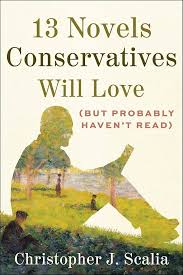
Amidst this tumult, Christopher Scalia speaks in the quiet voice of reasonableness in his new volume, 13 Novels Conservatives Will Love (But Probably Haven’t Read). Scalia abandons academic authority, if there is any left, and instead speaks as a man of taste and experience to his younger friends. He wants us to look to the English novel going back to the mid-18th century to find ourselves, to raise questions of morality and politics that major writers persuaded broad audiences to raise, and thus to inquire how to live our lives. To recapitulate that past is somehow to acknowledge our current tumult, and thus to demand the right to step back from making decisions before we are prepared.
Although Scalia does not claim to be writing about the best books, his choices quietly remind us of the liberal notion of “broadening the canon,” replacing great books with interesting ones, whether because the former are too inegalitarian for our taste, and hence not useful, or because they are too removed from our urgent concerns. He has six women among his authors (one of them black) and seven men (one of them Indian). Some are impressive novelists like Evelyn Waugh, some are not quite in that category, like Zora Neale Hurston. Some are major figures of English history, like Samuel Johnson. Others are among the “last novelists” of 21st century America, like Christopher Beha. Wonderful American writers like Hawthorne and Willa Cather make the list. But the majority of Scalia’s choices are British, reminding us that English is not just the language of globalization.
Since Scalia gives us a reading list and takes us through the history of the novel in his essay, all that it is proper to do in a review is to examine along with him the powers of the novel and its predicament by looking at a few examples. First, consider Dr. Johnson’s Rasselas (1759). Rasselas means a restless man and the book is a picaresque of an Abyssinian prince, his sister, her servant, and their teacher, who adventure through Africa before resuming their station in life. The entire plot of the novel is oriented on the human question: How should I live my life? The novel therefore becomes an allegory. Abyssinia is England; the characters represent the class system; at the end, everything is settled as it was at the beginning.
How can a novel function as an allegory? One obvious way is by insisting on the importance of education, which can be done in speeches. Rasselas is as much an allegory of education as it is of modern England—the commercial regime of free speech. In Johnson’s day it was easier to see and to say that politics is essentially education. The novel can play its part as a political enterprise because modern life is so boring and peaceful. That is what makes moderns restless. Novels can play a role in moderating that restlessness by providing the adventures and insights that that we can’t get in by ourselves. Critics in the 18th and 19th centuries worried that novels were revolutionary because they inflamed unreasonable desires. But they can also be conservative by giving those desires enough satisfaction that people don’t try to pursue them in reality.
Let’s rush to the self-destruction of the English novel a century and a half later, in the genius Evelyn Waugh. Scoop (1938) is also a picaresque, but about journalists not novelists. Modernity has advanced, democratized, it’s turning around to sensationalism and trash. All morality lost, you get every form of ineptitude and corruption in this rather different African adventure. London is as corrupt as the fictional Ishmailia, both also sharing progressive delusions that Western institutions and culture can be instantly adopted anywhere in the world. Much learning, which is much sorrow, is possible in this situation—at least if it is leavened with comedy. Savages can be nobler than the modern Europeans; but self-knowledge still is possible among the latter, not the former.
Somehow God is back of all this: Waugh is famously a Catholic convert. His mastery of the form of the novel, his return to its origins in Henry Fielding’s picaresques, Joseph Addison (1742) and Tom Jones (1749), to say nothing of Cervantes or Rabelais, also signals the end of the world—the imminent collapse of the British Empire, maybe of civilization itself. Adventure is now inevitable, because ordinary life is impossible. As Scalia notes, the novel’s ending is dark. A godless world is violent and the only peace we know, the English countryside—like suburbia—seems a very uncertain place after experience replaces innocence.
There is much more to be said for the novel and for this selection of novels, as well as for Scalia’s essay, which includes many sensible remarks on our contemporary situation. Everyone can enjoy 13 Novels, but the clever especially have reasons for gratitude if they take the implicit advice of the writer, to consider their strong feelings about our times in light of the wiser teachings of the novelists. That teaching, not happy endings, makes us able to understand our times.
I started with tumult, but I wish to conclude on a reassuring note. Scalia deserves our gratitude not only because he lavishes his erudition in the friendliest manner, but because he takes his part in a major effort on the right to take responsibility for American culture through education, which depends on reading. All the homeschooling mothers as well as the charter school initiatives, including the school choice political campaigns whose success gives us such hope, are part of the same movement.
Scalia’s volume sets the pattern for a class on fiction, but also for the development of taste by following the great themes laid out in the novel. It reminds us that we have hope with each new generation if we take responsibility for education. I have taken the liberty of teaching you how to think about two novels; having gone so far in the direction of arrogance—which Scalia lacks entirely—let me go further. Especially the most impressive novels involve reflection not only on character and society, but on art, beauty, stories—how art complements life and what its dangerous deceptions and its potential wisdom are.
The major opportunity we now have is a certain freedom from the social conventions of culture, which have obviously collapsed. We no longer need to pretend to “get it” or to assume novels are merely what we usually make of them. We can allow ourselves to fall in love with an author or a story and try to discern the reasons for that desire. There might be wisdom hiding behind the beauty.
About The Author
