





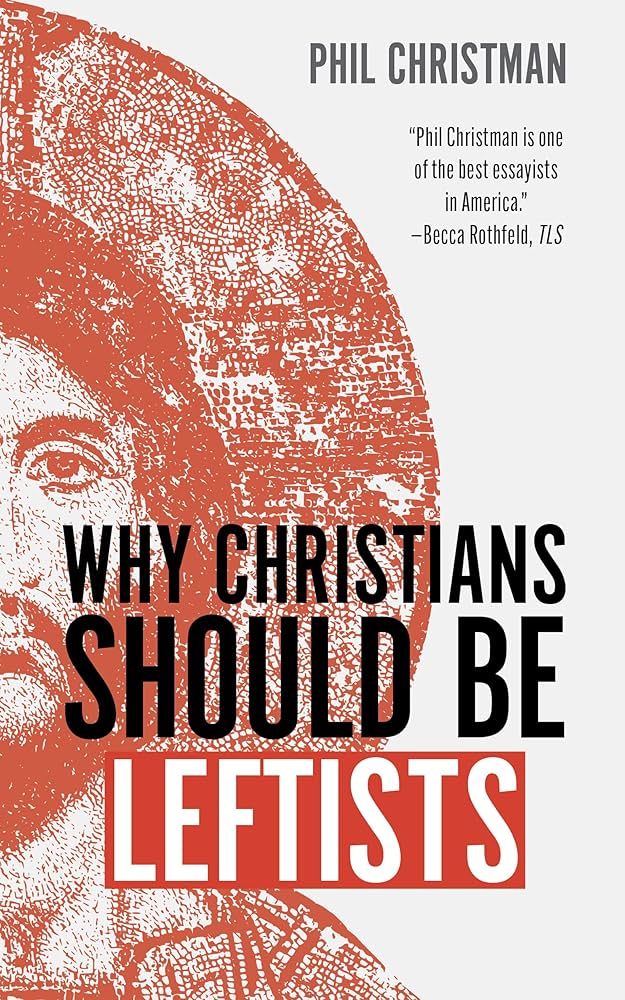


Every few years, another book arrives making the same pitch: Christians should be aligned with the left. Or at least, they should be more open to voting for Democrats. Scotty McLennan’s Jesus Was a Liberal, Brian McLaren’s Everything Must Change, Tony Campolo’s Red Letter Christians, and Robin Meyers’s Saving Jesus from the Church all tread the same ground, each offering slight variations on a single theme. The Christian Right, they argue, has hijacked the faith for political gain, misread Scripture, and done real harm to both church and state—while progressive Christians have failed to mount a compelling alternative. If you’ve read one, you’ve more or less read them all.
With a title like Why Christians Should Be Leftists, seasoned readers might reasonably wonder whether Phil Christman has anything new to add. The answer is: not really.
At first glance, Why Christians Should Be Leftists reads like a familiar artifact of progressive Christian publishing—a mixture of memoir and manifesto. But where other writers hedge their politics in pious language, Christman dispenses with euphemism. At a moment when hyper-online Christians are debating the strange death of “third wayism” (the Keller-inspired posture that sought a gospel-centered alternative beyond left and right), Christman makes no such gesture toward neutrality. His argument is not to transcend binary politics but to baptize one side. A self-described Christian socialist, he recounts his own conversion from fundamentalist conservatism to the religious left, grounding his political awakening in the Sermon on the Mount and what he calls a vision of “universal solidarity.”
So who is this book for? Christman would no doubt welcome any right-leaning Christian willing to approach his argument with an open mind, but he’s clear about his intended audience. Why Christians Should Be Leftists is aimed at conservatives who feel politically homeless after the Republican Party’s MAGA turn; “Never Trumpers” who have sworn to resist him at every turn; ex-evangelicals disillusioned by their faith’s entanglement with conservative politics; and mainline Christians who reliably vote Democrat but still wish their party’s leadership sounded a bit more moderate. Christman’s appeal to these groups is twofold. For those who haven’t thought much about religion, he invites them to consider following Jesus; and for those dissatisfied with America’s political system, he suggests embracing socialism.
In reaching out to these audiences, Christman is candid about his intentions. He freely acknowledges that the American left has a religion problem, and that socialism has often regarded Christianity with suspicion at best and disdain at worst. Still, he insists, if democratic socialists like Bernie Sanders, Alexandria Ocasio-Cortez, and Ilhan Omar hope to achieve lasting political power, they will need the support of Christians.
At the same time, Christman is unsparing in his criticism of churches that, as he puts it, can hear the Beatitudes read from the pulpit on Sunday and still support cutting Medicare, granting tax relief to billionaires, deporting illegal immigrants, opposing the expansion of the social safety net, and defending a political order built on competition rather than compassion. For Christman, such contradictions reveal a moral dissonance at the heart of much American Christianity that should trouble believers far more than it does.
What follows is an impassioned plea full of righteous anger at capitalism, coupled with a yearning for a Christian socialism that might redeem both church and society. Throughout the book, Christman writes with the fervor of a prophet denouncing Mammon, portraying capitalism not merely as an economic system but as a spiritual sickness that warps human relationships, distorts moral judgment, and enthrones greed as a false god. His prose brims with moral urgency and at times with hyperbole, such as when condemning the profit motive. There is also a touch of conspiratorial suspicion when the book discusses “fat cats” who supposedly pull the strings of modern life. For Christman, capitalism’s logic is inherently dehumanizing, its history a chronicle of theft and exploitation, and its outcome a society in which winners justify their success as providence and the poor are treated as refuse.
Yet for all his passion, his alternative remains hazy.
The Christian socialist order Christman envisions is more sermon than strategy—an imagined community animated by the Beatitudes, where power is shared, wealth is held lightly, and love replaces profit as the governing principle. Yet his rhetoric about greed too often collapses complex moral and economic questions into slogans, offering pious-sounding condemnations with little in the way of concrete policy, coherent politics, or credible alternatives. Given the book’s brevity, one would not expect a full theological treatise, but its unwillingness to engage seriously with Christian defenders of liberalism and free markets is a significant (and revealing) omission. What Christman never considers is that Christian concern for the poor and Christian defense of economic liberty might not be not opposites but for many serious Christians, complements.
Case in point, as Rev. Robert Sirico, president emeritus and co-founder of the Acton Institute, argues in The Economics of the Parables, Jesus’ teachings presuppose the moral legitimacy of exchange, ownership, and stewardship as integral to the created order. Properly understood, free markets are not engines of greed but arenas for virtue where prudence, creativity, and generosity can flourish. To dismiss markets as “Mammon” is to misunderstand how voluntary exchange, guided by moral law and shaped by virtue, has lifted billions out of poverty while preserving the moral agency Scripture requires of every giver. As the Apostle Paul reminds us, “Each one must give as he has decided in his heart, not reluctantly or under compulsion, for God loves a cheerful giver” (2 Cor. 9:7). By neglecting this tradition of moral economics, Christman reduces Christian ethics to a politics of resentment rather than stewardship, a vision animated more by envy than by creativity.
While Christman might want to pin socialism’s failures on authoritarian impulses, the deeper problem is that socialist economies are structurally unsound. By replacing markets with centralized commands, they eliminate the price signals, incentives, and local knowledge that make productive life possible. The results have been tragically consistent: Soviet collectivization devastated agriculture, Mao’s Great Leap Forward collapsed both food production and industry, Cuba has endured chronic shortages, the Khmer Rouge starved their own population by abolishing markets, and North Korea has lurched between famine and forced dependency. These are not incidental errors but the predictable consequences of suppressing voluntary exchange and concentrating economic power in the state. Any political economy that must enforce compliance to function is not compassionate. It diminishes the very human dignity Christians are called to defend.
What’s most frustrating about Why Christians Should Be Leftists is that, even with its urgent tone, it never develops a full coherent political vision. Christman rarely ventures beyond economics, giving only cursory attention to the moral and cultural issues that now define the deepest divides in American life. For many disillusioned conservatives or “politically homeless” Christians, it is not tax policy or welfare spending that make common cause with progressives difficult; it is questions of life, sexuality, and identity. Christman refuses to grapple with the fact that, for many believers, progressive views on gender and abortion are not policy disagreements but matters of moral and theological conviction. These are fault lines that no amount of shared economic concern can bridge.
Equally striking is Christman’s neglect of the growing faction within the New Right that shares many of his own anxieties about market concentration, worker precarity, and the moral costs of consumer capitalism. In recent years, Sohrab Ahmari has become one of the most forceful critics of laissez-faire economics, arguing that private power can be as coercive and dehumanizing as state power. Ross Douthat and Reihan Salam have likewise called for a conservatism that moves beyond Reaganite orthodoxy toward family-centered welfare, wage subsidies, and policies aimed at restoring social stability. Even Donald Trump’s embrace of tariffs, protectionism, and vows to safeguard Medicare and Social Security represented a populist departure from the GOP’s traditional free-market creed. Christman prefers to write as though the Right remains uniformly libertarian and indifferent to inequality, but the reality is far more complex. Today’s conservatives are increasingly skeptical of unregulated markets and open to precisely the kinds of economic interventions he claims only the Left is willing to imagine.
In the end, Why Christians Should Be Leftists is unlikely to reshape the long debate it joins. Christman writes with conviction, but it is difficult to imagine his voice carrying much influence in a political environment where the energy of the Democratic Party, and the American left writ large, grows steadily more secular. Some, myself included, will no doubt agree with his disappointment in the moral failings of many American churches, as well as his outrage at the ways American politics so often functions. But socialism, as history has repeatedly shown, is not the answer. Even Christ’s own words — “for you always have the poor with you (Matthew 26:11)” — caution Christians against expecting any system this side of heaven, however well-intentioned, to eliminate the tragic realities of a fallen world. Christman’s moral anger is not misplaced, but Christians would do better to seek economic arrangements that respect human agency and the limits of politics rather than to place their hopes in a utopian project that cannot bear the weight of them.
About The Author
