







The early 2010s television series The Newsroom has not aged well, its moral earnestness about the singular vocation of the Fourth Estate having long since run aground in the era of “fake news” and politicized fact-checking. As a snapshot of American ideals during the Obama years, however, it remains memorable. Consider the famous opening scene of the first episode, where the star, Will McAvoy, a popular TV news anchor, shares the stage at Columbia University with a prominent liberal pundit and a prominent conservative pundit. Asked by a rather vapid sorority girl, “Can you say, in one sentence or less, why America is the greatest country on earth?”, the liberal answers, with a typical tone of moral smugness, “Diversity and opportunity.” The conservative, without blinking, responds, “Freedom and freedom.”
To the extent that more reflective observers pause to interrogate this banal discourse of “freedom,” they generally do so within the poles established by the British political theorist Isaiah Berlin in his famous 1958 lecture, “Two Concepts of Liberty.” There, Berlin distinguishes between so-called “negative liberty” and “positive liberty.” Whereas the first designates “the area within which the subject . . . is or should be left to do or be what he is able to do or be, without interference by other persons,” the second names an ideal of “freedom for” or “freedom to”—a liberty of self-mastery and virtue in pursuit of a noble or exalted goal. Sometimes the former is described as a quintessentially “liberal” vision of liberty, the latter as more classically republican.
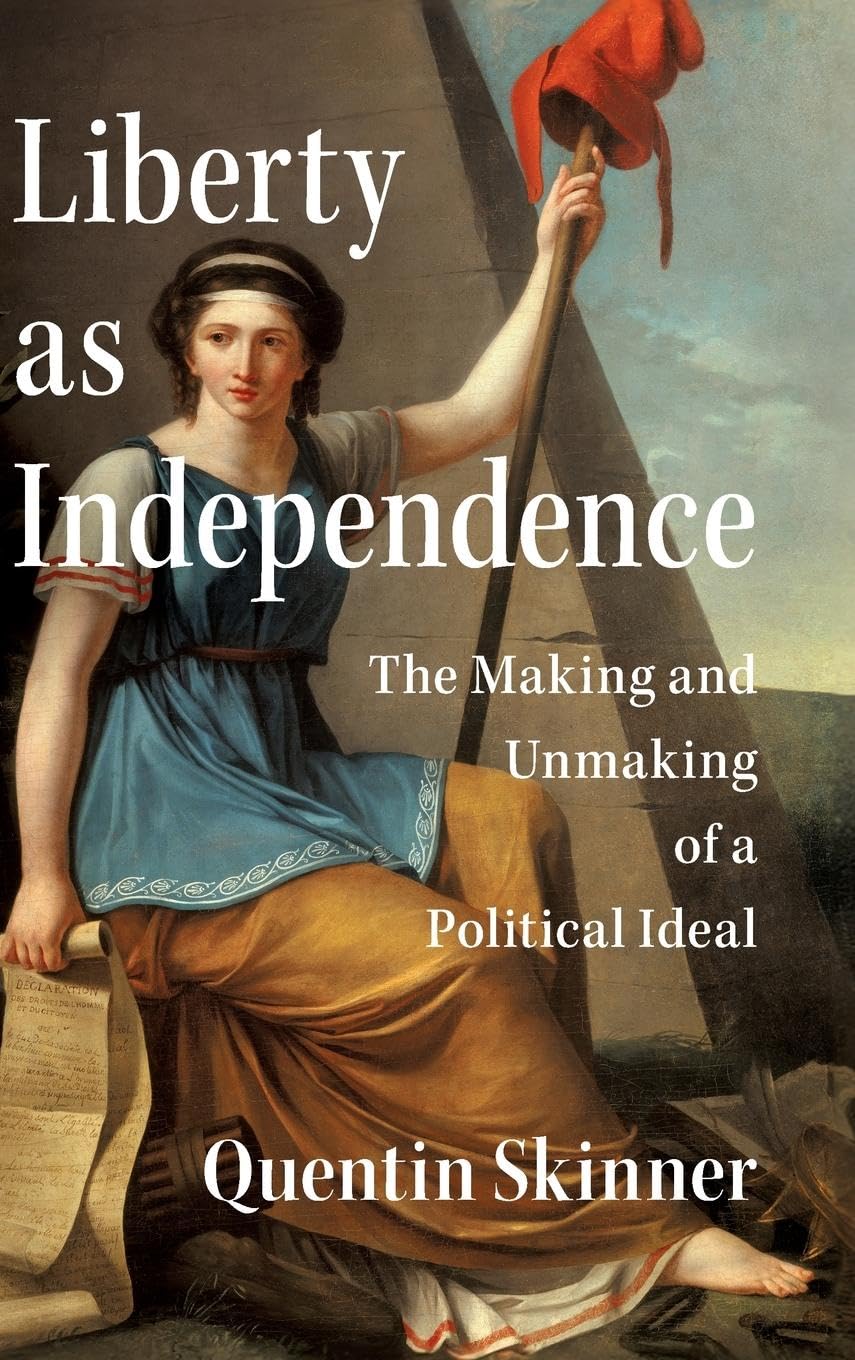
Missing from this schema, according to the acclaimed historian of political thought Quentin Skinner, is the vision of liberty that guided the Founding Fathers in their creation of the republic whose 250th birthday we are soon to celebrate. This topic is nothing new for Quentin Skinner, who has challenged the adequacy of Berlin’s “two concepts” in several previous essays and in the short book Liberty Before Liberalism. Against Berlin, Skinner insisted on the historical pedigree of a third, intermediate concept: “liberty as independence.” This year, with the publication of an exhaustively-researched 300-page study by that title, he secures his legacy as a giant in this field.
For Skinner, the ideal of liberty as independence is a kind of negative liberty—it is, after all, freedom from dependence. But this is not quite the same thing as freedom from interference. This distinction may seem like hair-splitting at first. Skinner could have been rather clearer at the outset in directly explaining the relevant concepts, rather than allowing them to unfold slowly over the course of his historical narrative.
But once the terms come into focus, it is impossible not to see the importance of the distinction, which can be captured in the phrase “a benevolent dictator.” This is no oxymoron; history does indeed know examples of absolute rulers who have exercised remarkable restraint and genuinely sought to benefit their subjects. But are such subjects free? On a now common view, the answer would be yes—if the dictator keeps his hands off their lives, property, and pursuit of happiness, they are free, because they are unconstrained.
For the American Founders and the early modern republican tradition, however, the answer was clearly “No.” To live under a dictator meant to live at the mercy of another’s arbitrary will, rather than at the direction of one’s own will. This was understood to be the essence of slavery: not to be the owner of one’s own actions.
Opposing submission didn’t mean rejecting law and authority. For the partisans of this older view, it was precisely the rule of law that protected against the exercise of arbitrary authority. What was essential, however, was that law reflect the consent of the governed in some meaningful sense. To be free, in short, we must at all times be guided by our own will, either as expressed personally in our own decisions and actions, or as expressed corporately in the decisions made by our appointed representatives.
It was for this reason that the cry “no taxation without representation” resonated so deeply and broadly among the American colonists. On Skinner’s account, they were the recipients of a long tradition, for several decades the reigning orthodoxy in England and the colonies, that equated liberty with independence and thus with representative government.
But the American patriots of 1776 were among the last who could appeal to this concept and expect their hearers to think instinctively of liberty as independence. Over the final decades of the eighteenth century, Skinner narrates, the tradition of interpreting freedom as self-government was swept away and replaced with the notion of liberty simply as non-interference.
Skinner argues convincingly that this shift was directly influenced by the American Revolution, which shocked many British Whigs into rethinking and reformulating their ideas. The colonists’ claims that they had been reduced to “slavery” seemed so preposterous that a chorus of British writers quickly began arguing for a new understanding of liberty. Although the idea of liberty as non-interference had been occasionally voiced since Hobbes, it quickly became the new orthodoxy, with thinkers like the theologian and philosopher William Paley soon articulating the concept with remarkable forthrightness.
If Skinner is right about this development, it furnishes a remarkable example of how, although “ideas have consequences,” consequences can also have ideas. In other words, concrete historical events can reshape the ideas and dominant concepts of a culture. But terminology does not always keep up. Rapid changes in structures of thought can sometimes give rise to dangerous incoherencies, as assumptions and connotations from older concepts linger over, attached to the same words even when these words have changed their meaning.
So it seems to have been with “liberty.” On the older understanding, liberty was an absolute good; it was always the goal of political society to maximize liberty, and anything else constituted a slouch toward slavery. But on the newer view of non-interference, liberty was only a relative good, to be balanced against the demands of order and the public good. It was obvious to late eighteenth-century Englishmen that individuals needed to be restrained by laws, for the sake of society; the question was simply how much. Liberty then was a question of more or less, limited by law, and the increase of liberty was only good inasmuch as circumstances warranted.
Although Skinner only gestures briefly toward nineteenth and twentieth century developments, it appears that these distinct notions of liberty cross-pollinated, so that by the time of John Stuart Mill, we have liberty as non-interference represented as an absolute good that must be maximized even against society. And with Herbert Spencer and William Sumner in the late nineteenth century, we find the “almost anarchical version of liberalism” that holds “that he governs best who governs least” (268). Strikingly, 19th century liberals like Mill, Spencer, and Sumner, did not believe that public consent was necessary to achieve a high degree of liberty—and speculated that appealing to public opinion might even be harmful. Today, we are heirs of a century and a half of this confusion.
Most of the book is intellectual history, but Skinner hints that a recovery of the older view of liberty as independence could help us out of some of the dead ends of today’s liberalism, which has been confused to rediscover that representative democracies can interfere with individual choices.
The old concept also holds promise for helping us think more clearly about the ideal of “national independence,” which forms the conceptual core of the nationalist resurgence that has baffled liberal commentators over the past decade. In light of Skinner’s analysis, it is easy to see how much of the angst that has fueled the nationalist Right rising from a sense of “slavery”—that is, being at the mercy of other powers.
When America runs a trillion-dollar trade deficit with China, including supply chains critical to our military power, Americans understandably do not feel free. It does nothing to dispel this feeling to argue that China is willing to keep supplying us with cheap consumer goods—for now. America’s position in world affairs highlights the gap between Skinner’s two concepts of liberty perfectly. Economists enthuse that we enjoy free trade, with no interference in individuals’ and firms’ economic decisions. Yet many Americans seethe under a sense of dependency, knowing that their fate depends on decisions in which they have no representative voice.
Although Skinner does not himself touch on this angle similar, a similar dynamic is at work in the populist revolt against “Big Tech”. Here too, we find many commentators confused at the frustration voiced by many voters. After all, technology companies don’t force anyone to use their products. And their business model means keeping customers happy—which means giving them maximal freedom to explore the digital realm. But most of us have a strong feeling that this benevolent dictatorship is not in fact so benevolent, that our actions in this arrangement are not truly our own actions, and that that whatever opaque laws and algorithms we live under, we certainly have no representative voice in framing them. We know that we aren’t exactly free, yet we no longer have a vocabulary to describe that condition. Skinner’s account of liberty as independence can help.
There are a few gaps and unanswered questions in Skinner’s exposition, to be sure. He gives precious little attention to the notion of “positive liberty” that Berlin drew attention to, and that makes up perhaps the dominant strand of thinking about freedom in Christian theology: the freedom to live virtuously and overcome sin within. Indeed, elsewhere, Skinner has highlighted the connection of virtue and “liberty as independence”: knowing that you are a “slave,” which is to say, subject to the arbitrary will of another, you will tend to behave slavishly, cringing in fear rather than asserting courage and manly virtue. This theme from some of his earlier work receives only brief passing attention here.
Finally, it would have been good to see Skinner attend a little more closely to the problems of representation in the theory of liberty he explores. If I am only free to the extent that I have consented to any laws that regulate my actions, then freedom implies direct democracy. Rousseau made a version of this argument in The Social Contract. Americans believed that representation qualified as consent. But even so, a consistent theory of liberty as independence would presumably require universal adult suffrage. Almost no one was prepared to concede that at the time of the founding. Indeed, it was partly the objection that a limited franchise meant much of the nominally free population was not actually at liberty that drove the pendulum away from the classical republican view. Skinner never reckons with it properly.
These are not so much complaints as invitations for other scholars to jump into the breach and fill out the picture. Skinner has rendered us a wonderful service by excavating this neglected concept of liberty. Armed with it, we may begin again to give voice to widely-felt but inarticulate political intuitions, and effectively navigate contemporary debates within a fragmenting liberal tradition.
About The Author
