





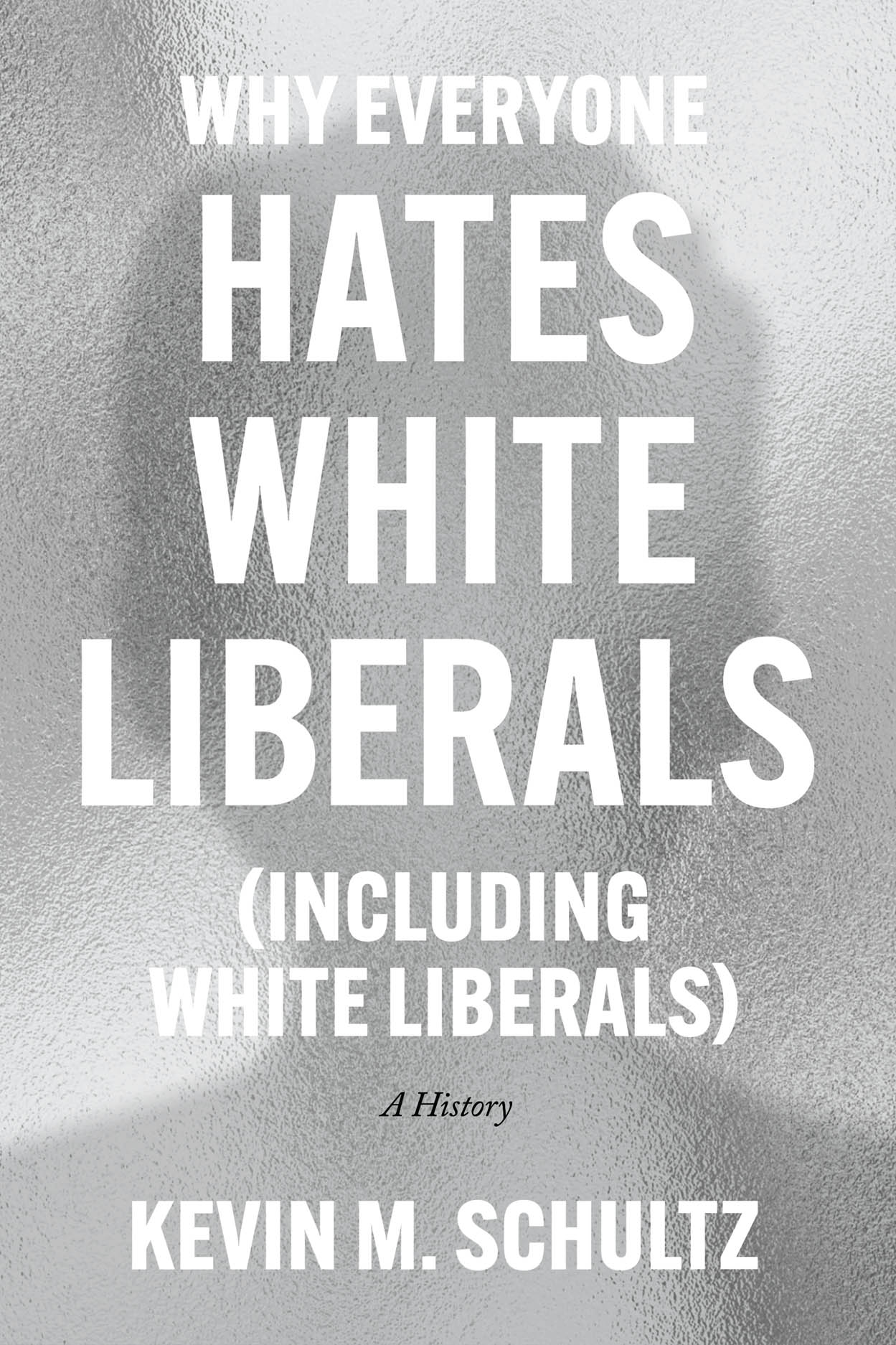


What does it mean to be a liberal in America—and why has that label inspired both devotion and disdain? Kevin Schultz, historian and author of Why Everyone Hates White Liberals (Including White Liberals), argues that liberalism as we know it was not born in Jefferson’s era or Lincoln’s, but in the crucible of the Great Depression, when Franklin Roosevelt deliberately adopted the term to stake out a middle ground between communism and fascism. In this wide-ranging conversation, Schultz traces how liberalism’s meaning has shifted across centuries, how figures from John Dewey to William F. Buckley battled over its legacy, and why today’s left and right continue to take aim at its contradictions. We discuss the accomplishments of the New Deal order, the fraught politics of race and inclusion, and whether liberalism’s adaptability is its greatest strength—or its fatal flaw.
This conversation has been edited for brevity and clarity.
Jacob Bruggeman: When did Americans start calling themselves liberals?
Kevin Schultz: This was one of the big surprises of my research. I had assumed there was this “long liberal tradition”—as us historians call it—in American history that goes back to John Locke and Thomas Jefferson and is enshrined in the Declaration of Independence and the Constitution. And one of the striking things I found when I was doing this research is that up until Franklin Delano Roosevelt—I like to say “no one” but that’s an exaggeration—very few Americans actually called themselves liberals or embraced anything that was called liberalism. Now today we might look back and say, “well these ideas are now enshrined in liberalism, so they were liberals,” and that very well may be true, but what was interesting to me was that they never called themselves “liberal” at all.
There were these moments that I get into in the early sections of the book, where there was the 1872 election and there was the Republican Party and then there was the liberal Republican Party, and the latter party got destroyed in the election and never was seen from again. Or there was the [National] Liberal League and there were a lot of anti-Catholic “liberal” people. There are these little flashes in the pan that come and go and they have their own interesting history, and it helps code the word in certain ways in the United States.
But as far as having it be a sustained political philosophy that exists under the label “liberalism” in the United States, that doesn’t exist in American history until 1932 when Roosevelt gave a speech to defend the New Deal. He knew that he’d be excoriated for being socialist or communist, but he also doesn’t want to come off as a defender of capitalism merely rebuilding the pillars that failed during the Great Depression. But he also doesn’t want to be seen as an authoritarian growing the size of government and taking away our freedoms. So he tries a few different words to describe his politics, and in the summer of 1932 he lands on the word “liberalism”, which he defines as a halfway spot between communism and fascism. One of his advisors, a guy named Rex Tugwell, asked FDR, “how did you come up with this? It’s not a word that’s in common usage in American history or in the American political world right now,” and Roosevelt just looked at him, shrugged his shoulders, and said, “does it matter?”
That’s as good as it gets. That’s the start of American liberalism. Thus I write the arresting line at the start of Chapter One, which your readers might hate: “Franklin Delano Roosevelt was the first white liberal.” Now of course there’s a tradition that goes back to British politics in the 19th century and I trace the origins of the word all the way back to the Latin liber which means “free.” But it wasn’t until 1932 that the word was used in any significant or substantial way in American life.
Jacob: I buy that FDR brings liberalism into modern America. But what background conditions and historical events enabled him to synthesize strains of thought into modern American liberalism?
Kevin: To answer this question, we need to examine the etymology of the words “liberal” and “liberalism.” So to nerd out very quickly here, I mentioned that the word has its origins in the Latin liber, which means free. And so to free an individual, you or me, we need to combat against the prevailing conditions, whatever they might be, that are restricting our individual freedoms. So, in Shakespeare’s time in the 15th and 16th centuries, the word liberal signifies a generosity of spirit or a generosity of wealth and attaining a liberal arts education, which is a broad education, where we learn philosophy, literature, history, political science, and the hard sciences. The word as conveyed a broad and generous understanding of the world.
In the 17th and 18th century, it also signified religious tolerance. There is this notion that to be religiously liberal is to, if not exactly welcome Catholics and Jews or the wrong sorts of Protestants in Europe, that they shouldn’t necessarily be castigated or murdered or anything along those lines for not adhering to the truth with a capital T as one understands it. To be liberal then means to be tolerant of different religious faiths. But it was during the great political revolutions of the 17th and 18th centuries, which we most often think of the American Revolution and of course the French Revolution, when liberalism became a term used throughout Europe. It comes to signify political freedoms and a right to say who governs us, including representative governments and things like this. Liberalism was a reminder of how individual freedoms can be achieved beyond whatever it is that’s oppressing us, whether that’s the yoke of the Catholic Church over Europe, for instance, or kings and queens.
And in this moment too, John Locke introduced property as a way to embrace liberal freedom. And that’s because in the era of kings and queens, one way that an individual could sort of showcase their freedom was through small-market capitalism, by being a small businessman and operating outside royal domains. This is where “economic” or what some people call “classical” liberalism is born, which introduces a friendly vision of capitalism as a way towards individual freedom.
This is a mammoth shift in Europe in the late 19th century, but not so much in the United States until Franklin Roosevelt comes about, and it becomes increasingly obvious that it’s no longer the Catholic Church or kings and queens that are oppressing people, but large businesses on the scale of the Industrial Revolution from the second half of the 19th century and into the first half of the 20th century. It was oligarchs, or “economic royalists,” to use FDR’s language connecting the royalism of kings and queens to the oligarchs, who were denying individual freedoms and preventing workers from having rights and the middle class from expanding. And so, liberalism shifts again, as it had in the 16th, 17th, 18th, and 19th centuries. In the 19th and 20th and now 21st centuries, liberalism signifies something different, and that is the use of the government to counterbalance the overwhelming power of big business, a reliance on laws and rational thinking in order to allow individuals to achieve certain freedoms that would be denied by those who are just out to squeeze the wealth out of the individual worker.
And this has been the underlying definition of liberalism since FDR tapped it in the summer of 1932, so that’s what it’s come to mean, and you get in our language in the notion of classical liberalism, a business-friendly version, and you hear this a lot on the right, “I’m a liberal but a classical liberal,” my former colleague Deirdre McCloskey was a sort of a big exponent of this kind of vision, and I would always say, “but that’s not what liberalism is anymore, here’s what liberalism is and it has been for the past hundred years,” and she would say no, and I say, “well then what about liberalism before your classical liberalism? Isn’t that classical liberalism this religiously tolerant version or this the notion of liberal arts,” and she and I would have at it, which is really a great conversation to have. So this is where the tenets of this modern day notion of what most Americans think about when they think of liberalism.
Jacob: Was FDR’s synthesis only possible in this historical moment? Could it have cohered in a different time and place?
Kevin: The answer is yes to both of those. In fact, in England in the middle of the 19th century you get the birth of the British Liberal Party which has friendly relations with small-scale capitalism, but it is also embracing those other components of liberalism: freedom of worship, public education—what we in the United States call free public education—so there wasn’t just a singular embrace of capitalism as it gets caricatured today, but instead it actually had a broader meaning in the British sense of what the British liberal party advocated in the 19th and early 20th century.
But in the United States, it didn’t arise until the depths of the Great Depression, and I think that’s where your question is really sort of targeting, is it this collapse of capitalism that takes place in the 1920s and especially in late 1929 with the stock market crash really toppling over and showcasing other weaknesses in the American economy—the housing market, the soft agricultural market, and the international structure of debt repayment that happened after World War I? This all collapses in 1929 and leads to the Great Depression, where you have 25% of Americans unemployed, in some cities 50% percent of Americans are unemployed, the Dust Bowl, these are all like these significant visual images that we have of the Great Depression. As to whether this is the only moment when liberalism can be born in the United States, I think that it probably could have been born at other times and there were significant gestures made in that direction, although hardly under the language of liberalism during the what we call the progressive era in American history from say the 1890s through the World War I period, say 1918 as a as a final point of the progressive era, just to throw some rough dates on that. Nut I do think it took the shape that it did in the United States because of the constraints of what was happening in our history.
So because of the Great Depression and then immediately following the Great Depression and, as a result of it, we have World War II, which allowed FDR’s liberalism to embrace a more powerful state than perhaps it would have had liberalism been born earlier. The progressive vision of what the state could do was much different than what the New Deal vision of the state could do. And I think that that was both a necessary response to conditions and also one that had consequences for the future. I don’t necessarily think it was a damning power grab by FDR, although there were a lot of executive orders that he imposed in the first few years of his presidency. But then, of course, he had a very friendly Congress to work with shortly thereafter as well. And so he didn’t have to rely on executive orders, although there were a significant number of executive orders. But it was sort of by mutual consent of Congress that the federal government grew, that it took a more interventionist role in the American economy.
And FDR was able to take advantage of the technological changes of the time, including, of course, his famed fireside chats, where he could go directly to the American population. In today’s modern-day Twitter or social media landscape, this might resonate. He could sell his vision to the American people. And one of the real accomplishments of the New Deal, despite or in addition to all of the economic consequences, which were significant, but it was to restore sort of hope in the American project once again. And that was one of the significant things that had been lost in the depths of the Great Depression, was hope in the American dream, to sort of put it in catchy phrases. And he helped restore that, not only by this simple notion that he was actually doing something, not only by the simple notion that he actually had a philosophy that was not a set of policies, but it was a sort of liberalism, as we call it, where the government should intervene in the American population’s lives when they demand it and when they need it. But it was a real sense of restoration of hope, that the American dream could prosper, that this notion that Americans could achieve, could achieve middle-class status as we like to come to think of it today. And this was one of the real accomplishments of mid-20th century American liberalism.
Jacob: The sheer scale of state capacity on display in the New Deal remains very impressive. When you look back at FDR’s liberalism, what were its central accomplishments?
Kevin: So all the historians from the very first historians of the New Deal to the most recent books about the New Deal, they all talk about how the New Deal was really a way to buttress the tenets of capitalism, ensure the success of the capitalist order, to regulate it, to make sure that it was more egalitarian in its distribution of goods, but not to overthrow it, not to overturn it, and not to challenge it, but just to regulate and modify it, to ensure that it didn’t create too many structures of inequality that would then lead to its demise, as for instance, you can argue had happened with the Soviet Union. But of course, that’s a whole different ball of wax that we don’t need to unpack. My point though, is that FDR realized that, this is another phrasing that I really like, regulated capitalism was probably the least worst way to structure a nation’s economy. And so in order to preserve capitalism, it needed to be regulated. And that’s what the New Deal was. He wasn’t, as I say in the book, he wasn’t mandating Moscow apartments that everybody shared the same square footage, but instead he was passing laws that built the suburbs, and that allowed people to get higher education so that they could go on and make as much money as they wanted. There was a pretty stiff tax structure that went up to as high as 91% for the highest earners in American life. He did want to make sure that the economic inequalities that existed in the earlier progressive era period were no longer able to exist. Or if they were able to exist, the wealthiest people were taxed at significantly high rates, so that the benefits of capitalism would be shared all the way down the pike.
I think that might be at a metaphysical or philosophical level. Like one of the things to remember about the New Deal, that it was designed to preserve a capitalist liberalism, a capitalist sense of freedom, but it was designed to ensure that those riches that were created by the system trickled down in a very significant way, not by hope or happenstance, but by government mandate, to ensure that it extended all the way throughout the American population. I think that in doing so, some lasting components of it was things like social security that we still have today, and some basic floor, some basic bottoms by which the poorest Americans might not fall behind. So I think that notion, both philosophically and in reality and in governance and law, are the lasting sort of components of the New Deal.
Jacob: In the book, you sometimes describe Dewey as an intellectual who elaborated on FDR’s example of liberalism. To what extent was John Dewey’s liberalism different from FDR’s?
Kevin: FDR’s liberalism was simply a preservation of capitalism from its own worst vices. John Dewey was more to the left of FDR, in our current parlance. He thought that capitalism was naturally always going to tilt towards an oligarchical structure, and it was going to always force laborers to sweat on behalf of somebody else, and to have to give up some of their value of labor, to use sort of Marxian language, in order to make other people wealthier. And he wasn’t a Marxist, that wouldn’t be fair to say at all, but he was in search of a structure of governance that would be more equal and fair, and also his other great pursuit, and simultaneously you can see these things happening side by side, was an ethical system that would encompass this kind of economic system that would be outside or beyond religion, by which people would be compelled to do good and care for their community. One simple way to sort of see this, is that one constant battle in society is between individual freedom, and communal awareness, and working on behalf of the commonweal. How much do we as individuals give up of our own individual freedom, in order to support the commonweal? And the argument is clear that if we tilt one way, too much, we will lead to the destruction of individual freedom. Where is the right balance? How much taxes do we have to pay to the common wheel in order to support our individual abilities to be free? And how much is too much?
I’d say that FDR and John Dewey were sort of side by side. Dewey wanted to have sort of more community and more communal spirit. And he thought that only by expanding the notion of community could individuals be free. And FDR was sort of more sympathetic with the notion that tilting the scales a little bit towards more individualism while acknowledging nonetheless the communal responsibilities that we have would be a happier and maybe more politically possible way forward.
Nonetheless, Dewey was aware that FDR was on the right track. Dewey still wrote op-eds critiquing FDR for being too kind to the bankers, he also grabbed onto the liberalism that FDR had resuscitated in the American political world. He tried to take the Lockean sense of property and freedom and update it with Jeremy Bentham through the utilitarians in Britain. And throughout the 1930s he asked: What is liberalism? Who is a liberal? How can we have social action and economic justice in our society? Liberalism is the answer and let’s redefine it in the following philosophical ways. So, I see FDR as really the political arm and John Dewey as providing the philosophical underpinnings of that. But they worked side by side, if in tension, to really develop this thing that you and I take for granted that’s called liberalism.
Jacob: The liberal order bears enormous fruit in the 50s and 60s. At the same time, by the late 60s, the liberal consensus started to crack up. So, just as liberals reached their zenith, what set the stage for the liberals’ demise?
Kevin: I do think it is very important to pause and at least linger for a little while over the real accomplishments of the liberal order. Not because I want to defend liberalism and not because I identify as a liberal, but let’s be fair. So the argument of the book is FDR redefines the political life in the United States. Both parties, the Democratic Party and the Republican Party, align with this sort of notion of liberalism—that the government needs to be used to buttress the power of big business and can be used in a very powerful and significant way to regulate the economy and to significantly govern Americans lives in ways that they hadn’t before. Dwight Eisenhower is on board with this plan. Both parties embrace what historians, Gary Gerstle especially, have called the New Deal order.
What were its accomplishments? Well, you get less income inequality than at any time in American history before or since. The crack-up of liberalism, as you called it in your question, is where you get the greatest expansion of the American middle class that we’ve ever seen. Where you get this expansion of the middle class, you get higher education. Why? Because the government subsidizes education through the GI Bill, which was FDR’s thank-you present to the soldiers who fought during World War II. The GI Bill also prompts the expansion of home ownership, especially the development of the suburbs, because of guaranteed the home loans. And pushing into other regions of American life, you get a regime of religious tolerance through Supreme Court cases, leading to the acceptability of Catholics and Jews as normative participants in American life. Today, in fact, our Supreme Court justices are six Catholics, three Jews, and zero Protestants. You also see the passage of the Civil Rights Act of 1964, the Voting Rights Act of 1965, the Housing Rights Act of 1968. Now, of course, these weren’t just put through by white liberals. Black activists and an upswelling of the population played a large role. But the people who voted on these bills in the halls of Congress called themselves liberals.
Jacob: Let me push on this. I’m thinking Jefferson Cowie’s The Great Exception, which makes a strong argument that this period of equality was premised on a homogenous white labor force and low immigration. The New Deal moment of racial cohesion reinforced labor’s political power. In time, one of the Left’s major critiques of the New Deal was that is reflected a white liberal order. What do you make of this?
Kevin: Absolutely brilliant question. It’s something citizens of the world need to think about. But to start, racial exclusion in society was not merely the midcentury liberals’ creation. For example, one accomplishment of mid-20th century liberals was the 1965 passage of the Hart-Celler Immigration Act, which opened up our immigration system. It allowed immigration from Asia, from Africa, and from Latin America in the way that the restrictive immigration policies of 1924, and especially 1929, prevented.
Still, it’s a fair question to ponder: Is the expansion of the welfare state, the expansion of government benefits to broad numbers of American people, the ability of a politician to get his or her constituents to listen to them, only be achievable during relatively homogenous periods, when there is low immigration? It’s a complicated question, and I think there is some research that shows, even in the 2020s, that where you have the greatest expansion of the welfare state in northern European countries with relatively restrictive immigration policies. So is it true that in order to expand welfare state, you need to have restrictive immigration policies? I don’t know the answer to that definitively, and I don’t know that we’ll ever know the answer.
But I do think your question is very suggestive that if you cannot create this sense of unity in the country, it makes it far more difficult to create a sense of collective sacrifice. Not every wealthy American loved to pay 91 percent, but a sense of contribution to a greater common cause, such as overcoming the Great Depression and defeating a foreign enemy in World War II, certainly seemed to help. It’s absolutely a great question worth pondering, not that I think very many people on the left are going to like the answers.
Jacob: It’s fodder for many dissertations. But let’s go back to the liberal’s fall from public grace. What prompted it?
Kevin: When I first wrote this book, a friend of mine said, “Why does everyone hate white liberals?” I didn’t have a ready answer, so I had to come up with a snappy answer. The line I came up with was that the liberal died by assassination and there were multiple shooters. At its peak, the midcentury liberal regime was all-encompassing and agreed to by both political parties, but people on the right and the left were critiquing the liberal order. The book details three lines of attack that start in the 1950s, if not before.
The first that I describe comes from the right: on the right you get the likes of William F. Buckley and Whittaker Chambers, who were criticizing mid-20th century liberalism as quasi-socialism and the road to communism. The “liberal establishment”—which is a Buckley coinage—derided in the pages of National Review was really out to get you, so the right needed to guard against liberalism because it represented a creeping erosion of freedoms.
The most expansive book that Buckley ever wrote about his own political philosophy comes in 1959 (he was a “salesman,” as he called himself; he wasn’t a philosopher, he let others do the heavy lifting), when he wrote a book called Up From Liberalism. Buckley borrowedd his title from Up From Slavery and made a very direct parallel between chattel slavery of the 19th century and 20th century liberalism. He tried to describe how Americans could come up from liberalism. So liberalism became the key enemy for those on the right. Goldwater might be the first moment of national success, but an engine of critique liberalism on the right revs up in the 1970s and under Reagan.
A second line of critique comes from a similar engine on the left that comes from the likes of Dissent magazine, which is sort of a parallel to National Review. Figures like Irving Howe, Norman Mailer, Saul Alinsky, and thinkers on the left who argued that mainstream liberalism had tied Americans to the yoke of capitalism. In short, liberalism was too friendly with capitalists.
And then you get the third line of critique from civil rights activists of the 1960s people like James Baldwin, Martin Luther King, Lorraine Hansberry, and Gwendolyn Brooks. Now black Americans have always had a very cautious relationship with so-called white moderates. But there was this notion that maybe, just maybe, midcentury white liberals were going to bring about the true equality that black activists had been fighting for for centuries. And starting in 1963 and 1964—you can see this exact moment in late 63 and 64—black activists turned against what they saw as the limited possibilities and limited willingness of white liberals to truly bring about racial equality. Sure, the white liberals will pass laws that end segregation, but will they bring about economic and social equality in the United States? And they turn against them as well.
So liberalism came under fire from the right, the left, and civil rights advocates. We still see these three lines of attack today.
Jacob: You write that what an American thinks a liberal is tells you more about the thinker than liberalism. What do you mean?
Kevin: When I ask people to describe a liberal, their description usually has nothing to do with liberals themselves. The answers tells me more about their politics than it tells me about the politics of a liberal. I tell them what their politics are, and they’re usually surprised because I’ve figured out who they are based on their definition of a liberal.
Once these three lines of attack were expressed in America—be it by newspapers, magazines, a pillar of YAF Republicans or, on the left, Students for Democratic Society activists—critique was constantly pushing the liberal center. Anytime liberals made a mistake, there is a huge outcry suggesting that liberalism as a whole is faulty. In the 1960s and 1970s, on the left the Vietnam War gets pinned—rightfully so—on Lyndon B. Johnson, who was achieving a lot of liberal policies through the Great Society.
Nonetheless, all of those liberal policies were seen in the shadow of the Vietnam War. Revulsion at war on the left cast the entire liberal order as a failure because of this significant error that was Vietnam. Parallels today are nowhere clearer than in leftist critiques of mainstream liberalism’s support for an expansionary Israeli military presence in Gaza. And I’m not saying either of these are right or wrong. I am saying that this line of critique has a history, and that history has grown to the level of caricature all too often. And so I worry that some of liberalism’s accomplishments are clouded by the caricatured version liberals.
Jacob: While I’m a fan of your pithy metaphor of the liberal’s “assassination” by multiple shooters, it strikes me on presentist grounds as political cope. To put it bluntly: weren’t the liberals’ failures more real than invented? Public perception of liberals as technocratic, bureaucratic, and spineless snowflakes a trope of their own making? Public backlash produced by bad or frustrated policy agendas that had real-world consequences?
Kevin: Absolutely, liberals made mistakes. I think two of the biggest ones that provoked a lot of revulsion happened in the late 1960s and early 1970s. One was sort of the way that the Vietnam War was managed, and LBJ certainly deserves a lot of critique for the expansion of the Vietnam War.
The other [big mistake] is the revulsion against the busing initiatives of the early 1970s. For those who don’t know, in the 1970s this was an effort create a more egalitarian society and listen to Black civil rights advocates who wanted to do more than merely take down segregation laws. Well, let’s see if Black people and White people will live in the same neighborhoods and then we can have racially blended schools. Well, Americans voted by their mortgage payments and they decided not. White Americans especially decided to move from neighborhoods that where Black people were moving in, right? This happened in all regions of America.
So the government is stuck and thinks, “well, if kids can learn to get along with people of different race, then maybe we can end this deadly cycle. So let’s bus kids from predominantly White neighborhoods into predominantly Black schools and vice versa, and so the schools will be racially integrated, these kids won’t grow up as racists, and then they will solve the housing problem,” a theory which contained all sorts of flaws.
First off, anytime you invoke children, you’re going to get a huge response. And secondly, I think there was a shortcoming of liberals to recognize the politics at play in our society. How did the busing issue play out? It wasn’t white kids from rich neighborhoods who had their children bussed to poor Black neighborhoods, but white working-class kids who were taken from their working-class neighborhoods into black neighborhoods, and vice versa. This prompted revulsion from the white working class against the liberal elites who tried to create equality in American life at the cost of my children and not their own children. The white working class felt like white liberals were elites, “limousine liberals,” driving around and sending their kids to private schools instead of actually enduring the consequences of their own actions. Rich neighborhoods don’t necessarily get the black poor kids in this busing scheme, and so they don’t suffer the consequences. It’s the pure power politics you see over and over again in the history of American democracy, where wealthy people are saved from the consequences of policy, and the white working classes are left to suffer the consequences. This was a real mistake of the postwar American liberals.
One of the great things about liberalism is that it’s adaptable. It can see and own up to its mistakes, and then shift. But liberals too often admit their mistakes and then they look wishy-washy, as if they don’t have a backbone or a foundational sensibility, as if they’re going to change course at the whims of whatever they heard most recently. And they get pilloried in the 1970s and in the 1980s. What do you believe in? Where are your deep-seated foundational beliefs? And so goes the history of liberalism. Liberalism is a sensibility. It is something that signifies individual freedom, while acknowledging communal responsibility. It is not a set of policies, and so the policies are going to change and shift over time, and as it changes and shifts over time, the deep philosophical roots look like they’re loose or non-existent. And this becomes the basis of a critique that liberals are unmoored. They often lack capital T truths, like blind nationalism or deep-seated religious belief. Liberalism has deep roots, but they appear sort of amorphic, especially when it comes to the policy level.
Jacob: Do you think governing philosophies or ‘political orders’ like liberalism are destined to rise and fall in such spectacular fashion?
Kevin: Governing ideology is always going to be susceptible to revolution or at least some sort of transition. As a historian, it’s inevitable, but there is no timeline to that inevitability. Is it 50 years? Is it four years? Is it 400 years? We don’t really know. We were living in a situation where many Americans loved liberalism, at least certain aspects of liberalism, but they didn’t call it by that name and hated liberals and pinned all the flaws of liberals on liberalism. Americans loved Social Security. They loved Medicare. They didn’t want to live in a military state. They loved free speech. They loved freedom of expression. They loved free worship They loved all these things in terms in our Constitution.
Today, the Trump 2.0 regime is attacking some of the signature components of American liberalism. We will see how the American electorate responds to that. Just yesterday, for instance, [on July 8th] I saw a website called the “Typical Liberal,” which is a right-wing troll site with four million followers on Instagram and four million followers on TikTok. The host tests out a lot of right-wing talking points about culture war issues and in one video, he explained what was in the Big Beautiful Bill. As I watched, all of a sudden the comment section was filled with MAGA folks turning against the host. They complained that they were sold a on ending our debt, but with DOGE and 12 million Americans kicked off Medicaid, we’re still not saving any money. I saw in live time the comment section against this bill and perhaps that’s because this bill is a first attack on liberalism as a philosophy as we’ve come to know it, rather than just liberals.
Jacob: As you’ve embarked on the book tour, how are you interpreting the Left, right, and center’s relationships to liberalism? On the one hand, the right, which governed in the liberal tradition, has embraced postliberalism. But the more interesting case is the Democratic Party.
Kevin: I think right now there is a “civil war” going on the left, and especially within the Democratic Party. I think that this is a long-standing tension within liberalism and ranks of the center and far left are warring about version of liberalism will win out, if we even want to use that word anymore. This tension surfaced after the rise of Bernie Sanders. I think that really the turning point here was 2008, which saw both the birth of the Tea Party and the Occupy Wall Street movement. This time also became Barack Obama’s moment, and what did he do? He saved the banks and rebuilt the structures of capitalism. In the shadow of 2008, we’re witnessing the left deciding which vision of American liberalism should be the rightful inheritor and which will be more electorally successful.
But one of the beauties of the right is they’ve castigated both the center and the left alike as snowflake socialists who want everyone to be woke. “[T]hey hate our country,” to use a direct quotation from Trump. I don’t know who will win in this inter-left struggle, but one thing that I think is useful for everybody to know is that the left has been most successful at bringing about its policy initiatives when the far left and the center left are united, as during the 1930s with huge amounts of New Deal legislation and in the 1960s when the Great Society built the welfare state as we know it.
Jacob: What do you make of the so-called “abundance” movement in all this?
Kevin: The abundance movement has historical precedence in the Atari democrats in the 1980s. The group embraced Silicon Valley technologies, said manufacturing is dead, and sought to put resources in high tech as the way to the future. This is just another version of that. I think it has very limited capacity to succeed, despite their book sales.
But the fact that they are selling so many books suggests that there is a real yearning for a new articulation of liberal order. At the end of my book, I go through a few terminological phrases or words that might better mark a middling position between the center and the left. I land by suggesting that perhaps it’s time for democratic socialism. Or perhaps “social democrats,” because social signifies a responsibility to community while Democrat is an individual word denoting one vote per person and a representative government. It might be too hampered by the language of socialism.
But nonetheless the most popular politician in America right now by many polls is Bernie Sanders, and he calls himself a democratic socialist. If we want to look at the New York democratic mayoral election, we saw Mandami win, and he calls himself a democratic socialist. And I want to pause there to talk about Mandami because his platform is basically two sentences long, and I’m paraphrasing: “New York is too expensive. We want to make New Yorkers lives easier.” Making Americans lives easier again would be a very effective political slogan, some version of that that would be able to encompass both the centrist democrats and the far left and create a credible coalition that might be able to make a plausible argument for liberalism.
About The Author
