





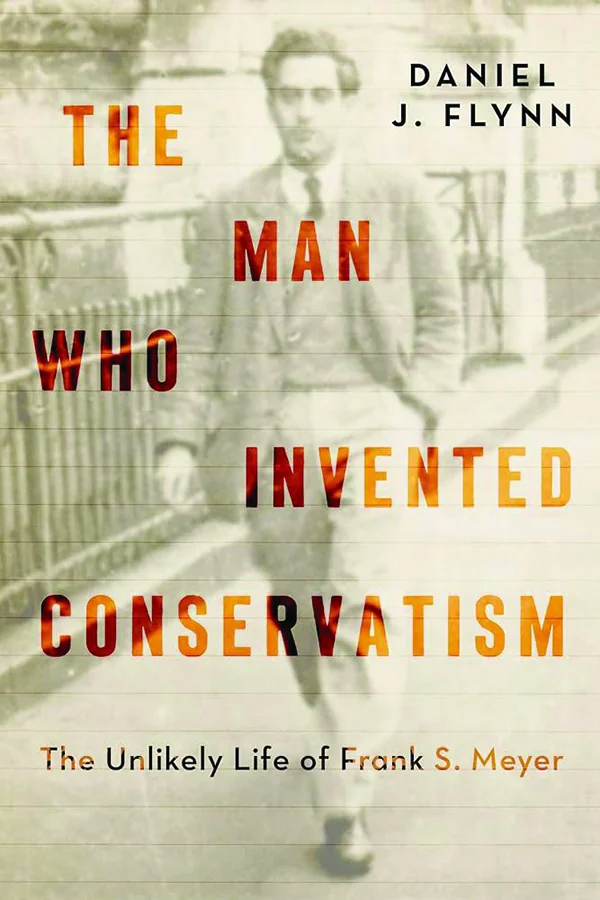


The Man Who Invented Conservatism: The Unlikely Life of Frank S. Meyer, by Daniel J. Flynn. Encounter Books, 2025, 544 pages, $41.99.
To the vast majority of Americans, the name Frank S. Meyer means nothing. It did to me prior to reading Daniel J. Flynn’s new biography, The Man Who Invented Conservatism. I was born in 2006, nearly a century after Meyer’s birth. My mother had not even left Cuba when he died. Yet, in reading Flynn’s detailed biography, I came to realize that I lived in his shadow’s shadow. In addition to Meyer’s life story, fascinating in its own right, I found a chronicle of the birth of postwar American conservatism.
Meyer defined better than perhaps any contemporary just what it means to be a conservative. At its core, conservatism is about conserving—that is, defending and adhering to the traditions and values passed down to you. But which? For the United States, this has much in common with the conservatism of other western nations—a Judeo-Christian moral foundation, for instance—but it also places a great emphasis on liberty. The importance of liberty to the Founders, and thus, to American identity, served as the bedrock to what came to be known as fusionism—Meyer’s synthesis of libertarian economics with traditionalism. When Meyer died in 1972, his project had yet to bloom. However, conservatives embracing his ideas rose to dominate first the Republican Party and then the nation in the years to follow. This brand of conservatism triumphed with the election of Ronald Reagan and has defined American politics since, permanently planting Meyer’s fusionist seeds in the American ideological garden.
One might think that this conservatism is still the dominant political ideology today. The Republican Party, traditionally the political vehicle of the American right, holds the presidency and both houses of Congress. Conservatives hold a supermajority on the Supreme Court. However, the coalition that brought this victory about has created a situation untenable in the long run. The unique presence of Donald Trump will not be on the ballot in 2028. Both parties will have to adapt. For conservatives, the way forward is not to emulate Trump, but to rediscover what it means to be a conservative.
Frank Straus Meyer was an unlikely engineer for the Reagan revolution. He spent years as a committed communist, even earning himself a deportation from England following his time at Oxford. His editorial defenses of the Communist Party USA’s party line carried him through its ranks. The global inferno of World War II began to burn Meyer’s Marxist devotion. While the party encouraged members to volunteer to fight for the Republicans in the Spanish Civil War, his superiors had tried to discourage him from seeking a commission in the Army. Although Meyer eventually failed Officer Candidate School, Flynn quotes Meyer’s son John to write that Meyer came to realize “that ordinary Americans in the military were not the proletariat they were cut out to be in Communist theory.” At the same time, Meyer was preluding his later synthesizing of libertarianism with traditionalism by attempting to fuse Marxism with the American tradition. Under party leader Earl Browder, American communists were largely sympathetic to Franklin Roosevelt and initially embraced Meyer’s first fusion. The reality of Cold War politics soon ended the experiment, as the Soviet backers of the CPUSA forced Browder and his supporters out.
Meyer came to accept that his communist fusionism had failed. Not just that it was anathemized by communists, but that the American Founding was itself incompatible with communism. So, Meyer sought to uncover and expound the true inheritance of the Founding—a mission that would come to define him for the rest of his life.
The mission came to define his country, but Meyer’s conservatism is no longer the only game in town. In the years since the 2008 financial crisis, there has been a rise in so-called “post-liberalism.” Figures like Hungarian Prime Minister Viktor Orbán have served as models to right-wingers in other western democracies that reject the embrace of freedom within conservatism. Steve Bannon even referred to Orbán as “Trump before Trump.” For many on the left, the parallels between Trump and these figures have prompted the oft-repeated line that Trump poses a danger to American democracy—a claim that isn’t without merit, particularly after January 6th. Crucially, however, democracy is a part of the United States’ DNA in a way it isn’t for Hungary, which transitioned away from communism in living memory. To be American is to be free. Trump is partially able to get away with casually shaking that foundation because he is an anomaly with a singular position in the cultural zeitgeist. Trying to emulate him will lead only to failure.
In looking back to conservatism’s birth, we see the roadmap for the post-Trump conservative moment lies in looking to the movement’s birth. In embracing an ordered liberty wherein the twin forces of freedom and virtue serve to support one another instead of being in conflict with one another. Rather, freedom becomes a necessary precondition for virtue because if not freely chosen, virtue ceases to be authentic. In Meyer’s distinctly American understanding, government’s role is to protect liberty and to create and protect the conditions under which a free and virtuous society could grow. The task of inculcating virtue was not the domain of the state, but rather of civil society—churches, families, communities, and other organizations. There have been disagreements over specifics and implementation, even between Meyer and his colleagues, but this ordered liberty has provided the philosophical backbone of conservatism since Meyer’s fusion. Looking back to the birth of post-war conservatism does not mean a reset to 2016.. Trump is as much a symptom of change as he is a catalyst of change. Conservatism must adapt if it wishes to not just be relevant, but even applicable to the times.
As America has become less religious over the last few decades, John Adams’ remark that “Our constitution was made only for a moral and religious people. It is wholly inadequate to the government of any other” has proven prescient. As such, conservatism must learn to engage with this reality. Appealing to traditional Judeo-Christian morality is far less effective now that less of the population is Christian, and even among those still identifying as Christian, few are practicing. While reversing this lies largely outside of the realm of policymakers, those in government should not abandon America’s Christian moral foundations. A “post-religious right” would, simply put, cease to be conservative, as would going to the opposite side of the spectrum by embracing theocracy or integralism, both antithetical to the pluralistic society the Founders sought to build.
Meyer recognized that America is built on government’s ability to trust its people with self-government, a trust sustained by an active and engaged citizenry. Conservatives should not merely hold to the ideals of the Founders, we must live them. We do this by being active members of our local communities, by participating in civil society through civic associations—like Rotary clubs, the Salvation Army, and similar organizations—but above all, by going out into the world. Just as Meyer began to abandon communism because he got to know average people by being in the army, reviving and revitalizing traditional civil society will naturally help to exorcise the demons of extremism out of the mainstream and back to the fringes by bringing Americans together again for more than politically tribal reasons. By revitalizing the common spaces where American culture was born, the shared values and beliefs that proceed from that will return. That America may seem far off, maybe even dead, but I believe she is instead dormant, waiting to be reawakened. Just as Meyer developed the ideological framework of modern American conservatism by looking back and embracing the founding ideals of this country, so too must we today look back to our forefathers for guidance. Trump is a product of an America that has forgotten what made it great. He should serve as a wake-up call for conservatives, and indeed, the entire nation, by reminding us of that.
I found that one of the most personally impactful parts of Flynn’s biography came at the very end, where Meyer, on his deathbed, suffering from advanced lung cancer, converts to Catholicism. As a devout Catholic myself, I’ll admit to being biased here. Yet, beyond my personal faith, I also found it a poetic end to his own story. I found Meyer to be representative of where conservatism finds itself now: perhaps nominally religious, certainly favorable in its view towards religion, but in no way active. Monsignor Eugene Clark, who baptized Meyer in his final days, remarked to Meyer’s wife Elsie that “a widening circle of people, who may need the witness of Frank’s integrity, will be affected by Frank’s completion of his turning to God.” The word “completion” finds itself particularly fitting here. Without its religious roots, the American tradition conservatives uphold is incomplete. This shows itself in the character of Trump—who, while he claims to be a Christian, is no paragon of Christian virtue. Once he’s gone, conservatives need to return to actively promoting and exemplifying the Judeo-Christian morality that we preach.
In the years after Trump exits the arena, conservatives will have a choice. We can try to pretend anyone else can fill his shoes, or we can remind ourselves of what it means to be a conservative, and try to help bring America back to the Founders’ vision. Being trusted with self-governance means not being indifferent, or living indifferently, to the actions of government. Alexander Hamilton directed his dying words to his wife, saying to her, “Remember, my Eliza, you are a Christian.” As conservatives, we must remind America of the same.
About The Author
