





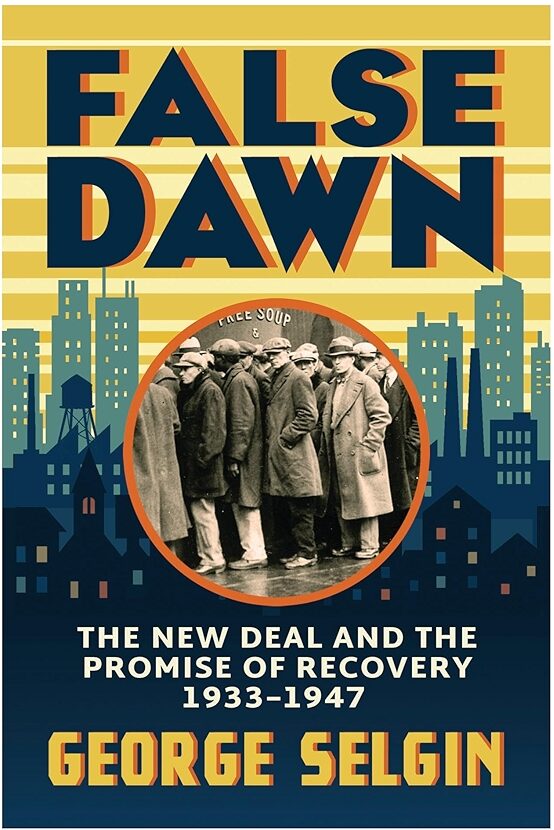


False Dawn: The New Deal and the Promise of Recovery, 1933-1947, by George Selgin. University of Chicago Press, 2025, 384 pages, $35.00.
As a policy regime, the New Deal remains an ingrained part of America’s political consciousness. Those confident in state action view President Franklin D. Roosevelt’s response to the Great Depression as proof that bold interventionist policies are effective, with every new crisis—such as the call for a “Green New Deal”—reviving this supposed lesson. In contrast, skeptics view Roosevelt as having pushed the United States towards European collectivism, leading to misguided experiments that actually prolonged the Great Depression. Attributing the end of the Depression to the start of the Second World War, the Roosevelt administration is seen as not just far from a model to be emulated, but rather the exemplification of the limits of technocracy. Each new crisis renews a seemingly perpetual contest: what role did the New Deal really play in the economic recovery, and what actually ended the Great Depression?
In False Dawn: The New Deal and the Promise of Recovery, 1933-1947, economist George Selgin synthesizes decades of scholarship in an impressive, 300-page volume that seeks to answer these questions definitively. Drawing on the work of economists, historians, and early commentators, Selgin analyzes the formation, rationale, and effectiveness of New Deal policies in promoting recovery. The result is an impressive reassessment of the New Deal’s economic consequences that captures the state of the field, refining and critiquing long-held interpretations. In their stead, Selgin offers a provocative thesis: a “Great Rapprochement” between industry and the state restored private confidence and investment, ultimately ending the Great Depression.
At its core, False Dawn reconciles the New Deal scholarship since the Great Recession that, as Selgin aptly characterizes it, “substantially modifies, when they don’t radically alter, our understanding of the New Deal’s consequences.” This literature examines how the New Deal facilitated economic recovery—one of Roosevelt’s “Three Rs,” alongside relief and reform. Underscoring this focus is a precise definition of recovery as the gap between actual and potential output. By framing recovery as a return to full economic health, rather than merely an alleviation of symptoms, Selgin offers a proper caution against naïve analyses of other metrics of recovery, such as growth rates and unemployment.
Even with recovery as the focus, the New Deal’s scope—15 acts creating nearly as many agencies between 1933 and 1939—defies concise analysis. To resolve this, Selgin organizes his narrative into three parts: the Hoover administration and Roosevelt’s response to the banking crisis; the New Deal’s key economic, monetary, and fiscal policies; and the New Deal’s postwar consequences. In its totality, the New Deal’s mixed record becomes apparent, and scholars acquainted with the literature will nod in agreement with familiar conclusions sharpened by Selgin’s analysis and caveats regarding data. Its most successful measures promoted stability, particularly early actions such as the Banking Holiday, abandoning the gold standard, and the establishment of the Federal Deposit Insurance Corporation. These short-run benefits did not necessarily extend in perpetuity, as Selgin notes that some measures, such as deposit insurance, created later problems. In contrast, the bolder central planning measures achieved mixed results at best (particularly the Agricultural Adjustment Act) or clearly prolonged the Depression (as seen with the National Industrial Recovery Act).
Collectively, this understanding of the New Deal challenges enduring assumptions, particularly the “Keynesian Myth” that characterizes Roosevelt as either anticipating or applying John Maynard Keynes’s economic thought. Selgin rejects the “proto-Keynesian” theory regarding gold revaluation, citing Keynes’s New York Times op-ed criticizing Roosevelt’s monetary policy and the influence of agronomist George F. Warren on the ill-fated gold purchasing scheme. Nor does the myth hold in its classic form, which depicts the New Deal as an experiment in deficit spending. While acknowledging that Roosevelt’s government spent roughly twice Hoover’s share of the GNP, Selgin shows that Roosevelt remained a budget hawk, going so far as to reject the Veterans’ Bonus and supporting deflationary excise taxes on businesses to balance the budget.
In severing the imagined link between the New Deal and Keynes, Selgin defends Keynes from efforts to impose Keynes’s intellectual prestige onto Roosevelt’s political popularity. Selgin compellingly makes the case that Roosevelt’s economic views were quite conventional by then-contemporary standards. His commitment to a balanced budget, acceptance of the high-wage fallacy of underconsumption, and confidence in bringing unions and business into order through the NRA reflected an evolution in progressive-era economic frameworks. That conventionalism had policy consequences. These views led to the higher taxes and spending cuts that sparked the 1937 recession, and Roosevelt, perhaps out of pride, delayed acknowledging his errors despite his supposedly experimental bent. Ironically, Roosevelt backed away from more successful, albeit inflationary, measures. Refining Christina Romer’s argument that monetary policy spurred recovery, Selgin demonstrates that monetary growth following the 1934 revaluation was driven by capital flight from Europe, rather than any specific policy. If Roosevelt had adhered to a Keynesian approach to deficit spending, Selgin concludes, recovery would have been much sooner.
In separating Keynes from Roosevelt, Selgin opens space for a rapprochement of a different sort—between Keynes and Friedrich Hayek. Often cast as opposites over technical disputes, both men considered themselves liberals in an illiberal age and appreciated each other’s work. In today’s uncertain moment for liberal capitalism, Selgin (briefly) invites readers to appreciate the insights of both thinkers.
This separation also provokes an interesting, unanswered question: given Roosevelt’s tendency to waver on beneficial economic policies and to prolong bad ones, and given the historical record linking poor policies explicitly to Roosevelt, should Roosevelt receive credit for the competent economic policies? Tellingly, among Roosevelt’s most successful economic measures, many appeared to be holdovers from earlier discussions during the Hoover administration.
If not the New Deal, what ended the Great Depression? Selgin’s answer is the role of business expectations in recovery. The New Deal was a policy regime, marked by experimentation and hostile rhetoric towards business, that created high uncertainty that dampened private investment. This hostility ended during the Second World War, as industry proved invaluable in American victory, creating a “Great Rapprochement” between private enterprise and Roosevelt’s administration that finally ended the Great Depression. As evidence, he points to the absence of a “phantom depression” at the war’s conclusion, despite the return of eight million servicemen to the workforce and their displacement of women workers.
This argument is certainly plausible. During the 1930s, it was unclear whether democracy or capitalism could survive, and prominent voices suggested that Roosevelt temporarily assume dictatorial powers. With Roosevelt haranguing business and imposing sometimes punitive taxes, it makes sense that businessmen viewed new investment as increasingly risky. Yet this argument can be stretched. Selgin’s suggestion that depositors withdrew gold from banks out of fear of dollar revaluation, deepened by Roosevelt’s policy ambiguity, perhaps over-rationalizes depositors. The legal security provided by gold clauses in bonds and contracts protected investors against monetary uncertainty until their abrogation in June 1933. Separately, Selgin’s evidence for rapprochement appears deferential to economic commentators’ presumption that a recession must occur. As a point of contrast, the 1920-1921 recession occurred a year and a half after the armistice and was driven by monetary policy. By 1945, the United States’ global position was even stronger than it had been in 1920, and TNEC appeared more concerned about the antitrust implications of the rapid privatization of wartime factories.
Despite this quibble, False Dawn is an excellent reflection of the recent New Deal economic historiography. Where there are weaknesses, it is less a reflection of Selgin’s analysis than of the gaps in the literature he surveys—particularly in agriculture, where data and regional variation complicate definitive judgment. For example, there seems to be a presumption that, after the Bank Holiday, the economy would only trend upward apart from the Roosevelt Recession. Given the pre-Depression state of agriculture, there are reasons to be skeptical of this. One is that Christopher W. Shaw’s work, while focused on politics, suggests structural banking issues played a key role in agriculture’s woes between Wilson and the New Deal. While the AAA’s allotment scheme and direct checks were counterproductive, the Commodity Credit Corporation’s non-recourse crop loans stabilized farm credit in the South and West, relieving pressure on country banks. These non-recourse loans also acted as quasi-automatic stabilizers, allowing farmers to surrender their crop if prices declined, thereby shifting the risk from rural credit institutions to the state. Although not a “recovery” measure per se, these loans likely facilitated farm mechanization. This contradiction, between agrarian confidence and industrial uncertainty, reflects one potential avenue for deeper research.
While acknowledging in the preface the temptation to polemics given his own intellectual predilections as a “neoclassical economist with a libertarian bent,” Selgin delivers an admirable and honest reckoning of the New Deal’s economic consequences, one that builds upon the insights of an intellectually diverse range of scholarship. Despite its scope, the book remains accessible throughout, with Selgin’s writing delivering brisk clarity that moves the narrative along. While questions regarding the New Deal as an economic regime remain, False Dawn is an indispensable starting point for future scholars, policy analysts, and the curious lay reader. It is undoubtedly the one I will most readily recommend.
About The Author
