







“Bliss was it in that dawn to be alive, / But to be young was very heaven!” Or so wrote William Wordsworth, recollecting the enthusiasms that accompanied the early days of the French Revolution. Of course, things didn’t quite turn out as planned.
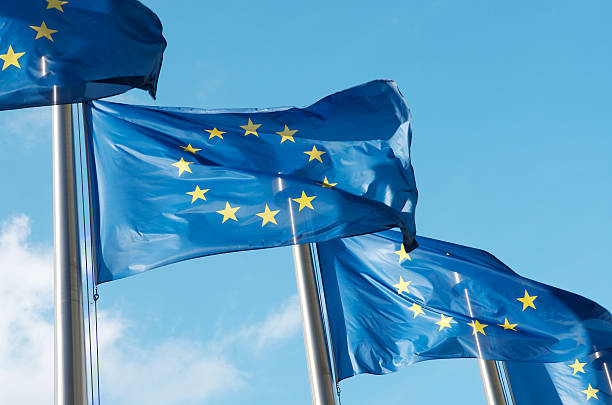
But hope springs eternal. And some of the fraternal hopes of the Revolution resurfaced in a new guise after the end of the Cold War, as the former European Economic Community was being transformed into the European Union. Despite some early setbacks (particularly in the Balkans), the luster of the European project was bright in those days.
Heading into the new century, and with certain national kinks worked out, the administrators and publicists of the Union trumpeted their almost-utopian ambitions to pretty much anyone who would listen. Like the French Revolutionaries, moreover, they found a receptive audience even beyond the Continent. This was a period that saw the publication of books like Mark Leonard’s Why Europe Will Run the 21st Century, which argued that, uh, Europe would run the 21st century.
What a difference a quarter century makes. Last month, the same author recanted, declaring that in fact Europe may now be “doomed.” Indeed, this kind of pessimism now seems to be the prevailing sentiment.
So when Canadian Prime Minister Mark Carney recently declared that the “new world order” would be built from Europe, it felt like a curious throwback. Like velour tracksuits or nü-metal, Euro-optimism was once pervasive, but now seems a product of its specific time. Today, after years of anemic growth and a demographic crisis that threatens to become a political crisis, the appeal is lost. How did this happen?
In retrospect, a lot of the initial excitement looks like an attempt to lead the End of History parade. It wasn’t just that liberal democracy had won out over ideological rivals. Now, the nation-state itself would wither away. In this respect, theorists of the European future believed they could overtake the United States, which dominated the 20th century. Sure, America may have been the arsenal of democracy (as well as the guys mostly firing the arsenal after 1945). But it remained wedded to nationalism and militarism—vestiges of more primitive times.
Such optimism wasn’t just wishful thinking. At the outset of the 21st century—fifteen years after the initial Schengen Agreement and eight after the Maastricht Treaty—the Continent seemed to have a certain vitality to it. Whatever one thought of the actual texts of these accords, they represented directional change for Europe and were greeted enthusiastically in many if not all EU member states.
One must also remember that alongside idealistic visions of superior governance, the EU’s boosters trumpeted its latent economic capacity. By the mid-aughts, its collective GDP was on par with the United States’. Without the burden of war, it seemed likely that Europe would continue its relative growth.
Suffice it to say, this didn’t last. Political momentum seemed to stall out as enlargement replicated the organization’s fundamental problems (discussed in more detail below) rather than resolving them or increasing economic productivity. And today, the Continent lags well behind the United States economically. Through the intervening period, there was no shortage of conventions, summits, diplomatic delegations, concordats, and other flashy meetings and statements. However, while the club has taken in new members, there have been no real milestones of further integration since the mid-90s—and the fundamental issues of borders and common monetary systems were replaced by mundane matters like the allowable circumference of artichokes. Arguably, the two signal moments of Europe’s 21st century were German Chancellor Angela Merkel’s Wir schaffen das and Brexit. Neither looks like an example of success.
The former sought unsuccessfully to deal with Europe’s migrant crisis. Beginning in 2015, over one million arrivals from mostly Middle Eastern countries sought asylum throughout the EU. Opening the borders pushed the implied universality of the European project to the breaking point. That loss of control, in turn, contributed to Brexit.
Britain’s decision to leave the EU was a symbolic reversal of the project of continual unification. No amount of mutual “good riddance” could change that. Europe’s architects imagined that progress, as they conceived it, was a one-way street. Brexit proved that the victory parade could be turned around.
It’s easy to blame feckless leaders for the problems facing Europe, but two structural tensions have been unavoidable. One is vertical and the other horizontal. The vertical tension is that the European project has pretenses to greater democratization, in that it encompasses a wider sphere of European citizenry. Yet the Union itself is a centralized and hierarchical organization that concentrates decision-making at a greater remove from ordinary citizens than most state governments do.
The horizontal tension is that Europe has pretenses to universality, in that it overrides the traditional boundaries of its constituent countries. Yet it is still obliged in principle to observe border and migration controls around its own periphery. Failure to do so creates similar social and political stresses as anywhere else. Going back to Monnet and Schuman in the 1950s, the European project was predicated upon its promise to better preserve the underlying nations than conventional state structures. After all, the latter had gleefully pursued catastrophic international conflicts, which had both bled the Continent white and exposed it to the twin depredations of Soviet conquest and American-style capitalism.
But that is not what happened. Today, the foreign-born population of the European Union stands at a record 64 million residents. Despite tighter controls over the last several years, immigrants and their descendants will comprise an ever-growing demographic share by 2050, as overall population numbers decline along with births. One need not go full Camp of the Saints to doubt that the entirety of this migrant population will make the smooth transition to national citizenship.
Here, the basic incoherence of the European appeal is apparent. The ambitious plan to accept unprecedented levels of migration is consonant with the rejection of traditional political forms. Yet the transcendence of national categories always presupposed the continuation of those same national categories. The contradiction could only be resolved if you assumed, as many Euro-boosters did twenty years ago, that the age of great conflicts between states and peoples was finally over. But that assumption was false. Europe could not be abstracted from the continuation of history beyond its borders.
Neither could the built-in tension between progress and conservation in European identity be resolved. On the one hand, Europeans are thought to be more liberal, more urbane, more advanced, less beholden to outdated political systems as they forge a Continental template. This is the future that the European elite celebrated.
Yet progress is not the source of Europe’s appeal. The Continent is also the site of the most beautiful buildings, the best culinary traditions, and a more refined way of life inherited from generations of overlapping aristocracies. By embracing progress, the EU threatened to efface much of what originally made the European way seem valuable and worth securing.
Maybe progressive Europe could have won the argument if it were really the cultural and economic workshop of the modern world. But the reality is that European creativity has lagged behind other regions for decades, even centuries. In his magisterial The Mediterranean and the Mediterranean World in the Age of Philip II, Fernand Braudel discusses how the global center of gravity shifted westward toward the Atlantic. Winston Churchill in his famed June 4th speech before Parliament spoke movingly of “the New World, with all its power and might, step[ping] forth to the rescue and the liberation of the Old.”
Speaking as an American, I think a world with a diminished Europe is itself diminished. One can laugh at the notion of a place where more people die from overheating than Americans do from gun violence, but we should try and keep the schadenfreude to a minimum. Tocqueville said of the Ancients that they prop us up where we lean. Something similar, I think, holds for our cultural and historical ties to Europe. Should they be finally severed, America will become a duller, flatter, shallower place—intoxicated with its own dynamism but lacking any perspective from which to reflect on the value or purpose of that dynamism.
Alas, there isn’t much we can do about Europe’s travails from across the Atlantic. There is some hope in the increasingly candid acknowledgment by figures like German Chancellor Merz that Europe cannot simply spend its way out of years of low growth, as well as the expanding space for discussing the real costs of immigration, though it remains to be seen whether either will lead to constructive action. But where possible, it is generally good practice to speak plainly about the problems of friends without gloating too much over their misfortunes. And so in lieu of a solution, I commend this approach to readers until something better comes along.
About The Author
