





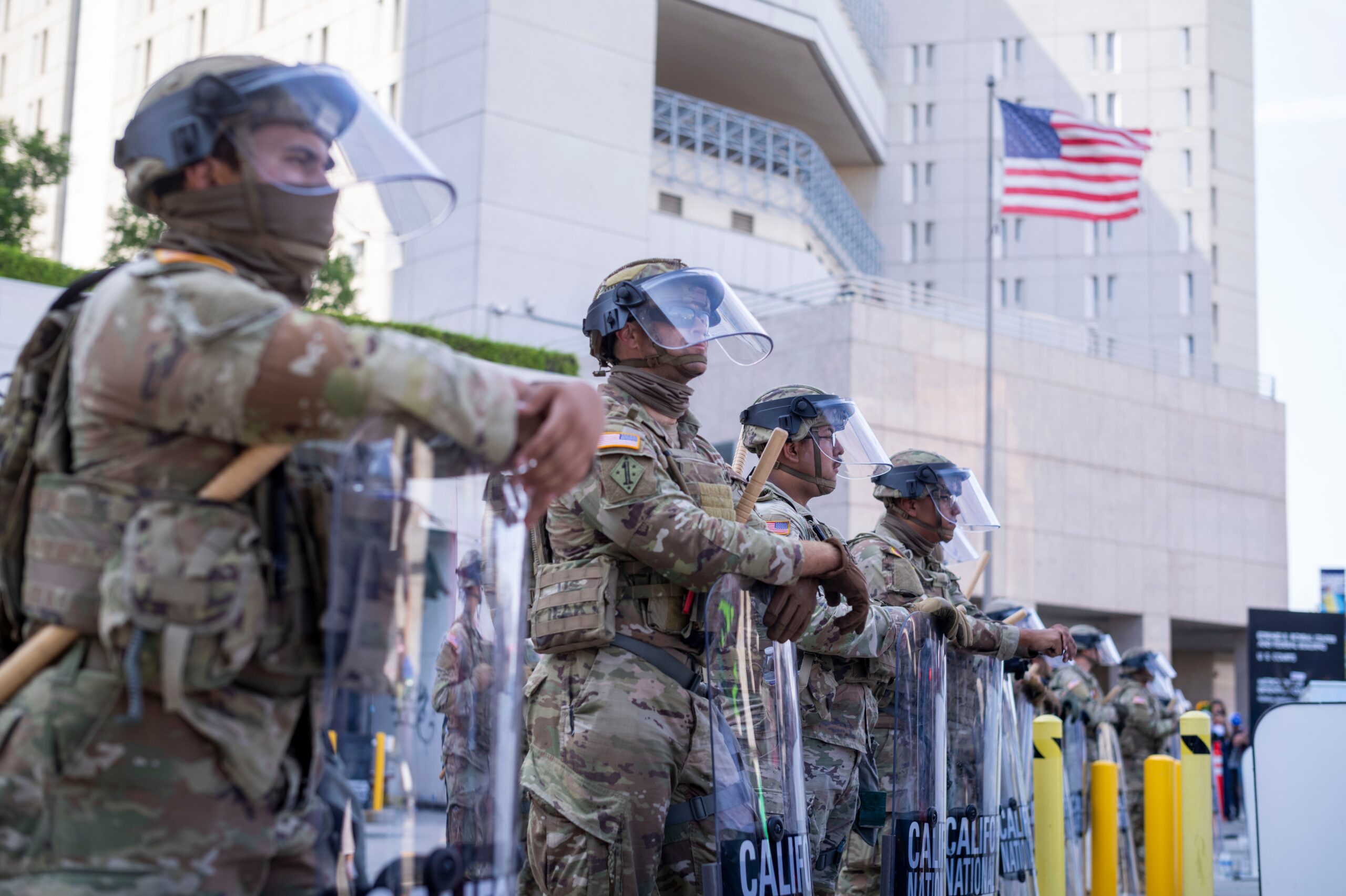


Earlier this year, following orders from President Donald Trump, National Guard troops began arriving in Los Angeles to assist federal and local law enforcement in restoring order after protests and riots erupted in response to Immigration and Customs Enforcement (ICE) operations in the city. By Tuesday, approximately 2,100 members of the California National Guard had been deployed, followed shortly by the arrival of roughly 700 U.S. Marines assigned to a support and security role, primarily tasked with protecting federal buildings and personnel.
Almost immediately, the deployment ignited fierce debate. Critics questioned not only the legality of the move, but its ethics, its necessity, and its long-term implications for American federalism. Supporters argued that the federal government had both the authority and the obligation to act when federal law enforcement officers were being attacked, federal property threatened, and local authorities appeared unwilling or unable to restore order.
The images coming out of Los Angeles—burning vehicles, barricaded streets, masked demonstrators clashing with law enforcement—were not unfamiliar to Americans. Not only have similar scenes played out repeatedly over the past several years, from Portland to Kenosha to Washington, D.C., but many in the Boomer Generation will undoubtedly remember similar scenes in the 1960s—from the civil rights movement to environmental and peace protests. And now, once again, they are unfolding in Minnesota, where riots and mass protests tied to immigration enforcement and broader anti-government sentiment have escalated into widespread property destruction, assaults, and sustained threats to public safety.
The repetition of these events forces a question that many Americans would prefer to avoid: What happens when the federal government enforces laws that a state or city has openly rejected—and what happens when that enforcement requires force?
Title 10, Posse Comitatus, and the Gray Zone of Authority
In his June 7, 2025, memorandum, President Trump stopped short of invoking the Insurrection Act. Instead, he relied on Title 10 authorities, directing federal forces to protect ICE agents, assist in enforcing federal law, and secure federal property. While gubernatorial consent is traditionally sought when National Guard units are federalized, it is not strictly required under Title 10.
California Governor Gavin Newsom strongly objected, filing a lawsuit against the Trump administration. Newsom argued that conditions in Los Angeles did not meet the legal threshold necessary to justify federal intervention. He also argued the deployment violated the spirit, if not the letter, of the Posse Comitatus Act of 1878, which limits the use of the military in domestic law enforcement roles.
The administration countered that federal agents were being attacked, federal property was under threat, and local authorities had failed to provide adequate protection. In this framing, the deployment was not about suppressing dissent, but about ensuring that federal law could be executed at all.
This legal dispute highlights a dangerous gray zone. The federal government is charged with enforcing federal law. But what happens when a state or city openly rejects that law, declines to cooperate, or allows conditions that make enforcement practically impossible? Where is the line between federal authority fulfilling its duty to protect the public and using that authority to “protect the public from themselves”?
Minnesota and the Escalation Problem
The unrest currently unfolding in Minnesota underscores why these questions are no longer theoretical. What began as protests against immigration enforcement rapidly escalated into riots that overwhelmed local law enforcement. Police precincts were attacked, businesses looted, and neighborhoods effectively abandoned to mob control.
Local officials, some openly hostile to federal immigration policy, were slow to request assistance. Federal agents operating in the state reported being targeted, doxxed, and assaulted. Highly organized and unruly mobs stalked and harassed federal agents every chance they got, escalating to violence. Federal agents responded in kind, resulting in several deaths so far.
Critics of the intervention argue that federal deployments inflame tensions and radicalize protests. Supporters respond that the absence of enforcement emboldens violence. It’s a deadly Catch-22: the withdrawal of federal agents would signal weakness and embolden hostilities elsewhere, but continued police action would also further tensions and encourage violence.
Historical Precedent Is Not the Same as Moral Clarity
President Trump’s actions in Los Angeles did not occur in a vacuum. The federal government’s authority to deploy troops domestically has deep historical roots. The Insurrection Act of 1807 and Title 10 of the U.S. Code provide mechanisms by which the president may federalize National Guard units or deploy active-duty forces to enforce federal law, suppress insurrection, or protect constitutional rights—even over the objections of state governments.
Americans are taught early on that this authority has been used for righteous ends. Perhaps the most cited example is President Dwight D. Eisenhower’s deployment of the 101st Airborne Division to Little Rock in 1957 to enforce desegregation orders. Few today would dispute that Ike’s action was morally necessary, legally justified, and historically vindicated.
But history is not composed solely of its best moments. Abraham Lincoln sent Union troops to suppress the New York City draft riots in 1863, resulting in hundreds of deaths. President George H. W. Bush deployed federal troops to Los Angeles in 1992 during the Rodney King riots. Lyndon B. Johnson repeatedly federalized National Guard units during periods of civil unrest in the 1960s.
Each of these actions was legal. Each restored order. None were a clear moral victory. Any weapon that can be wielded for justice, safety and order, can also be wielded for tyranny, oppression and control.
Effectiveness Versus Principle
This tension lies at the heart of the issue: federal intervention works. In Chicago, targeted federal operations reduced violent crime in key neighborhoods. In Washington, D.C., the visible presence of federal law enforcement stabilized areas that local authorities struggled to control. Along the southern border, federal deployments have at times dramatically reduced illegal crossings and associated violence. Public safety outcomes matter. Fewer assaults, fewer arsons, fewer deaths—these are not abstract metrics. They represent real lives.
But effectiveness alone cannot be the standard. If it were, there would be little reason to restrain federal power at all. The Constitution does not exist to optimize efficiency; it exists to limit authority. Crime in the Soviet Union was low and order was high, but at what cost? On the flip side, government authority in Mogadishu is low, but the citizens of Somalia are not truly free either.
States’ Rights and the Risk of Precedent
Those who defend state sovereignty are not merely engaging in political theater. The danger of federal overreach is not hypothetical. Power, once normalized, rarely retreats.
Today, many Americans may support federal intervention to enforce immigration law in defiant cities. Tomorrow, those same powers could be used to suppress causes they support: gun ownership, environmental activism, labor organizing, or political dissent.
This is the paradox at the center of federal authority: the tools you applaud when used against your opponents will one day be used against you.
States are laboratories of democracy precisely because they can pursue policies that diverge from federal priorities. When the federal government repeatedly overrides those choices through force, it risks hollowing out the very structure it claims to protect.
Yet the counterargument is equally compelling. States do not exist in isolation. Their failures spill across borders: crime, migration, economic instability, and violence do not stop at state lines.
At what point does sovereignty become negligence?
The Federal Government’s Duty to Citizens
Lost in much of this debate is the individual citizen. When riots engulf neighborhoods, it is not abstract “state sovereignty” that burns—it is homes, livelihoods, and lives.
If a state government refuses assistance or declines to enforce laws in ways that endanger its own residents, does the federal government have a moral duty to intervene? Or does respecting state autonomy require allowing citizens to suffer the consequences of their leaders’ decisions? In short, if it is the will of the people, does a state have the right to burn itself to the ground? Does the federal government have the right or obligation to put out the fire?
There is no clean answer. The Constitution was designed precisely because the Founders understood that governance would always involve tradeoffs between liberty and order.
A Necessary Power That Should Make Us Uneasy
A federal government powerful enough to impose order over resistant states is powerful enough to abuse that authority. The same mechanisms that restore calm today could suppress legitimate dissent tomorrow. Similarly, rule of the mob and local disobedience to the powers given to the federal government can themselves be tools of oppression.
It was a call for states’ rights that justified the subjugation, segregation and oppression of black citizens for nearly 200 years, and it was the flexing of federal power that formed a large part in ending that oppression.
Today, rioters posing as protesters, tens of thousands of foreign criminals and cartel traffickers posing as hardworking members of society, and thousands of bad-acting foreign nationals hailing from the Middle East to China posing as future citizens have put our national security at stake. They have taken advantage of the lenient laws from sanctuary states and camouflaged themselves amid other immigrants who genuinely are seeking to become productive members of the American experience. Despite the risks that so much concentrated power carries, it is the job of the federal government to answer this threat to national and personal security.
We can feel today the apprehension of ancient Rome every time they needed to elect a new dictator, but we can’t forget how many times those dangerous dictators did end up saving our grandfather republic.
Conclusion: Order Is Not the Same as Justice
Federal law enforcement and military deployments can restore order. They can reduce violence. They can protect lives.
But order is not justice, and effectiveness is not morality.
Each time federal force is used against domestic unrest, Americans should ask not only whether it worked, but whether it moved the nation closer to the balance of power the Constitution intended—or further away from it.
One day, the issue will not be immigration. And when that day comes, many who cheer for federal intervention now may find themselves at the receiving end of an uncaring government with more power than can be combated. This authority is sometimes necessary—but always dangerous. That is why it should never be accepted comfortably, never expanded casually, and never used without serious public scrutiny. Once a society becomes comfortable with a force that protects, it is inevitably threatened with a force that subjects.
About The Author
