





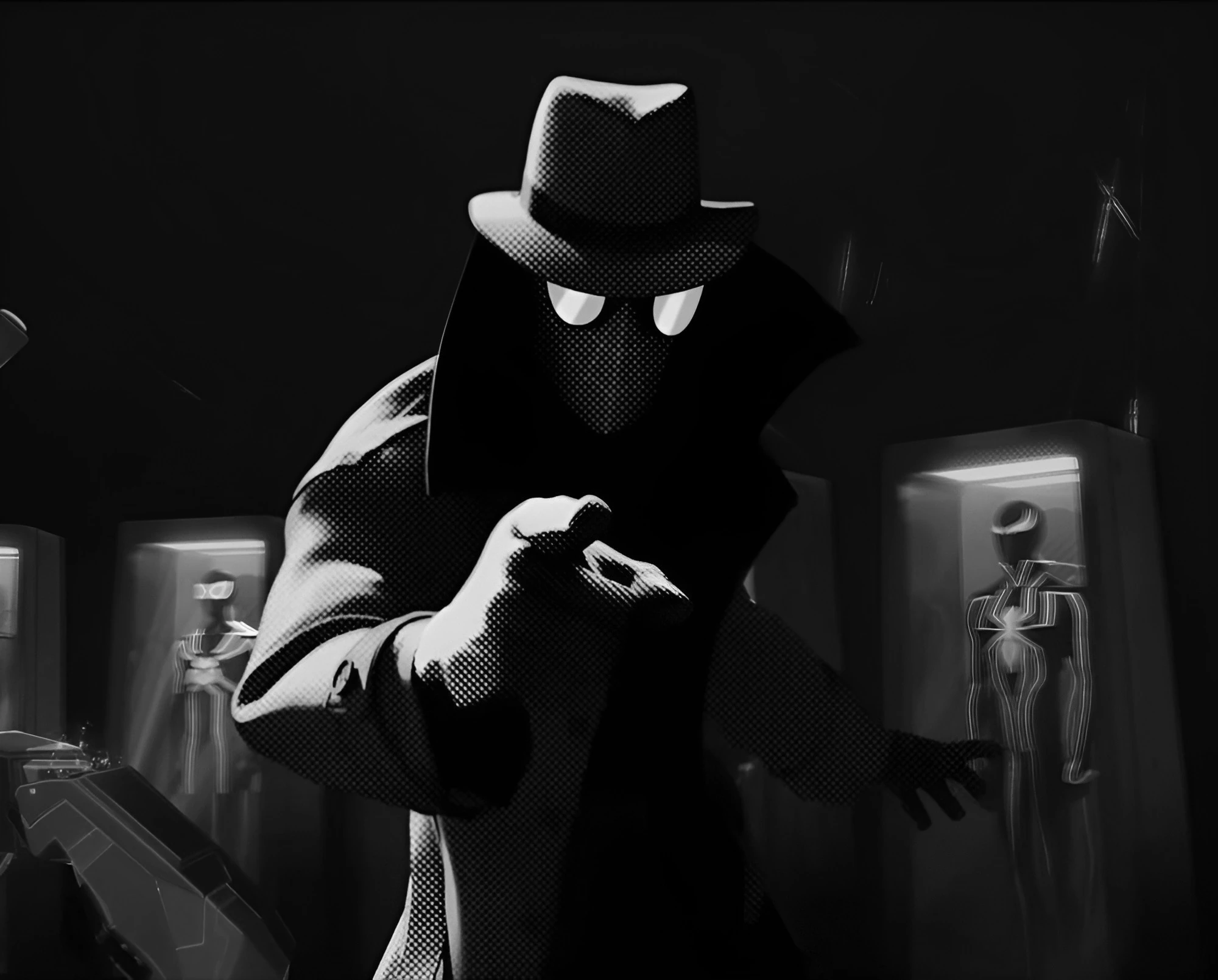


There was a period in the 1980s-1990s when neo-noir adventures, often parodies, sometimes tied up with comic books or fantasy stories, came out about every year, often directed by or starring impressive artists. Wim Wenders’ Hammet, Carl Reiner’s Dead Men Don’t Wear Plaid (Steve Martin), Robert Zemeckis’ Who Framed Roger Rabbit (Bob Hoskins), Dick Tracy (produced, directed by, and starring Warren Beatty), Dead Again (Kenneth Branagh), Cast A Deadly Spell, The Rocketeer, The Shadow (Alec Baldwin) all come to mind. Then with the arrival of Marvel, all of Hollywood turned into that sort of entertainment.
Now, we have a mix of that goofy older kind of story and the new, earnest but fake stories about the Avengers saving the world, if not the universe: Spider-Noir, starring the champion of goofy but earnest Nicolas Cage as the last popular comic book hero. The writers of the very successful Spiderverse trilogy (not to be confused with the even more successful live action Spiderman trilogy), Phil Lord and Chris Miller, produced Spider-Noir for Amazon Prime, but the series was created by showrunner by Uziel Oren, who got his first chance to run a major production.
Spider-Noir was highly anticipated (to judge by YouTube, which is more reasonable than you might think: the box office is dominated right now by two hits originating there, Obsession and Backrooms) and is highly regarded, judging by online markers like Rotten Tomatoes and IMDb. What does it deliver, except Nic Cage’s TV debut in a zany performance? At first glance, it’s just another “gritty reboot” story of a washed up anti-hero (Amazon offers the series in both color and black-and-white, to live up to the noir in the title).
Cage plays Ben Reilly, a private investigator in New York at the end of Prohibition, a victim of the roaring ‘20s. He is traumatized by the loss of the woman he loved—an enemy had killed her back in his crime-fighting days as The Spider. So he gave up the thrill of fighting crime. But in order to make ends meet, but also to save another woman from a similar fate (Cat Hardy, a femme fatale, gun moll, club singer wrapped into one), Ben returns to crimefighting. And he does so in the middle of a mayoral election that threatens the interests of the biggest bootlegger in town, Silver Mane. Said Irish mobster is played by Brendan Gleeson to perfection, as the thinking man’s brute, by turns having nobodies tortured and reflecting on entropy.
That’s the conflict, but here come two twists to the typical detective versus criminal mastermind story. One, we expect: superheroes show up. But even this turns into something unusual: these mutants with various powers, fire, electricity, strength, hardness, and the like—they’re victims of the times same as anyone in the Great Depression setting of Spider-Noir. They’re neither mythical figures of the past nor portends of the Progressive future. They’re men who have been pushed too far. Their very powers destroy them, and knowing this also drives them mad. This is a fairly obvious reflection on the character of celebrity in the modern world, that it is both dishonorable and uncertain.
Moreover, these super-powered non-heroes are doughboys! Veterans of the Great War, but also German POWs who suffered horrible experiments! What’s more typical than the past coming back to haunt one of our protagonists? Or German cruelty and wickedness? (Though the show deserves applause for avoiding Hitler!) This is the medical experiment that made Ben a monster, even as he was becoming a hero as the soldier liberating the POWs. The oddity, again, comes from the post-Progressive interpretation of “super powers.” Ben, like all the others, wants to forget about it, he has no delusions of grandeur, he realizes he’s just one guy caught up in the unraveling of the world—he doesn’t amount to a hill of beans.
So far, the story is a lightly dramatized version of the confusion of our times. Thinking back a century is not a bad idea. This is not the first time society is upturned. But to the extent to which this is a story aimed at young Americans, it has two unusual qualities. First, it shows them an older America, whose most distinctive feature is that it was peopled by adults who were often unhappy. It’s a silent rebuke to the cult of youth that characterizes our times—now that Americans are older than they’ve ever been. Second, Spider-Noir is an attempt to return to earnestness. Ben judges himself and is to be judged by his audience by whether he believes any man would kill or die for love.
The “noir” part of this romantic vision is that life mostly doesn’t work out—after all, we tend to pay attention to car crashes, as well as bigger catastrophes. Spider-Noir fits our times not because it’s a super-hero soap opera, but because the mood for younger Americans is darker than it’s been in a long time. In this context—the major genre for young men especially is horror—the feel good story of the year might be a washed up drunk getting his life back together for reasons, ultimately, of chivalry.
The other twist is that, far from trying to destroy Silver Mane’s crime organization, Ben starts out by agreeing to work for him, to figure out who’s trying to assassinate him. This is most of the plot, this is also the major love story, so I won’t spoil the plot. But I’d like to point out why the story twists this way: the basic orientation of the story is, justice might exist, but it’s probably not good—love, on the other hand, is good, if anything is, but it’s not at all clear that it is just. Hence, the tension, the conflict: but I think it also clarifies some of the confusion of the audience. Compared to social media discourse, Spider-Noir seems innocuous or even well meaning!
Our entertainment is now stuck with the collapse of the “woke Disney” project. For a long time, Marvel head Kevin Feige was the king of Hollywood, indeed the most successful producer ever. And he was only one part of Disney, which also included Star Wars and other properties. COVID, woke, and the zoomers killed that project just as every story was turning into a female salvation story, with various degrees of vulgarity thrown in. Disney has since faced any number of failures and its stock value halved from its COVID peak, but so also has the woke fever broken, and the influence of its storytelling has faded. So Batman, Superman and a few others characters were saved from the fate of Star Wars, which is now once again failing on screens across the nation with a Mandalorian story. Now we can say, Spider-man is safe, too. Funny how that works out.
Just like social media, to this “nothing ever happens” problem there is a “you can just do things” solution. Phil Lord and Chris Miller just had a major hit with Project Hail Mary, with a similar protagonist: white man who suffers a crushing defeat, but gets a second chance and saves the world. Spider-Noir is not free from the woke features—sidekicks of various races and sexes taking the protagonist to task for his privilege—but there’s very little of it, and instead we get a tentative turn to more edifying storytelling.
Usually, protagonists are thinly-disguised fantasies of their authors. Spider-Noir has that quality, too. Storytellers have been abused far more than audiences in Hollywood. What comes after such a process we don’t know—but in Spider-Noir, we see a way to reconnect writers and audiences on a more modest basis, without delusions of Progress or even ambitions like Nolan’s Dark Knight Trilogy at the beginning of the super-hero period two decades back. But surviving is in itself a victory. Returning to entertainment, compared to the madness of 2020, is sanity.
About The Author
