





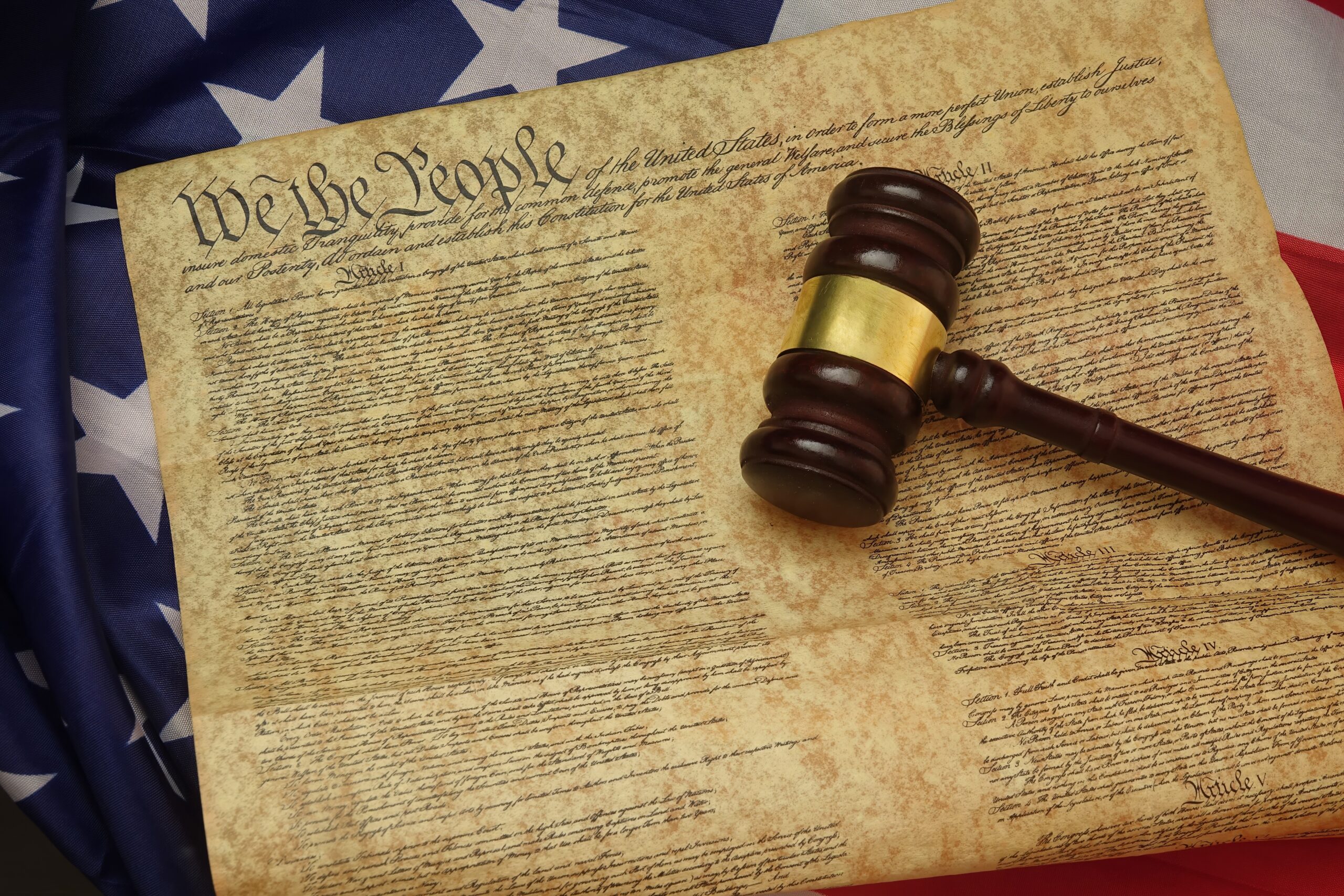


On June 26, 2015, the United States Supreme Court made one of the most consequential and controversial rulings of the twenty-first century. After decades of public debate, Obergefell v. Hodges legalized same-sex marriage nationwide. While this historic moment is interesting in and of itself, the arguments the justices deployed to defend their respective opinions reveal a deeper disagreement about the very nature of the Constitution. Writing for the majority, Justice Anthony Kennedy grounded the right to marriage, and the government benefits that accompany it, in the idea that marriage is vital to living a fulfilled life and is therefore a fundamental right that cannot be denied. Chief Justice John Roberts, writing in dissent, argued that the Court does not have the power to protect rights unless the Constitution or legislature explicitly guarantees their protection. In his view, whether the right to marriage is vital to living a good life is beside the point. Questions of fundamental rights are not the judiciary’s purview and should instead be left to the representatives of the people as the Constitution dictates. In this way, Roberts prioritizes constitutional arrangement over claims of rights.
These competing claims reflect two sides of a longstanding dispute in American constitutional thought. One tradition emphasizes fundamental rights, arguing that the Constitution exists primarily to secure liberty and equality even as their meaning evolves over time. The other emphasizes constitutional institutions, arguing that liberty is preserved not through appeals to abstract rights but through the structures and procedures established by the Constitution itself.
The debate between these two traditions is nothing new in American political discourse. From the earliest days of the American Revolution, American constitutional thought has contained both a strong fundamental rights tradition and an equally strong institutionalist tradition. The founders broadly agreed that natural rights formed the moral foundation of the American regime. They disagreed profoundly, however, about how those rights should relate to constitutional government. Some believed rights transcended constitutional limits and demanded implementation whenever justice required it. Others believed rights could only be secured through stable constitutional procedures and institutions, which themselves became the most important features of the regime.
Constitutional Theory and the Debate Over Rights
Competing visions of constitutionalism continue to structure modern constitutional theory. Among contemporary scholars, the fundamental rights tradition has been expressed by thinkers such as Ronald Dworkin. For Dworkin, a constitutional system must be designed to protect the moral integrity of a people. In the American case, that moral system rests upon equality before the law. Yet this equality is not limited by institutional or legal strictures. Rather, it demands fidelity not only to rules but also to the moral principles those rules presuppose. Discussions of justice and equality therefore cannot be confined to particular institutional structures, but must remain at the center of political debate.
Sotirios Barber advances a similar argument, though he roots his theory more explicitly in the American founding. Barber contends that the Constitution was designed to achieve the welfare of the people and that this well-being is “more important than any institutional form.” In this view the Constitution is not merely a document that establishes particular governmental structures. It is an instrument for achieving broad substantive ends such as national security, domestic tranquility, freedom of conscience, and economic well-being. Loyalty to the Constitution therefore requires more than adherence to procedures or institutional forms. It requires commitment to the substantive purposes the Constitution was designed to serve.
Advocates of the institutionalist tradition see these arguments as deeply problematic. For scholars such as Harvey Mansfield and Michael Zuckert, the danger of the fundamental rights approach is that it opens political debate to abstract doctrines that may destabilize constitutional government. Mansfield argues that while the Declaration of Independence proclaims that all men are created equal, the Constitution deliberately moderates this principle by embedding it within formal institutional arrangements necessary for political stability. The Constitution, in other words, restrains the radical potential of natural rights by channeling political conflict into institutional forms.
For institutionalists, the French Revolution stands as the most obvious historical example in support of their approach to constitutional government. While many American conservatives cringe at the fact, it is a simple truth that the French built their new system of government on similar principles to our own. The greatest evidence for this is that the Marquis De Lafayette drafted the French Declaration of the Rights of Man and of the Citizen in the dining room of the American Ambassador Thomas Jefferson. Yet the French political system lacked firm legal and procedural restraints upon the authority of the people and their government. As such, “liberty, equality, and fraternity” soon found their expression not in a careful system of checks and balances but in the horrors of the guillotine. For this reason, Mansfield argues that political discourse should concern itself primarily with constitutional provisions and policy rather than with high philosophical debates about rights.
Both sides of this contemporary debate frequently invoke the American founding in support of their arguments. Yet when one examines the writings of the founders themselves, it becomes clear that the founding generation was divided on precisely the same question.
Despite their disagreements, the American founders broadly agreed that natural rights formed the moral foundation of the new regime. Historians such as Forrest McDonald have noted that the founders shared a common purpose: providing protection for the lives, liberty, and property of citizens. The Declaration of Independence famously proclaims that all men are created equal and endowed with unalienable rights. Even figures who disagreed on nearly everything else accepted this premise. Thomas Jefferson declared that humanity had not been born with saddles on their backs for a privileged few to ride. Alexander Hamilton likewise insisted that the sacred rights of mankind are not discovered in old parchments but are written “in the whole volume of human nature.” Agreement on the importance of natural rights, however, did not resolve the question of how those rights should function within a constitutional regime. The central dispute concerned whether natural rights should guide political action even when constitutional forms proved restrictive, or whether rights could only be secured through stable constitutional institutions.
The Fundamental Rights Tradition
The fundamental rights tradition combines faith in natural rights with a progressive understanding of history. Its intellectual origins lie partly in the Enlightenment thought of figures such as Turgot and Condorcet, who argued that human history represents a process of continual progress driven by advances in knowledge and reason.
In the American context, the founders who most clearly articulated this tradition were Thomas Jefferson and Thomas Paine. Both believed that humanity had entered a new age in which reason and democratic government made it possible to realize natural rights more fully than ever before.
For Jefferson and Paine, legitimate government ultimately rested upon the will of the majority. Jefferson argued that the law of the majority is the natural law of every society of men. Paine similarly insisted that representative democracy was the only system capable of protecting liberty because elected representatives would share the interests of the people they governed.
This faith in popular reason also produced an early form of what might now be called living constitutionalism. Jefferson famously argued that each generation has the right to govern itself. In a letter to James Madison, he suggested that constitutions should naturally expire after nineteen years so that each generation might establish its own government. Paine likewise argued that government exists for the living rather than the dead and must evolve as circumstances change.
Jefferson’s presidency illustrates how this perspective operates in practice. The Louisiana Purchase provides the most striking example. Jefferson believed that the Constitution did not clearly authorize the federal government to acquire new territory. Yet he also believed that French control of Louisiana posed a serious threat to American security and to the property rights of citizens along the Mississippi River.
Faced with this dilemma, Jefferson ultimately concluded that protecting the well-being of the American people justified acting beyond the Constitution’s explicit limits. He urged Congress to ratify the treaty quickly, arguing that the safety and prosperity of the nation outweighed strict constitutional concerns. In this sense, Jefferson treated the Constitution as subordinate to the broader purpose of securing natural rights.
Jefferson even extended this reasoning to individual citizens. In extreme circumstances, he argued, the law itself might become inadequate for preserving liberty. In such cases, good citizens might be justified in acting outside legal constraints to defend the republic.
The Institutionalist Tradition
Opposing this view was an equally powerful tradition that emphasized the necessity of constitutional institutions. Figures such as John Adams, James Madison, and Alexander Hamilton believed that human nature placed strict limits on the possibility of political progress.
Madison famously warned that passion often wrests the scepter from reason. Even if people begin by ruling rationally, they inevitably fall under the influence of factional interests. For this reason, Madison argued that constitutional government must be designed to control both the governed and the governors. Institutions such as separation of powers and checks and balances serve precisely this purpose.
Adams shared this skepticism about human perfectibility and took it still further. He rejected the Enlightenment belief that increasing knowledge would fundamentally improve human nature. In his view, people remained driven by ambition, jealousy, and the desire for power. Governments that relied too heavily on popular virtue would therefore collapse into instability. Hamilton likewise distinguished between experiential reason, grounded in historical observation, and speculative reason, derived from abstract philosophical principles. Speculative reasoning, he believed, often produced factional conflict and political instability.
For these thinkers, the Constitution represented a remarkable achievement precisely because it restrained both the government and the people through institutional design. The system of separated powers, federalism, and representation created what Madison called “auxiliary precautions” that protected liberty even when citizens acted irrationally.
Institutionalist thinking also shaped early American political practice. George Washington’s response to the Whiskey Rebellion demonstrated a clear commitment to enforcing constitutional law, even against citizens who believed they were defending their natural rights. By mobilizing militia forces to suppress the rebellion, Washington asserted that individual claims of liberty could not override the authority of the Constitution.
Similarly, Hamilton’s defense of Washington’s Neutrality Proclamation rested on an expansive interpretation of presidential power grounded in the Constitution itself. Rather than appealing to natural rights or popular sovereignty, Hamilton justified executive authority through the institutional structure established by the Constitution.
The Constitution and Its Tensions
The existence of these competing traditions raises an important question: which one better reflects the Constitution itself?
At first glance, the Constitution appears to support the fundamental rights perspective. The Declaration of Independence proclaims that governments exist to secure natural rights and that the people retain the authority to alter or abolish governments that fail to do so. The Constitution’s preamble likewise emphasizes broad goals such as promoting general welfare and securing the blessings of liberty.
Yet the Constitution also reflects institutionalist principles. The document itself focuses overwhelmingly on the structure and powers of government rather than on abstract rights. The framers devoted far more attention to designing institutions than to articulating philosophical principles. The circumstances surrounding the Constitutional Convention reinforce this interpretation. In the years following independence, many state governments adopted constitutions that emphasized popular participation and broad declarations of rights. However, these systems often proved unstable. Madison famously described the resulting problems as the “vices of the political system,” including excessive populism and frequent changes in legislation. The Constitution of 1787 was therefore designed in part to correct the perceived excesses of democratic government by strengthening institutional constraints.
The result is constitutional disharmony—a tension between competing principles within a nation’s constitutional identity. The American Constitution simultaneously embraces natural rights and institutional restraint, creating an enduring conflict that continues to shape constitutional interpretation.
The modern debate between fundamental rights and institutionalism therefore reflects a disagreement that stretches back to the founding itself. Advocates of both perspectives can legitimately claim support from the founding generation and from the constitutional text.
This fact alone should caution scholars and judges against claiming that their preferred interpretation uniquely reflects the “true” meaning of the American founding. The tension between rights and institutions is not an accident of American constitutionalism. It is one of its defining features.
Perhaps the most compelling attempt to reconcile these traditions came from Abraham Lincoln. Lincoln insisted that the Declaration of Independence’s commitment to natural rights provided the moral foundation of American politics. Yet he also believed that those rights must be pursued through constitutional means rather than through revolutionary action. For Lincoln, natural rights set the moral horizon of American politics—something to be constantly looked to and labored for. But those rights could only be secured through the institutions established by the Constitution.
Understanding this relationship may help contemporary constitutional theory move beyond the search for a single authoritative interpretation of the founding. The American constitutional tradition has always contained both commitments: a devotion to natural rights and a reverence for constitutional institutions. The enduring challenge of American politics is learning how to preserve both at once.
About The Author
