







If history is any guide, it is unwise for European royals to marry Americans. The marriage of King Edward VIII to twice-divorced American socialite Wallis Simpson led him to abdicate the British throne and live in France. The more recent marriage of Prince Harry to once-divorced American media personality Meghan Markle resulted in his giving up public use of his title and living in the U.S. One senses that in both cases the American in the relationship demanded and, by degrees, the royal relented.
The great nineteenth-century novelists predicted all this, having warned Europeans that when they marry an American, they are not just marrying a person but also wedding themselves to a raw energy beyond their understanding.
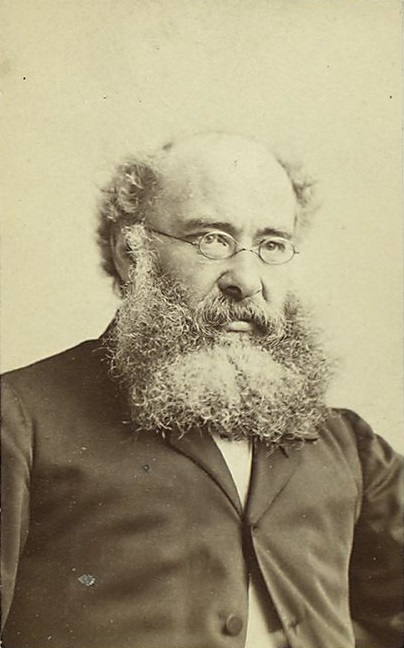
Anthony Trollope captured the dynamic in his 1875 novel The Way We Live Now. Living as an expatriate in England, the American widow Mrs. Hurtle grows up learning how to hold “her own among rough people after a very rough fashion,” once even shooting a man. By the novel’s end, she realizes that she and her English lover are “not fit to be mated.” Compared to that civilized—“over-civilized,” Trollope writes—Englishman, she is a “wild” animal, “fitter for the woods than for polished cities.” Parting ways was a wiser course than international marriage, which was becoming popular at the same time.
Simply being an American was enough for Mrs. Hurtle to terrify the English woman caught up in their love triangle. Tempted to write Mrs. Hurtle a letter, the English woman frets, “What if the American woman should put it [the letter] in a newspaper! She had heard that everything was put into newspapers in America.” And if she visited Mrs. Hurtle, wouldn’t “the American woman, as a matter of course, trample upon her with rough words?” There seemed no hope that English manners would subdue American wildness. The less civilized party would unavoidably get the last word.
All the novel’s Americans, palpitating with life, return to America in the end, bidding farewell to what Trollope calls that “effete and stone-cold country in which passion is no longer allowed to hold sway.” The only European to travel with them is the possibly Jewish character Marie Melmotte, with the finishing touches on her own Americanization completed aboard the ship. A rich but disgraced heiress, she hears that “in the United States, a married woman has greater power over her money than in England,” so she is willing to consider marrying her pushy American suitor. Suspicious, as most wild animals are, she agrees to the engagement, but warns her suitor not to try to pull a fast one.
Not all Americans are such swaggering pieces of living matter. Yet many European novelists visiting America during the nineteenth century spotted common traits among its people. The notion of the “ideal type,” from Weberian social science, was once a popular way to express a character trait’s prevalence in a population, but that method has fallen out of fashion. Relying on quantitative social science, the German national character, the Russian soul, and the American temperament elude our grasp.
But when so many observers notice the same thing, quantitative methods be damned. In North America, for example, Trollope comments on an attitude widely shared in Europe at that time. In terms of culture and education, Europeans believed, the best in America could not compare with the best in Europe. But the average American was higher. “It is always the same story,” Trollope writes. “With us there is no level of society. Men stand on a long staircase, but the crowd congregates near the bottom… In America men stand upon a common platform, but the platform is raised above the ground, though it does not approach in height the top of our staircase. If we take the average altitude in the two countries, we shall find that the American heads are the more elevated of the two.”
Trollope also noted Americans’ tendency toward violence. That Mrs. Hurtle shot someone may have shocked English society as portrayed in the novel, but it was not shocking that such an event happened in America. After all, Americans were always shooting at each other, Trollope observed. That is still the case today, even though a comparable number of Europeans apparently die each year from lack of air conditioning.
Charles Dickens even joked about the trend in Martin Chuzzlewit. When an American brags to a visiting Englishman how he recently “shot a man down in the state of Illinois,” the Englishman replies in a mocking tone, knowing that Americans equate gun ownership with freedom and independence: “Did you, indeed? Very free of you—and very independent!” Robert Louis Stevenson echoes a similar sentiment in The Amateur Emigrant (1895), a record of his journey to America. He wrote that as he approached New York by ship, he imagined he was about “to land on cannibal island.” He says he had been warned that upon arrival he “must speak to no one in the streets, as they would not leave you till you were rooked and beaten. You must enter a hotel with military precautions…if the worst befell, you would instantly and mysteriously disappear from the ranks of mankind.”
Most social scientists say the American character is no less an illusion than any other universal concept, such as “human nature” and “natural law.” For it is true that many Americans are not like wild animals, are not prone to violence, and do not carry guns. Yet a sliver of truth exists in most cultural stereotypes, which people aspiring to public life in America ignore at their peril. Ignoring such prejudices is a triumph of rationalism over common sense.
Both President Trump’s strategy in attacking Iran and the Iranian strategic response remind us of an enduring facet of the American character. Despite our national propensity for individual violence, Americans won’t accept casualties in a war that is not obviously a matter of national survival. The Russians can take casualties, the Chinese can take casualties, but the Americans cannot—not because Americans lack courage, but because in each American lurks the following stream of thought, more or less: The war may be for a good cause, but what about me? What about my life and my happiness? I don’t need this war in my life right now. This is why Trump is so reluctant to put boots on the ground in Iran—and why Iran can pursue its interests by seeming to invite invasion.
On a geopolitical level, it is also why in the future, an American president who believes the country needs to go to war must find a better way to make the threat seem imminent. Most American presidents in the past seemed to understand this; some have even “maneuvered” us into war. In the Mexican-American War, President Polk could credibly argue that the Mexicans shot first. In the Civil War, President Lincoln kept the garrison at Fort Sumter intact, almost inviting an attack from the rabidly secessionist South Carolina. In the Spanish-American War, President McKinley could cry, “Remember the [U.S.S.] Maine!” In the First World War, President Wilson worked the infamous Zimmermann Telegram. In the Second World War, President Roosevelt cut off oil exports to Japan, making an attack inevitable (although he was expecting it in the Philippines rather than Pearl Harbor.) President Johnson manufactured the Gulf of Tonkin attack. President Bush’s use of a chemical weapons threat in the Iraq War was weak, hence the inevitable pushback. President Trump had a far more credible threat in Iran’s nuclear weapons and ballistic missile program, and yet he did not make it seem credible enough to the American people.
On a more domestic level, it also explains why in the future, European royalty might do well to read one of the great novels before jumping into matrimony with an American.
This post is an installment of American Crazy, a series of posts devoted to literary depictions of American national character.
About The Author
