





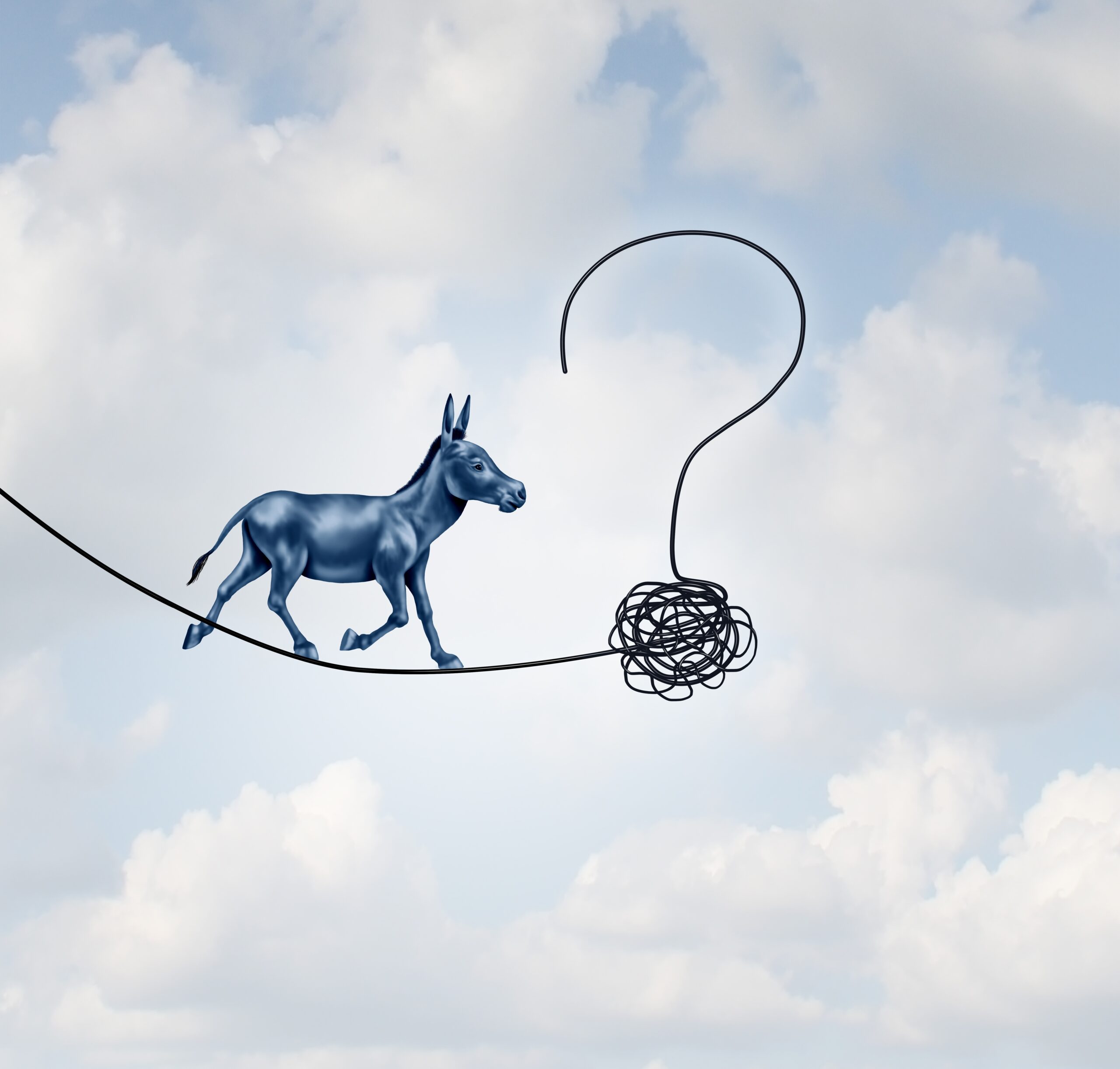


Do national Democratic leaders intend to outsource the job of winning this year’s pivotal midterm elections to none other than Donald Trump? It certainly seems like it.
The much-fêted “realignment” heralded in November 2024 has fallen apart amid the cruel mania of Trump 2.0. MAGA’s alleged popularity, especially among young men and Latino voters, proved evanescent. Given the thermostatic nature of modern electoral politics, it is plausible that being “Not Trump” will suffice for Democrats to retake the House of Representatives and gain ground in the Senate this November. National leaders like New York Senator Charles E. Schumer substitute the occasional squirm-inducing TikTok video for political strategy and coherent policy vision. Intraparty debate rages over what a more substantive approach should be. This debate has yet to yield productive conclusions.
Relying on the MAGA Right’s unpopularity postpones rather than resolves the crisis that has loomed over the Democratic Party since Trump’s first presidential campaign began in the febrile summer of 2015. Trump exposed the Democratic Party’s weakness and coalesced a roiling ferment of reactionary discontent into a new Right-populist movement. More than a decade later, national Democrats lack a clear response to this challenge.
Liberalism’s Present Crisis
It is possible to believe that no profound crisis afflicts the Democratic Party, or political liberalism more broadly. The center-left public intellectual and obstreperous internet personality Matthew Yglesias offers an incisive rundown of this view. “Donald Trump winning,” Yglesias’s argument goes, “caused the crisis of liberalism,” and was not “the consequence of some major substantive failure of liberalism.” Put more pithily: O’Malley would have won.
True, the 2016 presidential election could have easily had a different outcome; famously, Donald Trump did not expect (or want?) to win the White House. Americans would clearly look out at an unrecognizable political landscape today had a Democrat won that year. But I believe that in this alternate reality, liberalism would still be facing a structural crisis.
I am also skeptical of the belief – popular among “post-liberals” on the Right like Patrick Deneen and Ross Douthat – that liberalism is in crisis because it fails to offer Americans “meaning” or “purpose.” Right-wing media entrepreneur Andrew Breitbart once argued that “politics is downstream from culture.” Contra Breitbart, values, mood, and culture are downstream from economic conditions. For example: historian Christopher Lasch’s critiques of liberalism, The Culture of Narcissism (1979) (which secured him an audience at the Carter White House), The True and Only Heaven (1991), and The Revolt of the Elites (1995), have recently been rediscovered by communitarians on the Right and Left. But Lasch’s critiques were originally legible only in the context of the breakdown of America’s postwar economic order. Critics like Lasch had argued for years that the consumerist and technocratic politics of the postwar “liberal consensus” alienated Americans and undermined social values. Such a critique was powerless, however, as long as the “liberal consensus” sustained broad-based, regionally dispersed economic growth.
Gauzy criticism of liberalism’s cultural or spiritual decline distracts from its real, structural and political crisis.
Since the late 1960s, the Democratic Party has been unable to construct a durable national majority in federal elections. To win power, Democrats have relied on their opponents. The 1990-1991 recession – partly a hangover from the deregulation-induced Savings & Loan crisis – and its “jobless recovery” helped propel Bill Clinton into the White House. In macroeconomic terms, Clinton’s economic stewardship turned the rest of the 1990s into a “fabulous decade.” While it was unevenly felt by ordinary Americans, the United States’ recovery from the Great Recession under Barack Obama was swifter than that of its Western allies. In both cases, new Democratic administrations sorted out the economic mess left by Republican elites. Yet if liberal stewardship of the U.S. economy was so effective, one follow-up question is obvious: why did American voters not reward Democrats beyond a single two-to-four year election cycle?
The answer is that, in the last four decades, Democratic policymakers gradually adopted an ethos that economists rebarbatively characterize as “compensate the losers”: redistributing the proceeds of growth to less fortunate communities, rather than crafting ways to stimulate growth within such communities. If this strategy was good politics, Democrats would not find themselves scrounging for one- or two-percentage-point electoral margins, even against President Trump’s most unhinged epigones.
So, political liberalism is in crisis because Democrats fail to construct a strategy for broad-based, sustainable growth dispersed across different regions of the U.S. The frustrating irony of the past decade is that the Biden Administration made a stumbling effort to construct such a strategy with “Bidenomics.” This agenda was ambitious and complex. The Biden Administration sought to reshore high-tech manufacturing (e.g., semiconductor-chipmaking), upgrade U.S. infrastructure, and invest in a techno-economic transition to green energy. As historian Brent Cebul explains, much of this developmental investment was structured around “business incentives” like tax credits and public-private partnerships, which largely favored corporate champions like Intel. “Bidenomics” also involved significant investment in workforce development, garnished with welfare- or equity-flavored add-ons such as requiring subsidy recipients to offer training programs for historically “underrepresented and underserved communities.”
While perhaps more successful than its critics contend, “Bidenomics” ultimately unraveled under the pressure of malformed political communications, procedural bottlenecks, and self-inflicted errors in other policy arenas (notably, immigration and the Middle East).
The resolution of liberalism’s crisis will come only when a new growth agenda emerges. For now, the intraparty debate between the Left (social democratic or “populist”) and self-avowed “moderates” does not make substantive progress because these two broad factions insist on talking past one another. Identifying avenues towards resolution, however, requires a historical analysis of how political liberalism reached this impasse.
How Democrats Got Here
Both the U.S. economy and American liberalism have undergone profound changes since the 1970s. Those years were, as historian Philip Jenkins put it many years ago, a “decade of nightmares”: the turning of the Sixties dream, catastrophe in Vietnam, a loss of public trust in institutions occasioned by scandals from Watergate to CIA malfeasance. In the context of these political and social ills, the outlines of an economic transformation began to emerge from the mist of postwar affluence. Attenuated by C-Suite complacency and relatively low capital investment, U.S. industries like steel and automaking were revealed to be giants with feet of clay. Competitors arose from West Germany to Japan; ironically, these countries had benefitted from a flow of American investment, uncorked in the postwar years as a Cold War strategy to blunt the appeal of international Communism. The 1971 “Nixon Shock,” whatever its architects’ goals, set the stage for a new economic era. Ending the dollar’s nominal convertibility to gold, it enabled capital to flow more liquidly through international markets and began to encourage greater financial speculation. At decade’s end, the “Volcker Shock” slayed the dragon of inflation but dealt U.S. manufacturing employment an irrecoverable blow. Sociologist Greta Krippner contends that this policy’s interest-rate hikes, and the subsequent recession, disincentivized “productive” investment in fixed assets or industrial development and pushed more economic activity towards finance.
In sum, the “pivotal decade” of the Seventies birthed our globalized and financialized economic order.
Critically, American liberalism was simultaneously in the midst of its own transformation. This transformation shifted the Democratic Party’s center of gravity from the union hall to Whole Foods. That demographic re-composition did not mean that Democrats became the “party of the rich” per se; as Trump 2.0’s orgy of executive self-dealing illustrates, the GOP remains the party of plutocracy. Rather, highly-educated, socially liberal, metropolitan, “professional-class” Americans came to form the core of Democratic Party personnel and, over time, a critical part of its electoral base. This shift was gradual: in the case of white voters, it was only in 2020 that college-educated outnumbered non-college-educated whites in the Democratic electorate. Non-college-educated voters of color still make up a plurality of the Democratic electorate. Numbers alone aren’t the determinant of the Democrats’ transformation. “Professional-class” voters came to dominate the Democratic coalition in ways – policy preferences, party personnel, political messaging – that transcend the raw quantity of votes.
Democrats’ transformation was a product of postwar liberalism’s success. “Professional-class” liberals benefitted from the U.S.’s postwar expansion of higher education. Rather than industrial firms, the future Democratic leaders and voters in this cohort often gravitated towards knowledge-based professions like law, consulting, and academia. Coming of age in America’s “affluent society,” they embraced “quality of life” causes such as environmentalism and consumer rights since it seemed that, by the 1960s, economic growth had been achieved. The postwar liberal order had, in effect, nurtured a generation of liberals who were materially untethered from that very order.
Consequently, the view voiced on both Left and populist Right is typically that Democrats’ transformation (first among party leadership, then within its electorate) created a party uninterested in the economic wellbeing of working-class Americans. That perspective forms what I describe as the “liberal betrayal narrative.” This conventional wisdom is wrong. As I have previously written, the “New Liberals” (think Gary Hart, Jerry Brown, Michael Dukakis, pre-presidency Bill Clinton) became acutely aware in the late-1970s and 1980s that the stalling-out of America’s growth model constituted an existential crisis for liberalism. The “New Liberals” shared a formative interest in industrial policy. (To borrow political scientist Richard D. Bingham’s broad definition, industrial policy refers to “a nation’s official total effort to influence sectoral development;” market-crafting interventions more concerned with shaping production rather than with goosing consumption.)
New Liberals’ formative interest in industrial policy revealed their overriding goal to be the political construction of a new, broad-based, and technologically-upgraded growth model.
Of course, this project did not come to fruition. The “liberal betrayal narrative” tells us that reform-minded Democratic politicians like the Clintons, alongside party mandarins like Robert Rubin, engineered a baleful ideological reinvention: liberalism became “neoliberalism.” This political morality tale limns an incomplete picture of history. It obscures the chance, compromises, and lost opportunities of liberalism’s recent past.
In 1992, Democrats were restored to unified control of the federal government for the first time since the “Reagan Revolution” of 1980 (the second such restoration came in 2008). President Clinton’s first years in office coincided with the full unleashing of globalization, enabled by the Cold War’s end. Almost as significant was the onset of Japan’s “Lost Decades,” a period of economic stagnation that delegitimized East Asian industrial policy in the view of U.S. policymakers. (Japan’s stagnation was not actually caused by industrial policy.)
These factors, post-Cold War globalization and Japan’s stagnation, conjoined to discredit industrial policy. Under pressure from these conditions, the Clinton White House chose to back away from industrial policy-style investment, which – based on Democratic proposals from the time – could well have constituted a more coherent form of “Bidenomics,” implemented amid more salutary macroeconomic circumstances. Nelson Lichtenstein, coauthor of a critical history that nonetheless eschews the “liberal betrayal narrative’s” ideological determinism, points out that Robert Rubin’s finance-friendly budget cuts sat within a long tradition of Democratic presidents staffing the Treasury with Wall Street potentates. The differentiating and decisive factor in the 1990s was liberalism’s ongoing transformation: demographically rooted in the “professional class,” the new generation of Democratic leaders lacked a popular constituency for their own industrial policy agenda. To describe Democrats’ lost opportunity of the Nineties as an ideological revolution is misleading. In reality, at that stage, Democratic elites combined a policy commitment to reinventing postwar liberalism’s growth politics with a political base poised to benefit from the new globalized economic order.
This situation was untenable. Consequently, liberalism settled into an uneasy truce between political transformation and policy stasis. Democrats grew increasingly popular, in electoral terms, among the “winners” of the new economy. The Brookings Institution’s analysis of the watershed 2016 election, for example, suggested that Hillary Clinton won a commanding majority of “high-output” counties.
But there had been no ideological revolution. Democrats, who cling to a narrow majority of the lowest-income voters, retained a commitment to redistributive and meliorative social policies. Hence Democrats’ policy stasis: an ethos of “compensate the losers” that failed to rebuild American liberalism’s durable electoral majority.
Moderate liberals are correct to criticize anti-growth proclivities on the Left. However, not only can we not go back to the Clinton or Obama eras – liberals shouldn’t want to go back. The only Democratic majorities of that period came from Barack Obama, a politician of wholly unique and irreplicable talent. And these majorities swiftly collapsed.
What about economic growth and broad-based prosperity? The so-called “neoliberal” era since the 1980s has yielded spottier, more uneven growth than during the midcentury decades of the “liberal consensus.” One might colloquially identify neoliberalism with some sort of “growth at all costs” mentality. Reality is, eerily, the inverse: Democratic policymakers since the mid-Nineties haven’t paid enough attention to growth.
Where Democrats Could Go Next
The Democratic Party has historically been coalitional, an unstable blend of factions and constituencies that sometimes overlap around particular policies. 2026 is no different. The populist Left (think Alexandria Ocasio-Cortez, or Maine’s Graham Platner) is usually happy to break bread both with the tonier, metropolitan “fair capitalism” faction exemplified by Elizabeth Warren, and with industrial policy advocates clustered around the Roosevelt Institute (the nerve center of “Bidenomics”). All of these factions coexist uneasily with moderate, center-left groups like Third Way or Congress’s New Democrat Coalition. There are a handful of Democrats, the winnowed-down Blue Dogs in redder states and districts, who are genuinely more conservative. Institutions most representative of something like a Democratic “mainstream” (i.e., at the party’s ideological center), notably the Center for American Progress, tellingly lack a distinct intellectual identity. Meanwhile, the Democrats’ potent new suburban base of wine mom insurgents is far more open to expansive, progressive economic policy than upscale voters of the past, while remaining closely identified with cultural liberalism. Chicagoland congresswoman Lauren Underwood, a terrifically impressive yet publicly unsung legislator, is a good representative of this latter trend.
For now, Democrats’ internal debate is an obstacle to charting a path beyond November 2026’s expected anti-MAGA backlash. The debate is stalled in a “Left versus moderate” framework that clarifies nothing. A recent series in the Boston Review usefully distills this debate. The Left defines itself around progressive policies, like Medicare for All and universal childcare, that collectively constitute economic democracy. Some populist Left ideas – the Green New Deal – gestured towards developmentalism. But the Left’s agenda is fundamentally focused on more expansive redistribution. Today’s Left occasionally militates towards class-based critique of liberal “identity politics.” But most on the Left nonetheless resist calls to moderate on social and cultural issues, on the muddled basis that such calls are a Trojan horse to “betray” loyal constituencies.
In an odd mirroring of the Left’s agenda, many on the party’s moderate side contend that Democrats need to focus on redistribution – from moderates’ perspective, rejecting the Biden era’s frustrated experiments with industrial policy. President Obama’s former economic advisor Jason Furman, for example, intervened early on during the post-2024 debate to argue that Democrats ought merely to retouch their old “compensate the losers” model.
Other aspects of the debate find Democrats’ two broad dispensations talking past each other. On the one hand, it is self-evidently true that Democrats who win tough elections, such as Arizona’s Ruben Gallego or Washington’s Marie Gluesenkamp Perez, must take some “heterodox” policy positions that reflect their constituents’ (and their own) views. These Democrats invariably line up with their party on key, bread-and-butter economic votes. On the other hand, moderate influencers boosting these politicians are delusional if they believe that district-specific, issue-by-issue heterodoxy translates into coherent, long-term political and policy strategies.
The answer, in my view, is to seek unity around broad-based economic growth. Some self-avowed moderates are abstractly comfortable with this notion. But, as with Furman’s intervention, it is not clear whether they care about where, in geographic and sectoral terms, and how growth ought to occur. Many moderates’ vision of growth seems to consist of a noun, a verb, and AI.
A politically serious Democratic growth model has to focus, I believe, on production and jobs. This does not mean trying to reconjure the postwar economy in all its particulars – the genie of industrial transition is out of its bottle.
Nevertheless, Democrats can pursue an economic future characterized by high-technology manufacturing and the deployment, rather than only the development, of scientific, technological, and industrial innovations. One glimpses the contours of this mission emerging via the “abundance agenda.”
Skeptics argue that abundance means deregulation tout court. Unsheathing trusty rhetorical weapons, abundance’s most intemperate critics say it’s a “rebrand” of neoliberalism. A new liberal growth politics can’t afford to let this caricature become reality. Targeted deregulation can help build desperately needed housing and infrastructure. Crucially, however, removing procedural sediment should not only help the private sector build, but must also help government deliver big, ambitious projects.
Moreover, procedural deregulation can, in my view, be genuinely targeted. For example, should it be easier to build a manufacturing facility for pharmaceuticals developed in one of America’s research hubs than it is to build an AI data center? Quite possibly; at the very least, this is a conversation policymakers must have. Should it be possible to slow the rollout of some machine-learning tools in order to manage disruption to jobs? Again, this is, at minimum, a discussion about market-crafting that Democrats must have. (And let’s face facts: Americans are getting wary of AI, especially given its current incarnation as a plaything of socially-maladjusted Silicon Valley billionaires.)
Furthermore, it is imperative for a new liberal growth agenda to devote attention to regional development. Critical strengths of liberalism’s postwar political economy were, first, the regional dispersal of economic development and, second, the state-sponsored cultivation of regional research hubs that became global leaders, from Massachusetts’s Route 128 to California’s Silicon Valley to North Carolina’s Research Triangle. Regional development meant liberal policymakers could bind local elites into the postwar political economy, deliver material gains for a wider swathe of workers, and establish resilient Democratic political machines that outlasted the ebb-and-flow of presidential politics until the crackup of the Seventies.
Focusing on growth’s regional dimensions is not a novel insight. Early New Liberal policy thinkers, like Robert Reich and Ira Magaziner, advocated regional development banks and pushed for state-level developmental regimes. More recently, the Biden Administration endeavored to craft place-based industrial policy, often targeting purple or red states and districts that, the White House theorized, could be turned blue. This plan was stymied by implementational bottlenecks of the sort the abundance agenda is designed to unplug.
These stumbling efforts illustrate that despite recognizing regional development’s political utility, Democrats have not successfully centered it in their economic policy since the postwar settlement fragmented in the Seventies. A new growth agenda must build on procedural deregulation to target and develop a range of regions of the U.S. It must not focus exclusively on coastal urban hubs like San Francisco, Boston, or New York, as critics of abundance reasonably argue that its advocates currently tend to do. Any regional development scheme should also, of course, seek to identify rural growth zones. Of course, the GOP routinely immiserates its own rural base. But it’s not enough for Democrats to point that out. They need to have a genuine rural growth agenda. In fact, rural development furnishes us with a powerful case study from liberalism’s midcentury apogee: rural electrification. Electrification was highly visible. And due to its rollout via local, consumer-owned rural electric cooperatives, it perfected the art of binding constituents into liberalism’s political economy. Fast, regional growth: this is hardly an easy agenda to execute. Many in the Democratic coalition clearly blanch at the notion of procedural deregulation. The key to unifying Democrats around this approach will be framing it as a way to achieve big public goals. Democrats only win when they deliver sustainable, broad-based growth. History suggests that there may not be another option if Democrats want to reach further than the next one or two election cycles – and want to have more to offer voters than being “Not Trump.”
About The Author
