





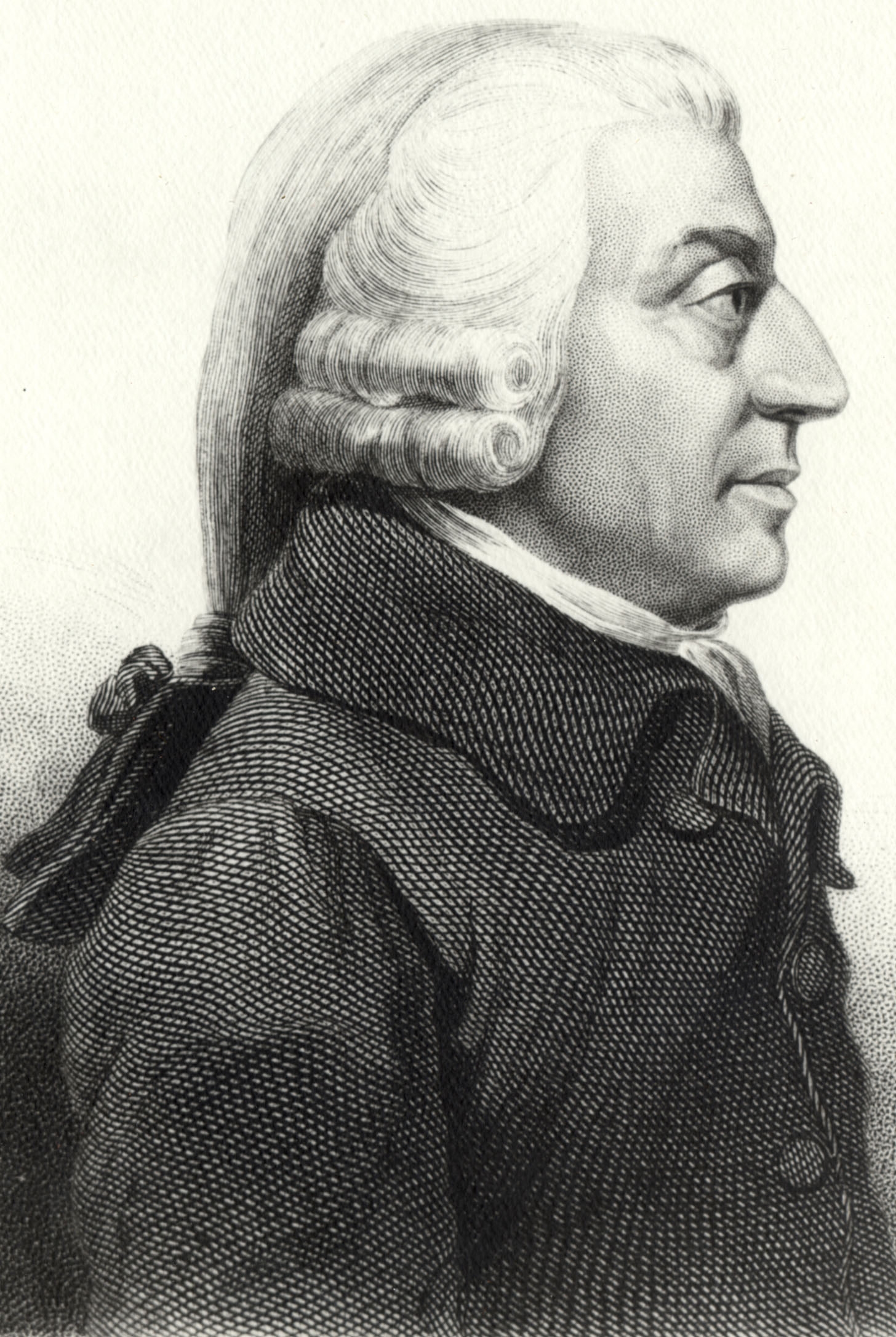


This year is the 250th anniversary of two remarkable events: the birth of the United States of America and the publication of Adam Smith’s The Wealth of Nations. Today, Smith is mostly remembered as the founder of economics as a separate discipline. Most of those who attempt to read Smith focus on Book I of his famous book. There they encounter the pin factory, the division of labor, the butcher and the brewer pursuing their own interests—other illustrations of how the market process brings individual plans into coordination without any central design. This is the reasoning we often evoke with Smith’s celebrated metaphor, the invisible hand.
It is also natural to read these arguments through a normative lens. Smith is an advocate of free markets and a critic of mercantilism and planning. For centuries, many economists naturally saw Smith as primarily offering a justification for pursuing the conditions under which free markets lead to prosperity and order. As Frank Hahn, one of the pioneers of general equilibrium theory, put it:
That a society of greedy and self-seeking people constrained only by the criminal law and the law of property and contract should be capable of an orderly and coherent disposition of its economic resources is very surprising. Marx called such a society anarchic and so it is. Yet ever since Adam Smith economists have been concerned to show that such anarchy is consistent with order and indeed with certain desirable outcomes.
More recently, though, scholars have emphasized that Smith was more than just a normative economist. For several of the last decades, Smith has been reclaimed and reassessed as a moral philosopher and author of the Theory of Moral Sentiments, as well as The Wealth of Nations. More recently, there has been growing appreciation of Smith as a practitioner of what we would now call historical political economy (HPE)—the use of theory and evidence to explain why political and economic institutions take the forms they do. In addition to economics and moral philosophy, Smith was doing HPE more than two hundred years before the field acquired a name.
You can see this side of Smith clearly in the less widely read parts of the Wealth of Nations, such as Book III, on the rise of European towns, and Book V, on the duties of the sovereign.
Book III is a piece of conjectural history of the kind the Scottish Enlightenment made famous. Smith begins in the wreckage of the Roman Empire. He is not very specific about dates, but he portrays a world of endemic violence in which the great lords oppressed everyone weaker than themselves and the king was too feeble to stop them. Towns were small islands of commerce in a feudal sea. The puzzle Smith set himself was how this disordered world gave way to the ordered, commercial, increasingly centralized states of his own day.
Smith’s answer is a story about a three-way relationship between kings, lords, and towns. The towns and the lords were natural enemies: lordly predation was precisely what kept merchants from capturing the gains of long-distance trade. The king feared the lords too. Lacking a centralized state, their independent military power threatened his rule.
So king and towns struck a bargain. The towns supplied the king with taxes, loans, and urban militias. In exchange, the king granted them charters, self-government, and protection from baronial predation. The alliance brought a measure of peace, and peace was the precondition for prosperity. This wasn’t just an example of the invisible hand in the economic sense. It reflected a coalition of actors pursuing their own political interests.
A recent paper of mine in Public Choice restates Smith’s analysis in the language of game theory. I then turn to the actual history and find considerable support for Smith’s conjectural history. The story of the rise of the French monarchy in the 11th to 13th centuries fits his analysis perfectly. Smith wasn’t a historian in the modern, academic sense. But his historical instincts were impressive.
As the simple model of development that I described indicates, however, other political equilibria are possible. In some cases, the towns might ally with the lords and against the king. In other cases, the king and the lords might join together against the towns.
These different alliances bring about different trajectories of state development. For example, where the king allies with the lords against the towns, commerce and trade can never fully develop. This poverty trap helps explain why Eastern Europe diverged so sharply from the West. Small differences in initial conditions produced dramatically different destinations.
Smith’s account is not a story of one-way, inevitable progress. The king-town alliance, he saw, was self-undermining. As commerce grew, the great lords frittered away their military power on luxuries. They exchanged the power to feed a thousand retainers for jeweled trinkets—Smith’s famous “diamond buckles”—and ceased to be a threat to monarchical power. When that happened, the king no longer needed the towns and had few incentives to protect their interests.
The very success of the developmental bargain, then, dissolved the conditions that made it necessary. On ran the road toward royal absolutism. This is what happened in early modern France, reversing medieval gains and setting the stage for the Revolution that broke out a little more than a decade after Smith published The Wealth of Nations.
We can celebrate Smith for his prescience, but it brings him greater honor to apply his insights to new inquiries. Writing the paper on medieval towns and Europe’s economic development revealed to me how Smith the historical political economist can still be used as a foil and inspiration for an empirical research agenda today.
One example is a recently published paper by Glory Liu and Barry Weingast in History of Political Economy, which demonstrates the relevance of Smith as a theorist of state capacity. State capacity is not a term either Smith or his contemporaries used. But in the last 15 years it has increasingly become the focus of scholarship in political science and political economy. The question is less what the ideal state should do than what actual states can do—why do so many of them fail at even basic tasks?
The case Liu and Weingast make is that Book V of The Wealth of Nations, often read as a collection of independent policy recommendations, contains an implicit theory of state capacity.
In the 18th century, political theorists, including Smith’s Scottish contemporary Adam Ferguson, were inspired by the republican models of antiquity. They believed standing armies were corrupting and favored a return to some kind of civilian militia. This general argument was popular among Americans in the struggle for independence.
Smith, however, provides a historical account of how standing armies emerged. In poor or “rude” societies, Smith observes, every man is a warrior and an army costs the sovereign nothing. But as the division of labor advances, the opportunity cost of pulling a weaver or a smith out of his trade becomes ruinous. Soldiering thus becomes a specialized profession, and the state is forced to fund a standing army out of taxation.
At the same time, a more commercially developed economy becomes the target of raiders. It can no longer rely on ad hoc forces for defending the wealth produced by the division of labor and expansion of the market. A standing army, then, is an equilibrium outcome of Europe’s political and economic development. As such, Smith recognized that it wasn’t going away any time soon (despite his criticism of the mercantilistic means by which it was supported).
Other areas of state development can be subjected to a similar treatment, inspired by Smith but more historically grounded and theoretically rigorous than his own discussions. Smith’s treatment of taxation, for example, Liu and Weingast argue, is often read in terms of normative ideals. But Smith is actually more interested in the “persistent challenges and trade-offs that modern states face in designing effective systems of taxation”.
All of this points to a broader lesson about reading Smith today. Even 250 years after its publication, the Wealth of Nations remains a source for ongoing work in political economy. Indeed, one can read Smith as the ancestor not just of economics or free market thinking, but also of the recognition of the importance of the central problem of politics (one that remains unsolved to this day): how to build a state strong enough to tame arbitrary power yet constrained enough not to reproduce domination in new forms.
The pedagogical role of the Great Books is currently the subject of much debate. What I think this discussion demonstrates is that texts like The Wealth of Nations remain a source of inspiration for ongoing empirical scholarship. Treating them as holy writ is likely to be a recipe for sterility, but it is possible to integrate them into an active research agenda. Indeed, in a world of agentic AI and increasingly homogenous methods, these Great Books may serve as rare sources of original insight and continuity with the origins of the discipline of economics.
About The Author
