





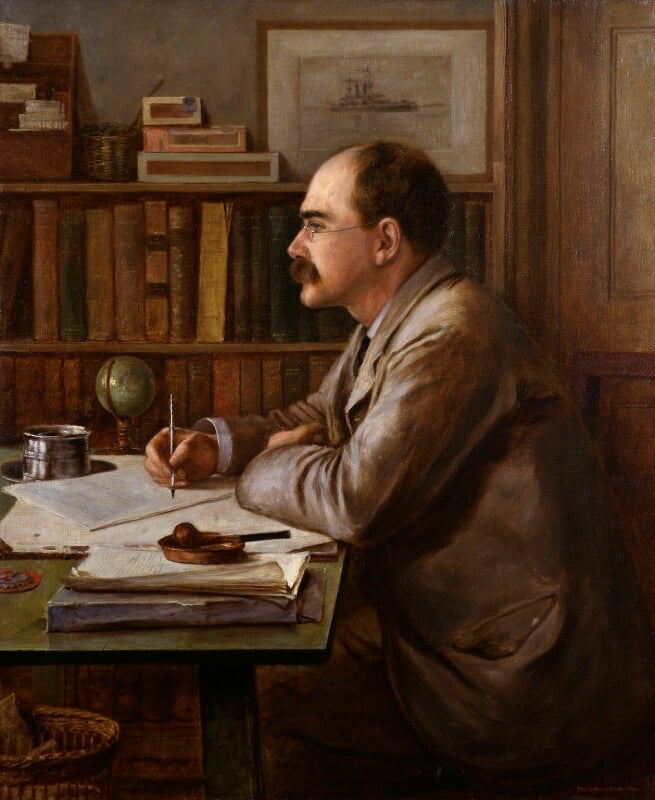


Many visiting European novelists wrote disparaging things about America. Georges Duhamel (1884-1966), author of America, the Menace, was probably the meanest of the French writers. The harshest among the English novelists—and arguably the harshest of them all—was Duhamel’s contemporary Rudyard Kipling, who lived in Vermont from 1892 to 1896, then traveled through America in 1899.
This surprised me. Most of Kipling’s works offer a heroic conception of life, one that is neither exclusively British nor exclusively imperial. Whatever milieu he describes, he discerns a hierarchy, at the top of which lie heroes who fight against idleness and fear to bring order. What could be more heroic than the American pioneers who braved the elements to build, even by Kipling’s time, the richest country in the world?
Then again, Kipling’s heroes also wage an internal struggle against ambition, desire, and envy, or at least conceal these passions under a cloak of silence. In contrast, American heroes who trekked west to pan for gold or build ranches in the wild did so with the overt goal of making money.
A nineteenth-century American farmer, for example, was a man of action who imposed ceaseless toil on himself—squarely within the Kipling mold. Strong and cautious, he fought weather and the elements, and accepted the strokes of fate as bravely as any hero in Greek tragedy. But let’s not kid ourselves. Unlike Hobden, the farmer in Kipling’s poem The Land, whose family owned and tilled the same soil, passed from father to son, for over a thousand years, the American farmer had little romantic attachment to the land, nor did he farm for the honor of farming. He was, as the writer Edward Steiner described him, a merchandizer in dirt, someone who would sell “not only the products of the soil, but unhesitatingly the soil itself.”
This is one source of Kipling’s ire. His sensibility was aristocratic and above petty profit-making, while the American sensibility is democratic and business-minded. But whatever their origin, Kipling’s insults toward America never stop. In American Notes, published in 1891, he drones on about the bad manners of the Americans. He was particularly incensed by their habit of spitting, also noted by Frances Trollope (mother of novelist Anthony Trollope) sixty years earlier in her own nasty little book, Domestic Manners of the Americans.
But unlike Frances Trollope, Kipling makes explicit the connection between America’s awful traits and the country’s obsession with freedom. If you dislike that obsession with freedom, you will read his American Notes with a feeling of salacious vindication. If you love it, however, you will chuckle at American craziness and vulgarity, and feel warmth toward the country, the way an uncle might feel toward a spunky, go-getting young nephew.
Kipling’s heroes are strong, silent ascetics. They are men of action, not men of talk. American heroes are also men (and women) of action—but, boy, do they talk. Just go into a bar and an American will start talking to you, Kipling complained. “He [the American] would begin almost every sentence with, ‘Now tell me something about India,’ and would turn aimlessly from one question to the other without the least continuity.” The usual dig about Americans being like a bunch of children is also there: “It was exactly like talking to a child—a very rude little child,” Kipling wrote.
American men talk too much, said Kipling, “but the girls of America are above and beyond them all. They are clever, they can talk—yea, it is said that they can think,” suggesting that what they said was not enough on its own to show evidence of thought. About the American girl, Kipling complains, “She is—I say it with all reluctance—irreverent, from her forty-dollar bonnet to the buckles in her eighteen-dollar shoes. She talks flippantly to her parents and men old enough to be her grandfather.” Kipling venerated women while believing they should be confined to a separate sphere, and strongly opposed women’s political agency, including their suffrage. For him, the fierce independence of American women was a nightmare.
American chatterboxes, both male and female, are just one more awful consequence of that country’s obsession with freedom, he suggests. Kipling himself was not hostile to the idea of freedom. But he did fear freedom that crosses over into irreverence and lawlessness. To avoid that state of affairs, a free people must be magnificently self-controlled, he argued. Above all, they must conquer themselves because, deep within, the dangerous brute lives on.
That is not the American way, which is why, to Kipling’s mind, lawlessness was everywhere in the U.S. He writes, “The bond between the States is of an amazing tenuity. So long as they do not absolutely march into the District of Columbia, sit on the Washington statues, and invent a flag of their own, they can legislate, lynch, divorce, railroad, and rampage as much as ever they choose. They do not need knowledge of their own military strength to back their genial lawlessness.” In contrast, Kipling’s image of the British Empire was one of a kind of hive—with strong, silent, disciplined people revering the monarchy lying at the center of the English world. The hive prospers so long as the bees work, obey the law, and feed the queen. The strong sense of Empire that tied Calcutta to Quebec, Newfoundland to New Zealand—what an English boarding school of the era might have called “team spirit”—depended on people’s respect for the law and on their obedience to the chief dwelling in London.
Little has changed in America since Kipling’s time. Indeed, during his time in office, what has aroused President Trump’s ire the most about the D.C. protests? Answer: whenever activists deface the Washington statues, and whenever they dare fly a flag other than the American one. Yet even Trump found that he could do little to prevent these practices, offensive as they may be. Vandalism and trespassing are crimes, but disloyalty and vulgarity are not.
Yet despite all their talkativeness and vulgarity, the Americans were a success, Kipling grudgingly admitted. This fact seemed to surprise him. “Fine feathers ought to make fine birds. There was wealth—unlimited wealth—in the [American] streets, but not an accent that would not have been dear at fifty cents.” In contrast, in the British experience, or at least in Kipling’s interpretation of it, wealth went with asceticism rather than with constant arguing and yapping.
Kipling and America simply had different conceptions of freedom. To his mind, those who cannot provide themselves with a leader of their own will find themselves subject to the lead of others. Freedom consists of ruling and being ruled, and those who refuse to be ruled forfeit the right of self-rule, he argued. Indeed, the very idea of the vote seemed to bother Kipling. He had little respect for voters in the mass. In his story The Village That Voted the Earth was Flat, Kipling describes how an irresponsible people, when given the vote, can be tricked into passing the most ridiculous legislation. For him, freedom comes from being ruled by the law, and that law, in his eyes, is the natural outcome of age-old wisdom that only a few people possess.
The American conception of freedom is vastly different. It suggests that people do not need a leader other than to make sure that a few basic laws are obeyed, with those laws springing not from the leader him or herself, but from the talky-talk of the democratic assembly and the votes of the crowd. Order in America comes from each person pursuing his or her dream of individual happiness, while respecting the few guardrails voted into place while doing so. Americans enjoy self-rule precisely because they refuse to be ruled.
And the system works. Tocqueville once expressed amazement that an American city could be so orderly without police presence on every street corner. Where is the hand that moves the machine, he wondered? Why do Americans behave lawfully with no one around to force them to behave? Because Americans enjoyed self-rule, he concluded. Were it not for the drug addicts and mentally impaired in today’s American cities who, by definition, cannot rule themselves, and who are responsible for much of the crime and homelessness in these cities, much of what Tocqueville observed might still be true.
For Kipling, the Law of the Jungle demanded a great leader, the hero, to maintain order. For Americans, that Law demands the opposite. It demands talkative, vulgar, profit-seeking individuals with just enough self-discipline to behave but not so much to stifle. That, more than any military review in India, is a thing of beauty.
This post is an installment of American Crazy, a series of posts devoted to literary depictions of American national character.
About The Author
