





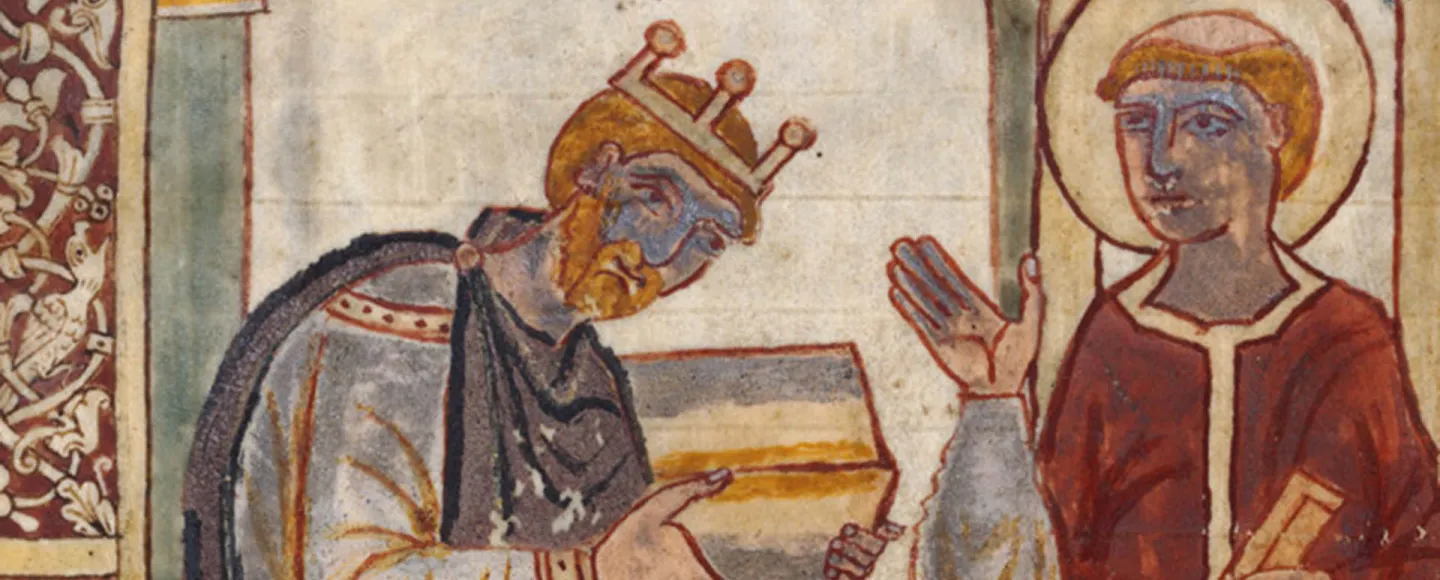


The 4th of September 2025 was the 1,100th anniversary of King Æthelstan’s coronation. At the coronation, the Anglo-Saxon monarch promised to rule with justice and mercy and also stated that he was not above the law.
A couple of years later, in 927, Æthelstan proceeded to conquer the remaining parts of the Viking kingdom in the North of England. This conquest thereby created a unified nation, known as the “kingdom of the English”. Æthelstan thus became the first King of England. In 2027, then, were could reasonably celebrate the 1,100th birthday of England. As such, it seems to be a rather good time to reflect upon the state of England today.
The English are not the only ones who might be interested in such a reflection. The President of the United States, Donald Trump, is seen as an Anglophile. He has said that he loves the United Kingdom and that “[i]t’s a very special place.” In his unprecedented second State Visit to the United Kingdom in September, Trump stayed at Windsor Castle and visited the grace-and-favor country home of the British Prime Minister, Chequers. Just a month before the State Visit, the Vice-President, JD Vance, had a summer break in Britain, too. Staying in the beautiful Cotswolds, and other places, and he did a bit of fishing at the Foreign Secretary’s official residence, Chevening House.
Despite such expressions of Anglophilia, England or the United Kingdom has become a cautionary example for some on the American right. President Trump was highly critical of Britain in his address to the United Nations General Assembly last month. In May, the late Charlie Kirk also visited England and described his stay for The Spectator. He captured Americans’ mounting skepticism well when he wrote:
“When I was growing up, people often said British politics were where America’s would be in five, ten or 20 years. What this meant was that Britain was more to the left of America: more secular, more socially liberal, more environmentalist, more globalised. The assumption was that, over time, the left would always win out, so wherever Britain was now, America would soon be.”
For his part, JD Vance has said he did not want Britain to go down a “very dark path” of losing free speech. Steve Forbes condemned Britain for the “plunge into the kind of speech censorship usually associated with tin-pot Third World dictatorships.” Forbes added: “The UK has, with increasing vigour, been curbing what one is allowed to say, all in the name of fighting racism, sexism, Islamophobia, transgenderism, climate-change denial and whatever else the woke extremists conjure up.”
Some Americans, such as Elon Musk and Steve Bannon, have moved beyond pessimism. Bannon has said that “England is heading to a civil war as we speak”. Musk has said that “Violence is coming” and that the British people “either fight back or die.” Related sentiments have become common on social media.
Let’s just get one thing straight: The Labour Prime Minister, Sir Keir Starmer, is deeply unpopular. In fact, he is the most unpopular Prime Minister since records began. Rachel Reeves, Chancellor of the Exchequer, is the most unpopular Chancellor as well. The latest polling by YouGov shows that 70% of the British public disapprove of the Starmer administration’s record and only 12% approve. According to Ipsos’ polling, 67% of British people think the country is going in the ‘wrong direction’ and only 15% believe that it is heading in the right direction. According to this polling, the last time that a majority thought the country was heading in the right direction was back in 2021, when Boris Johnson was still Prime Minister.
Let’s jump back to Kirk again. He explained that when he travelled to Britain, the reason was “in large part because that old assumption”—that Britain is on an ever-leftward slope, and America will follow is—“dead and gone”. According to Kirk, “Donald Trump’s political revolution has destroyed it”, the former understanding of the relationship between the two countries. “Now,” Kirk added, “Britain is the country trailing behind America. Make no mistake: Trump’s revolution is coming to the UK.”
There are definitely people who wish to believe this is the case. In electoral terms, this has to wait, as the extremely unpopular Labour Party still has until August 2029 before it is required to contest the next general election; during this time, Labour could restore its fortunes. In the past, analysts made the mistake of assuming that wherever Britain goes, America will follow. Today’s Anglo-skeptic conservatives risk making the opposite error.
Two Nations in England?
Is the pessimism about Britain by some on the American right justified? The short answer is: up to a point (as Evelyn Waugh famously put it). Pessimism can be a kind of prudence. The late Sir Roger Scruton argued that there is a place for pessimism “in restoring balance and wisdom to the conduct of human affairs”. Yet it should also be noted that many of the problems in England are not new. Indeed, many of the criticisms by the American right have a kernel of truth, but they are often extremely exaggerated. In 1897, the young Winston Churchill wrote an essay, unpublished for years, called “The Scaffolding of Rhetoric”. The future prime minister argued that one of the scaffolds that provides “rhetorical power” is a “tendency to wild extravagance of language”, and some of the language used about England’s plight is useful because of its rhetorical power.
All is not lost; there is still patrimony to conserve and restore in England, and England’s American friends are right to encourage that effort. Yet some of the doom and gloom is exaggerated. Churchill noted in his essay that such rhetoric can be “so wild that reason recoils.” Reason recoils at the suggestion that England is heading towards a civil war—so much so that I almost spilt my tea into my saucer. To recognize solutions that might work in England, we need a clear understanding of the problems. The situation is serious, but not quite so dire as the most extravagant critics claim.
England and The Multicultural Nation Within England
Benjamin Disraeli, in his most famous novel, Sybil, utilized one of his characters to tell the male protagonist that England is not one nation but two. Indeed, it is claimed that between these two nations, “there is no intercourse and no sympathy”, and they are “ignorant of each other’s habits, thoughts, and feelings, as if they were dwellers in different zones,” they may be “inhabitants of different planets”.
Disraeli’s two-nation framework still explains England, but a few changes are required. Writing in the early 1950s, Russell Kirk agreed with Disraeli that England is two nations, “but the two nations are distinguished today not by an economic demarcation, but by a radically different kind of conscience”. This is quite right. We can still see these two morally distinct nations of England today in the debate about the assisted suicide bill that has been making its way through Parliament. But Dr. Kirk’s demarcation needs to be broadened. There are parts of England today that are “not governed by the same laws”, that have different “habits, thoughts, and feelings” that have different cultures, religions, languages, and are fed by “different food, and are ordered by different manners”. It is tempting to say the two nations in England are the urban areas vs. non-urban areas. But this is far too simplistic. Even the same city can contain zones belonging to each nation.
Perhaps the two nations could be London vs. non-London. But again, this will not do, because we see both these two nations in other English cities, such as Birmingham.
Rather than rich and poor, urban and rural, or London and non-London, the two nations are best understood as England and an Anglophobic multicultural nation that is situated within England. The former is more law aiding, more culturally homogeneous, and English patrimony is passed down from one generation to the next. In the latter, individuals are expected to sacrifice their national identity for the multicultural project. Online, it has been designated “yookay”, adapting a term that emerged on the Marxist left.
The emergence of the second nation has several causes, but the most important is immigration. The Migration Observatory states that “the UK’s foreign-born population increased rapidly between 2004 and 2021.” And since 2021, immigration to the United Kingdom has skyrocketed. From 2021 to 2023, migration added roughly “2.2 million people to the UK population,” according to a House of Commons Library Research Briefing. This huge increase in immigration to Britain, which has been dubbed the “Boriswave” because it was enabled by the policies of Boris Johnson, who served as prime minister from 2019 to 2022. In 2024 and 2025, the numbers have fallen, but they are still historically high.
What is the context of this immigration? The OECD estimates indicate that Britain’s foreign-born population is around 15%, about the same level as the United States, and lower than in other English-speaking countries, such as Australia (31%), New Zealand (27%) and Canada (22%). The same figure indicates that Britain’s foreign-born population is lower than other European countries, such as Germany (18%), Sweden (20%) and Switzerland (31%). However, the OECD estimate is likely to be on the low side. The Office for National Statistics (ONS) estimated in June 2023 that there are 11.4 million non-UK-born residents in England and Wales, which amounts to 18% of the estimated population of 66.9 million.
More important than the aggregate number, though, is the fact that immigrants are not equally distributed throughout the country. According to the Office for National Statistics, in parts of Cornwall, there are areas where the foreign-born population accounts for just over 2%. In some areas of London, by contrast, around 90% of the population is foreign-born. Similarly, there are parts of Leicester where over 80% of the population is foreign-born. Nevertheless, in the countryside around Whitfield, Northumberland, the foreign-born figure is below one percent of the total.
Even these numbers just tell part of the story, though. They are quantitative measures, and the challenge to England is qualitative. This can be seen in Bradford, where the main university student population is over 80% non-white. This means that a whole group of students are outside English cultural norms and practices, but still with the yookay. It is tricky to see how English culture is transmitted through shared experiences, community stories and intentional preservation of traditions in such an institution. English culture is at stake as well as community cohesion and identity. Let me be clear, it’s about culture rather than race or ethnicity. England is not only receiving record-breaking numbers of immigrants and concentrating them in certain locations. It is also failing to integrate them into English society. These communities are living in the yookay but not in England. For example, there are communities in cities such as Leicester whose lives are punctuated by different festivals, norms and mores, and cultural activities. This was plain to see when Ramadan and St Patrick’s Day overlapped, as Ramadan was celebrated and people who marked St Patrick’s Day sought venues outside the city center.
Immigration and a Lack of Common Culture
As Kenneth Minogue defined it, multiculturalism is the “belief that all cultures are equal in value.” This seems like a tolerant and welcoming sentiment. When applied to mass immigration, however, it implies that the host nation has no right to preserve itself, while newcomers are entitled to the protection of whatever beliefs or practices they bring with them. A generation ago, Minogue could say that “virtually everybody in Britain believes, and rightly, that whatever the shallowness and injustices of European life, it is superior to that of most other cultures. This powerful conviction results not merely from the fact that it happens to be the way of life with which we are familiar. It also arises because we regard our apparatus of rights and the rule of law as better than the Islamic Sharia, for example.”
In the Anglophobic multicultural nation, however, it is not axiomatic that they would agree. It is also not axiomatic that our neighbors’ children and grandchildren living in yookay will be culturally English, and “familiar” with this “way of life” and that they will think that “rule of law” is “better than the Islamic Sharia”. We can see elements of this in England’s infamous scandal of Pakistani-Muslim men raping white, mainly underage, working-class girls. A core aspect was the concept of Islamic supremacy and the belief that these girls were at the bottom of the so-called ‘honor’ pyramid. These Pakistani-origin men do not subscribe to the apparatus of rights and do not believe that the rule of law should be abided by, let alone that English laws are better than Islamic Sharia law.
Cicero told us in De Legibus that “the good of the people is the chief law.” Multiculturalism has not been for the good of the people in either nation of England. This type of immigration has had a corrosive effect on English cultural identity, its national identity, its national pride, and it has actively undermined its national heritage, its continuity and traditions. This type of immigration is linked to multiculturalism and has worn away trust within the community, and hacked at the roots of political stability and public order. But the current policy hasn’t been good for immigrants either, because they have entered a situation that is characterized by increasing crime, hostility, and communal antagonism, such as Hindu-Muslim conflicts in Leicester.
Rather than going to the core of the problem, defenders of multiculturalism have sought increased government intervention and more bureaucracy to surmount the communal antagonism. The alternative to common culture is not the live-and-let-live pluralism that multiculturalists once imagined but ever more intrusive policing of relations between hostile communities. This can especially be seen concerning free speech, one of the areas where American criticism has rightly been focused.
Not Free to Speak?
Let’s get to the point: Britain does have a free speech problem. Indeed, freedom of speech and even free opinion are both threatened. It is a threat of state encroachment and statute law, but also and perhaps more concerning, the perverse way that England’s new multiculturalism interacts with radical Islam. This new multiculturalism does not treat all cultures equally but elevates and protects ‘approved’ minority practices and religions, and radical Islamists are using this new multiculturalism to effectively reintroduce blasphemy in England (abolished in 2008) concerning Islam.
Lord Ashcroft polls show that 48% of voters say, “they normally feel able to express their true opinions on controversial issues,” in contrast with 42% who said, “they often stopped themselves from doing so.” People on the right of center in British politics are more likely to self-censor because of the fear of being judged or receiving negative responses, or indeed losing their jobs.
The famous cases of legal suppression include Lucy Connolly, who posted on X, advocating “Mass deportation now”, and setting fire to the hotels where the migrants were, and she concluded, “If that makes me racist, so be it.” This was posted following the murder of three young girls by Axel Rudakubana at a dance class at Hart Space studio, in the Northwest of England. Connolly “admitted inciting racial hatred” and was sentenced to 31 months’ imprisonment, and she served 40% of this sentence before she was released. Another is the arrest of Irish comedy writer Graham Linehan at Heathrow Airport on suspicion of inciting violence concerning three of his posts on X, which were critical of trans ideology. Here is one of those posts: “If a trans-identified male is in a female-only space, he is committing a violent, abusive act. Make a scene, call the cops and if all else fails, punch him in the balls.”
After Linehan’s arrest, the author JK Rowling claimed that Britain was now a “totalitarian” state. At the US congressional committee on limitations on freedom of speech in Britain, Nigel Farage, the Leader of Reform UK, said, “At what point did we become North Korea?” and, remarking on the state of free speech in Britain, he said it is an “awful authoritarian situation we have sunk into.” Yet Farage’s party has had its own controversies around free speech and its interactions with the press. The Independent newspaper reports that the “leader of a Reform UK council effectively barred a local newspaper and website from interacting with the authority,” and that the party had been making threats to journalists.
Free speech, as Churchill remarked that can bring with it “the evil of all foolish, unpleasant and venomous things that are said,” but he still wished to keep it. The cry today is that it is necessary to curb free speech to keep people safe from harm, especially ‘minorities’. The desire to avoid causing offense has been used as an excuse for the cover-up of the Grooming gang scandals, as not to “inflame racial tensions”. Similar restrictions are now being applied directly to citizens. We now see a thing called hate speech or Non-Crime Hate Incidents, which “is an act that is motivated by prejudice or hostility towards a person’s identity but does not amount to a criminal offence.”
The police have a difficult job of judging what is truly evil, merely foolish, or a bit unpleasant. The Commissioner of the Metropolitan Police, Sir Mark Rowley, remarked that “It’s a nonsense to pretend that with all of the [online] content out there that enforcement is the answer.” Indeed, Britain needs more free speech, not more legal enforcement. But do my countrymen agree with me? In recent polling by YouGov, 61 per cent of British people wish to be “safe from abuse and threats” online, and only 28 per cent think people should be “able to speak their minds freely” online. Moreover, Britons were asked if they agree or disagree with the statement that: “There should be no limits on free speech, even if this enables people to voice offensive views.” There were mixed results with 28% “mildly agree” and 27% “mildly disagree”, with 26% neither agreeing nor disagreeing. J.S. Mill had written about these restrictive attitudes, which were also present in the British culture during the Victorian Era, and therefore, it does not represent a change in British attitudes per se, but a continuation of them. Yet, there is something new that is threatening traditional free speech in England. This is not a version of an old English intolerance, but an imported one. This has two main strains: one is derived from the extreme woke mind and the other from radical Islam. Both wish to restrict free speech, but for different ends, and yet the woke mind is facilitating radical Islam, because Muslins are seen by them as an oppressed minority. There is no better example of this than the hate matches in London that are on prima facie pro-Gaza, but are really full of antisemitic bile.
Cultural Change and Statute Encroachment
Paradoxically, one may argue that free speech is supposed to have more legal protection now than in the past. Article 10 of the Human Rights Act 1998 deals with freedom of expression. It states in section 1 that “Everyone has the right to freedom of expression.” It then states that “This right shall include freedom to hold opinions and to receive and impart information and ideas without interference by public authority and regardless of frontiers.”
But the Act immediately qualifies that claim. Free expression “carries with it duties and responsibilities”. Therefore, it is a restricted right. Section 2 states that “restrictions” on speech can be imposed by law when they:
“are necessary in a democratic society, in the interests of national security, territorial integrity or public safety, for the prevention of disorder or crime, for the protection of health or morals, for the protection of the reputation or rights of others, for preventing the disclosure of information received in confidence, or for maintaining the authority and impartiality of the judiciary.”
Other laws that infringe on freedom of expression date back to Margert Thatcher’s administration (which are not being used for their original intention), but the paradigm shift was under Sir Tony Blair’s New Labour government. These include the Public Order Act 1986, the Malicious Communications Act 1988, Communications Act 2003, Terrorism Act 2000 and 2006, and the Equality Act 2010. The most prominent and pernicious is the Equality Act 2010, which provides nine protected characteristics, two of which are race and religion. The essence of the Act, we are told, is to stop harassment and discrimination. However, it has had a negative effect on free speech in England. Even simply being offensive can be against the law in Britain. Due to the Communications Act of 2003, anyone sending a “grossly offensive”, “indecent” or obscene message, or being menacing in character, is likely to have an encounter with the police.
The flow of statues has not been all in one direction. There has been The Higher Education (Freedom of Speech) Act 2023. This Act is meant to ensure that universities do not censor controversial or unpopular topics on campus, or in short, it is meant to endeavor to cancel “cancel culture”. This Act already had a positive effect on higher education in England due to the risk of the universities being fined, and the University of Sussex has already been fined for breaching its duty to uphold free speech. Nevertheless, until cultural attitudes towards free speech are renewed and refreshed on campus, the woke suppression of conservative voices on campus will continue. One necessary but not sufficient step to achieve a new appreciation for free speech on campus is the hiring of conservative faculty.
Law and Order in London and Beyond
A left-wing journalist posited that British conservatives are only concerned about lawless cities, especially London, because of the influence of Republican Presidents of the United States, Richard Nixon and Donald Trump. This is demonstrably false and historically illiterate. Conservatives have been concerned about lawlessness, immorality and vice within cities for hundreds of years. Some of the oldest examples include the illustrator William Hogarth’s pictures of “Gin Lane” and “Beer Street”, which depict a drunken mother dropping her baby, infanticide, madness, decay and mass brawling. In 1751, Hogarth’s chum Henry Fielding published his “An Inquiry into the Late Increase” in Robbers. Before these works were published,Dr Johnson published his poem “London” in 1738, in which he laments the vice, crime and corruption of London. Worries about lawless, neighborless, immoral cities are not new, then. English Conservatives have often equated the countryside with the English nation and the cities of England. Charles Dickens’ fictional Coketown, in his novel “Hard Times”, is dirty, unnatural, full of madness, and decay. This portrayal of cities still plays a role in the English Conservatives’ imagination of England’s former industrial cities, as well as England’s capital city.
Some critics claim that perceptions of urban crime and disorder are exaggerated. But there is a difference between the official crime rates and the amount of crime that is happening on the ground because official rates are based only on reported crime. The official statistics from the Crime Survey for England and Wales show that some types of crime are on the decrease, including criminal damage to property and homicides. Homicides in London are at a record low. Nonetheless, overall crime has increased by 7% in the country, driven by jumps in theft and fraud. On the Police.UK crime map, in which you can look up crime statistics across the country and see hotspots for criminal activity. In my area, the two top crimes are ‘violence’ and shoplifting. One may have come across videos of criminals walking into shops, filling their bags full of produce and walking out with impunity.
Once again, the statistics show two nations, divided into separate zones. In some areas, crime is negligible, or at least manageable. In other areas, it is ubiquitous. Debates about crime don’t seem to go anywhere because the people conducting them have very different expectations and experiences. It’s impossible to speak simply of the “state of England”—you have to state which England you’re talking about.
Justice and Ordered-Liberty
Multiculturalism has harmed justice and ordered liberty in England by allowing an Anglophobic counter-nation to develop within it. This Labour administration is intent on smashing England’s common sense political system; for example, they wish to restrict the right to trial by jury, and they are undermining the rule of law.
A fundamental principle of the rule of law is that everyone is bound by it. Normally, the focus has been on including the wealthy and powerful. However, our elite have rejected this principle because the left wishes to excuse the poor and ethnic minorities from this fundamental principle. The shoplifting impunity, which I aforementioned is one example, but the Sentencing Council provided new guidelines that explicitly directed the courts to consider the previously noted “protected characteristics” in their sentencing. This meant that women and ethnic minorities would receive a lesser sentence than a white man for the same crime.
The acceptance by the left and by those who live in the “yookay” of a two-tier justice system is further fraying England’s social fabric. A high-trust society requires a shared moral language that knits the social fabric together. In parts of England, we are proceeding towards a low-trust society, and the social fabric is pulling apart; and in such a society, liberty and justice cannot long exist. Aristotle taught us in his Nicomachean Ethics, we “refrain from evil” because we fear punishment, but some individuals in England do not fear punishment from law enforcement at all. However, the law-abiding citizens certainly do fear the evil that criminals do not refrain from.
Some of the American critics of Britain’s overall direction have been warmly welcomed in England, especially by Reform UK and some of the conservative members of the Conservative Party. The more mainstream conservatives have brushed off the more extreme rhetoric about civil war and the Muslim takeover of England as American hyperbolic nonsense. Nevertheless, the unpopularity of this Labour administration and the rise of Reform show signs that conditions are beginning to change and that the Overton window has become more conservative. The American right has played a role in achieving this.
The American right is correct on many issues, but too much focus is on the Anglophobic multicultural nation within England, rather than the England that survives alongside it. This one-sided emphasis distorts the full picture of the state of England today as the “yookay” receives too much attention. To paraphrase an old saying, England is currently like a kettle; she is up to her neck in hot water, yet she still sings. When asked in polling about their own life satisfaction, in stark contrast to satisfaction with the direction of their country, English people are happy with their lives. Indeed, the polls show that the parties of the right combined, Reform and the Conservatives, sit at 52% of the vote across the United Kingdom, and in England, they are polling higher. There is a consensus building amongst the English, including those on the soft left and the young, that immigration policy must change. There is a strong case for prudential pessimistic optimism about the state of England today.
About The Author
