





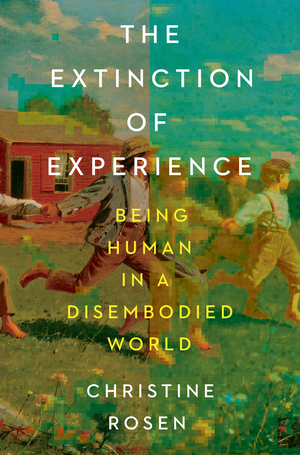
The Extinction of Experience: Being Human in a Disembodied World, by Christine Rosen. W.W. Norton & Company, 272 pages, $29.99
In his Life of Samuel Johnson, James Boswell recounts a conversation with his subject about one philosopher’s “ingenious sophistry to prove the non-existence of matter, and that every thing in the universe is merely ideal.” It’s obvious nonsense, Boswell says, to think that we are ethereal concepts, rather than corporeal beings. But can how can we ever convincingly refute the argument to the contrary? “I never shall forget,” Boswell writes, “the alacrity with which Johnson answered, striking his foot with mighty force against a large stone, till he rebounded from it, ‘I refute it thus.’”
Boswell’s story came to mind as I read Christine Rosen’s The Extinction of Experience. Rosen, a senior fellow at the American Enterprise Institute, takes on an updated, technological variation on Johnson’s target: the folly of forgetting our nature as physical beings in favor of abstraction and distraction. She also frequently follows Johnson’s style of refutation, insisting, with good reason, that what she is saying about our warped use of technology should be so obvious as to make any formal, logical argument unnecessary, if not plain ridiculous. But she also faces the same limitation as Johnson. Though Rosen is so often correct in her consideration of the losses occasioned by “being human in a disembodied world,” as her book’s subtitle suggests, she says little to convince those who most need convincing.
Rosen’s contention is that many of the technologies we have embraced in recent decades have formed a filter between humans and our environments, separating us from a previously immanent encounter with the world. “More and more, we relate to our world through information about it rather than direct experience with it.” Think of our urge to text others while ignoring the people next to us, or to observe people’s hobbies on social media rather than pursue our own. We might think that this indirect, technological mediation is still letting us encounter the “real” world, just in a new and improved form. But technology, Rosen suggests, by intermediating between individuals and reality, serves instead as a portal to another, virtual world. The virtual world, precisely because it can only be reached through technology’s interposition, can never have the same vibrancy or frisson as good old reality. The result is an estrangement from our own physicality. Basic acts and encounters—“the ways we become acquainted with the world”—are deadened. As a result, we have weakened our awareness of our humanity and the fundamental experiences that enrich or even define it.
So summarized, this all sounds rather abstract, and contrary to Rosen’s goal of getting us to reject undue abstraction and return to reality. But The Extinction of Experience focuses on eminently practical, everyday physical experiences and their perversion by technology.
Consider, for example, a chapter on face-to-face interaction and the importance of the “primal language” of facial expression for our physical, social, and emotional functioning. So much of our communication, intentional and not, occurs through the “exchange of unspoken signals and gestures,” an exchange demanding physical presence and proximity. But technology, Rosen argues, is increasingly interfering with this exchange. Self-checkout kiosks, automated services, and online shopping mean we can go through previously social experiences without meeting a single person. And when we do have to go somewhere in person, our phone addictions claim any attention we might have given to the people around us. Tech offers convenience, but it also diminishes simple social pleasures—compare the casual watercooler chat with a coworker to the agonizing Zoom meetings many endured during the pandemic. Tech’s interruption of face-to-face encounters can also lead to more degrading experiences, as when a nursing home resident finds employees replaced by “care-giving robots.” The cumulative result of diminishing of physical interaction is a lonelier, bleaker world, even if it’s also a more efficient one.
Other chapters follow a similar pattern, tracing technology’s enervating effects on our bodies and their interactions with the world. Rosen documents many joys and skills in decline, from handwriting, drawing, traveling, and waiting, to articulating our emotions, appreciating art, and even enjoying sex. The old, eroded experiences all have something in common: they’re slow burns, whereas the new, technologized spectacles let you take a hit this instant. Learning to understand a painting, to become comfortable with oneself in silence, to know a lover, takes time; but tweeting, getting your fix of Funyuns through Uber Eats, and watching porn can happen right now. Along the way, Rosen provides a good reading list, citing thinkers such as sociologist Erving Goffman, philosopher Walter Benjamin, and naturalist Robert Michael Pyle, from whom she takes the phase “the extinction of experience.”
Rosen is especially alert to the social consequences of our digital intermediation beyond the individual level. One might think that only the person alone in his room on TikTok suffers for his withdrawal from reality. But precisely because that reality nevertheless remains shared among all, “scrolling alone,” as Michael Toscano has put it, will at scale wreak havoc on society. Initiative and agency are not supported by the virtual world, which transforms agents into spectators and participants into audiences. Whereas citizens in a community recognize their obligation to act in public life, “distracted, daily voyeurs” and “mediated bystanders” wait passively for something to happen and then post a picture of it. As we retreat into our customized virtual lairs, “our sense of shared reality and purpose is further frayed, and … a growing distrust of human judgment will further polarize our culture and politics.”
By book’s end, one’s impression is that virtually all of life has become less edifying, less noble, and simply less fun than it could have been had it not been “improved” so much by technology. Rosen depicts many relatable experiences, humdrum and grand alike, that have had the verve washed out of them, as though we are living through The Wizard of Oz’s color change in reverse. Every reader will feel the pang of familiarity at some experience that our devices and algorithms have meddled with, whether it’s having legible handwriting, remembering a route without GPS, attending a concert without being swamped by selfie-takers, or lasting five minutes without checking one’s email. Such depictions benefit many from many pithy lines: “we no longer talk about the Human Condition, but rather the User Experience”; “social media platforms replace pure sociability with quantified popularity”; “the injunction we give curious toddlers around breakable objects—“look with your eyes, not with your hands’—has become the slogan of pleasure in our age.”
But as with the thrill of seeing the likes on one’s Instagram post rack up, the edification from such vignettes, laments, and one-liners proves fleeting, for neither of the two ways that Rosen makes her case are ultimately persuasive.
In the first, Rosen follows Johnson in appealing to common sense and intuitive understanding, asking us to simply stop and look at the manifest decay and ugliness that tech has wrought. Hence the frequent rhetorical questions: “Is it any surprise that it is becoming increasingly difficult to distinguish between what is real and what isn’t, both online and IRL?”; “In a world of digital experiences, do we any longer recognize any of them as ersatz?”; “Isn’t something wrong when 53 percent of sixteen- to twenty-two-year-olds around the world say they would rather lose their sense of smell than their favorite personal technology?” Elsewhere, insisting on the importance of face-to-face conversations, Rosen assures that “We know this intuitively,” backing up the claim with a quote from Montaigne. It’s as though the assertions are so transparently correct that no argument is needed beyond a good kick of the rock.
But in that case, why write the book? Who can be helped by it? This reader found himself continually nodding along with Rosen’s claims, but only in agreement, not out of persuasion. Of course texting is a lousy substitute for seeing someone in person, and of course eating “convenient meals prepared by someone else while watching TV chefs create elaborate meals from scratch” has something creepy about it. It’s so manifestly obvious, we might think, that no argument is necessary, or perhaps even possible. If you know that vlogging your morning makeup routine or fleeing to the Metaverse is no way to go through life, you know. And if you don’t know—if you, like Johnson’s philosophical adversary, have fooled yourself into thinking the unthinkable—you probably can’t be helped.
Still, if nothing else, the very futility of appealing to what we all know, to criticize what we all do, does help to call one’s attention to just how strange our lives are today. So many of us recognize that our smartwatch-wearing, Soylent-drinking habits are eroding our well-being and our humanity; and then we keep on doing them. Why? To be fair, this is not exactly a new problem. Saint Paul lamented that “the good that I would I do not: but the evil which I would not, that I do,” and even earlier, Socrates was so puzzled by our weakness of will that, in a bit of his own “ingenious sophistry,” he concluded that it must be an illusion. But past ages did not need so many reminders that we are particular, corporeal humans—the thing it might seem we could have the least possibility of ever being tempted to deny.
At other times, Rosen takes the opposite approach, calling in the spreadsheets for hard empirical evidence. But such evidence can hardly persuade either. She frequently appeals to academic studies and data to defend physicality, but it seems impossible that these could actually tell us anything new, or persuade anyone who needs persuading. Defending leisurely museum wanderings, for example, Rosen writes, “We know museums are good for us. One study … found that museums serve as ‘restorative environments.’ Another study … discovered that museum visits have positive impacts on people’s self-reported happiness and health.” If this is how we know that museums are good, then by some anti-academic perversity I am tempted to conclude instead that such places are dangerous and should be studiously avoided, if not banned altogether. Anyone needing the authority of the Journal of Biosocial Science to understand why patience is a good thing, or Psychological Science to realize that smiles and eye contact make people feel better, is probably a lost cause.
It’s an odd manner of argument in a book seeking to defend the irreducible, almost phenomenological physicality of our selves. Rosen calls for a “a new humanism, one that can challenge the engineering-driven scientism that has come to dominate culture”; but, the thinking seems to go, as long as scientism does dominate, we will need to beat it at its own game. (At least, this seems a more plausible explanation of Rosen’s strategy than that she has succumbed to the very rationalistic, disconnected mindset she elsewhere criticizes.) After all, it sounds reasonable enough to suppose that to reach the scientistically minded, we need to speak the scientistic language. But there’s just not much to say in the language. A new humanism will not earn followers through such facts as that “researchers videotaped 200 family mealtimes and found that when the family dinner last on average only 16.4 minutes, children were at greater risk of becoming overweight when compared to families whose dinners lasted an average of nearly 20 minutes.” Such language only gets in the way of Rosen’s much-needed invitation back to a simpler, more direct engagement with the world. She is aware of this tension between kicking a rock and consulting the periodic table, so to speak, at one point mentioning “something your grandma might have told you but that is still nice to see endorsed by contemporary social science.” But the tension remains.
We thus have a dilemma of tech criticism on our hands. The first horn—those of course cases of common sense—must not persuade, otherwise so many of us would not be guilty of the problems Rosen identifies, at the same time that we concede the truth of what she says. And the second horn—confronting the scientistic mindset on its own turf—doesn’t persuade, either. It’s a category error to hope that such quantitative studies, however rigorously conducted, could convince us to reject the algorithmic way of life. So what is a thoughtful observer of our technological addictions like Rosen to do?
Here, we might take another page from the philosophers’ arguments over the external world. Immanuel Kant, who took the skeptic’s denial of the external world far more seriously than did Johnson, called the lack of a knock-down rebuttal the “scandal of philosophy.” For our own self-respect and legitimacy as rational beings, according to this perspective, we need to give the philosophasters of absurdity the definitive intellectual drubbing they deserve. We might put Kant down as endorsing at least the spirit of the second horn of the dilemma, demanding an irrefutable proof of the obvious.
But there is another approach. We could instead heed the words of Martin Heidegger, who gave his own rather Johnsonian insistence on the truth of our situated embodiment: “The ‘scandal of philosophy’ is not that this proof has yet to be given, but that such proofs are expected and attempted again and again.” The mistake, in other words, is not that we have failed to demonstrate reality to its skeptics, but that we think reality is even the kind of thing that someone who denies it might ever be compelled to accept through mere logic. Heidegger is not simply repeating Johnson’s curmudgeonly griping and thus falling on the tech critic’s first horn of the dilemma. Rather, he is prompting us to take our inquiries in another direction, into how we got into such a mess in the first place. How did we ever come to think that we needed to prove the existence of the external world? What had to happen for the skeptic’s argument to even get off the ground enough to apparently deserve a refutation?
A similar question could be asked today. Our scandal is not that we still lack the irrefutable defense of our nature as “the embodied, quirky, contradictory, resilient, creative human beings we are,” against the dehumanizing attack of the Machine. The scandal is rather thinking that any mere argument could convince us of what we have incredibly managed to forget—the fundamental facticity of our physical selves. No argument could be more compelling than this facticity; and yet we still have managed to reject it. Rosen is thus on to something with her stone-kicking insistence that “we know this,” but leaves unasked the greater question that The Extinction of Experience’s arguments cry for—the question that Heidegger’s scandal intimates. What about our technology, or about ourselves, has made it possible for us to live in ways that deny the most basic truths about ourselves? How did it come to be that that which should be universally assented to should instead be so widely forgotten? That would be a worthy subject for Rosen’s next book.
About The Author
[article_authors_bios]
