





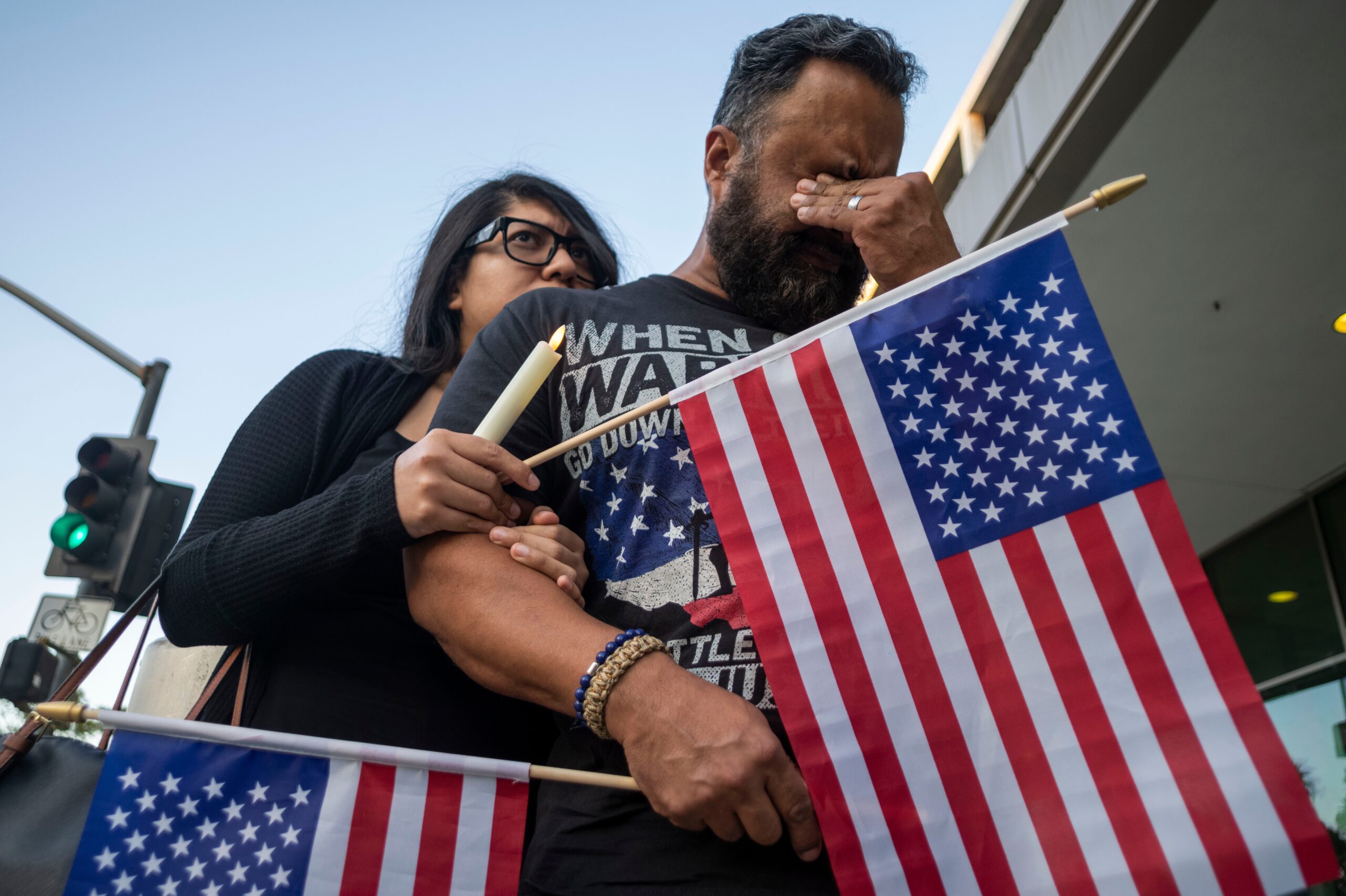


There are times when the death of an individual reveals itself to be larger than that individual. It feels as though with that individual, something else has died. Or perhaps, there just emerges a recognition that something else had already died. As our nation reels from the gruesome murder of young conservative influencer Charlie Kirk, one of the looming senses in the background is that we have lost any kind of psychology for the pre-political—a psychology for whatever it is that makes shared life within a political community worthwhile in the first place.
As a political philosopher, I believe there is much value to be gained by careful attention to questions of political organization and governance and to answer such questions well demands a robust understanding of the pre-political. As the term suggests, the pre-political is not dictated by the political but rather it is that which supersedes, undergirds, and grounds it. Any value the category of the political enjoys is derived from this more foundational source of value. It is a kind of value that is prior. It is a kind of value that stands ontologically distinct. What makes any theory of political organization or conception of political justice viable is the way in which it interacts with pre-political realities. Any merits rightfully claimed by political structures, ideals, or policies are moored in the way they protect or cultivate that which is pre-political.
This concept of the pre-political is foundational to Western civilization. Classics in the history of Western thought place a strong emphasis on the moral and familial institutions that precede the State. The State must preserve these prior bonds and arrangements to retain its legitimacy, as the State is beholden to the natural dictates of morality, never capable of floating free of them. In his 2011 address to the German Bundestag in Berlin, Pope Benedict XVI succinctly articulated the essence of the pre-political:
The conviction that there is a Creator God is what gave rise to the idea of human rights, the idea of equality of all people before the law, the recognition of the inviolability of human dignity in every single person and the awareness of people’s responsibility for their actions. Our cultural memory is shaped by these rational insights. To ignore it or dismiss it as a thing of the past would be to dismember our culture totally and rob it of its completeness. (Pope Benedict XVI, “The Listening Heart: Reflections on the Foundation of Law”)
As referenced by this quote, the value of a human person is at the heart of the pre-political. However you attempt to explain this value, it surely cannot be derived from the political. If so, the failure of any given political regime to recognize human value would mean that human beings under that political arrangement are valueless. If we wish to preclude this possibility, we need a metaphysics of the human person that precedes the political and that can deliver us something like intrinsic value. This is the kind of value that can constrain the political instead of being its subject. Other kinds of pre-political goods include familial relationships, beauty, knowledge, and spiritual pursuit—all of which are goods that the political should foster instead of snuff out.
Any just political regime is constructed on a set of pre-political truths, practices, and principles, with the implicit understanding that the political and the pre-political constitute two distinct domains of value. The political is derivative and fleeting in a way that the pre-political is not. The political is set in place to free up humanity to pursue the higher things, whether that be the cultivation of beauty, the pursuit of truth, the fostering of intimate relationships, or the veneration of the sacred. The political is to shield that which is intrinsically valuable from various forms of harm and destruction and to fertilize the soil within which the intrinsically valuable can grow. The political can never supersede in worth that which serves as the very basis for its existence, which is most fundamentally the intrinsic value of each and every human being.
The danger is that we have started to see the political as baked into the higher and prior things instead of as fundamentally distinct. We have lost any sense of distance between these two categories, with little to no awareness of the hazards of doing so. Our culture has become hyper-politicized, with the pre-political often relegated to a mere supporting role. As the political seeps further into people’s choices of where to live, who to befriend, where to send their kids to school, and which stores to shop at, something of great value slowly decays in the background. The thing decaying is a shared vision of why exactly we have all embarked on this political experiment together in the first place.
In light of this hyper-politicized climate, our various partisan-tinged affiliations and political identities bear a weight that they cannot withstand. They serve as cheapened substitutes for that which actually confers value upon us, promising to signal our value to the external world—but inevitably coming up short. Our cultural obsession with political identity threatens to undermine the pre-political goods that infuse the political with value. The psychological impulse of our culture has become to see a person’s politicized identities before we see the person who possesses them. And while such identities might very well be merely political, the person who bears the identities is surely not.
The current lack of a pre-political psychology is perhaps most clearly evidenced in the way we respond to tragedy, as was on full display in the wake of Charlie Kirk’s death. We seemingly cannot express grief without first stumbling over our own ambivalent feelings regarding the politics of the victim. We feel obliged to proffer our own socio-political stances before expressing any condolences. We instinctively start to riff on downstream policy implications instead of being present to the emotional weight of the moment. These ingrained habits of response function to keep the political wedded to the pre-political within our psychology, threatening to undercut that which matters most.
A pre-political psychology is one that is tuned into these higher goods of loving relationships, the appreciation of beauty, moral contemplation, and the value of life itself. It is a cognitive disposition to engage not in the register of the current political moment but as a person who has spent time cultivating the pre-political goods within their own life. It is constituted by a commitment to regard the primary value of others and of oneself through the lens of our shared humanity.
A pre-political psychology is one that sees a young father brutally murdered in front of his family before all else. It sees a married couple peacefully asleep in their bed before being gunned down in their own home. It sees a helpless mother clinging to the body of her starving child knowing she is powerless to save him. It sees a young woman, attempting to rebuild her life, viciously attacked on her commute home. Ultimately, it sees human life marred by unspeakable tragedy with incomprehensible frequency.
The political should serve the pre-political, and whenever and wherever this order is subverted, any hope of political justice is lost. Thus, part of the remedy for our current societal ailments must be the restoration of a pre-political psychology. We need an inner posture that simply grieves, rather than withholds grief because of political context. We need to develop the capacity to see that which is more valuable before seeing that which is less valuable. We need to learn how to weep with those who weep and mourn with those who mourn. And we need to cultivate a collective, internal will to respond to hurting people, whoever those hurting people might be. To achieve this, we must deliberately separate the pre-political from the political. We must work to re-establish an appreciation for the foundation upon which all of the political is constructed, the foundation upon which all of our hopes for a just political order are pinned.
About The Author
