





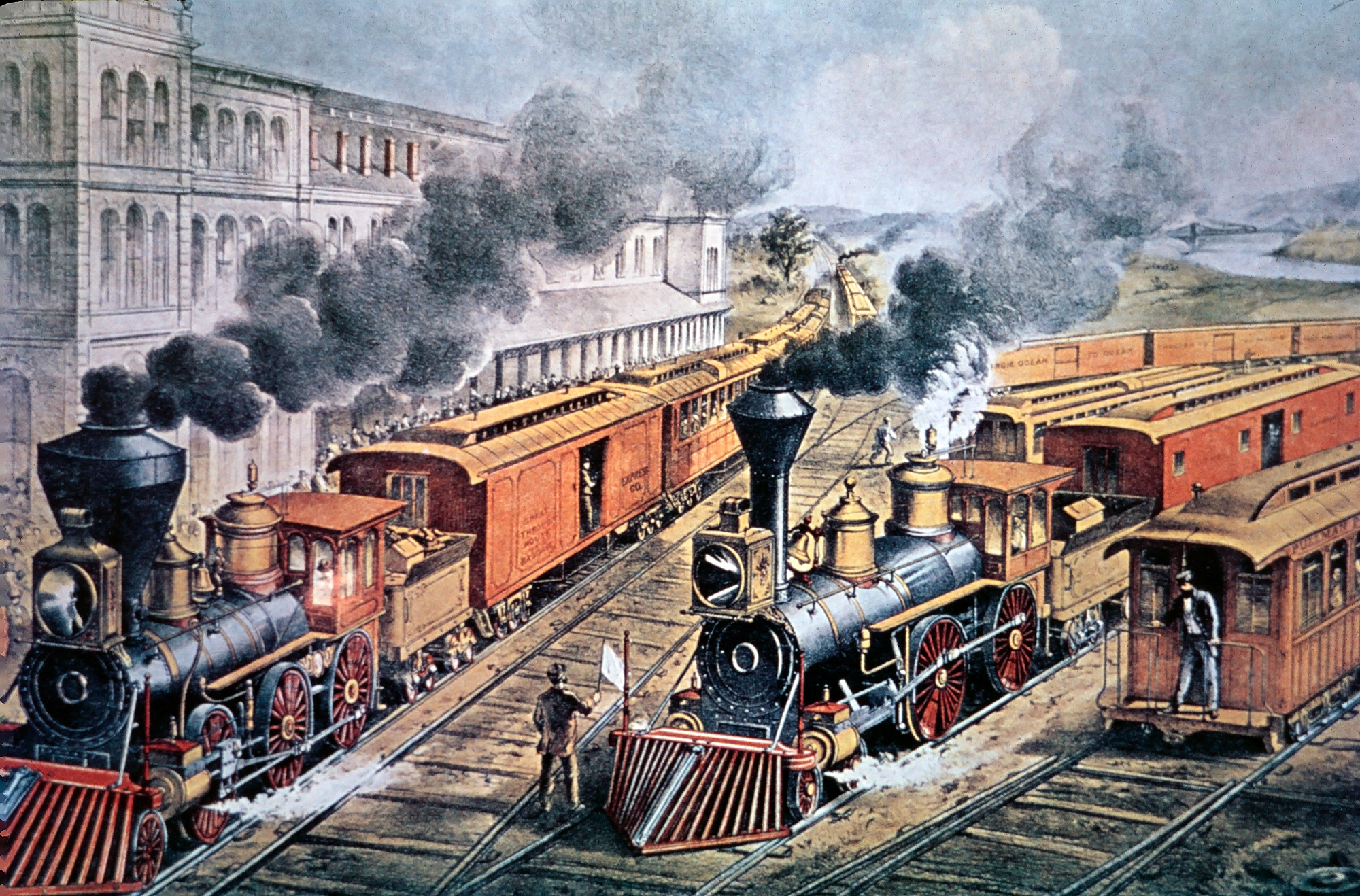


“Public-private partnership” has a modern ring, but it is as old as the concept of the public. Such complex relationships have long been at the heart of infrastructure projects, as have waste, fraud, and abuse. In recent years, California’s high-speed rail network has generated headlines thanks to an astounding series of cost overruns and delays amidst little progress. Among its many initiatives, the Inflation Reduction Act sought to feed massive sums over many years to questionable private entities claiming to pursue a “greener” environmental infrastructure. The amount of money wasted in such endeavors is never easy to measure, but perhaps the historical example offered below can move us beyond the number of zeroes in estimates of waste to consider the inescapable moral dilemmas encouraged by mixing public and private goals and resources.
The zeal with which Americans sought to build railroads in the 19th century shares a mentality with modern infrastructure projects. The intense immediacy of the goal overrides common-sense scruples, most obviously the day-to-day strictures of the market, concerning the interrelationships between public and private that would have to be forged. The decentralized fever for railroad building in the 19th-century United States displayed a commonality of thought that moved hundreds of localities to act similarly. Local officials and entrepreneurs moved on their own, not under any state or national program, to enmesh their communities in a morass of debt and dissembling that would be repeated across the nation for decades. The dilemmas bred by these numerous disputes as they worked their way through the courts would constitute what 19th-century judicial critics recognized as a process of “demoralization.” They recognized and deplored a momentum that would encourage infrastructure fiascos by ignoring what had been lost through a haphazard mixing of private and public.
The federal government’s support for the transcontinental railroad and its attendant corruption are well-known, but the role of local government in supporting rail projects throughout the nineteenth century is far more obscure. According to one estimate, some 2200 state laws were passed between 1830 and 1890 to enact some form of local aid.[1] How much that aid spurred or retarded the spread of rail networks and the economic development they promised is a tangled econometric problem that cannot be solved in this essay. But beyond the reckoning of dollars and cents, infrastructure funding by local governments would repeatedly drag their communities into turmoil. Two examples can introduce the sociopolitical “train wreck” that hundreds of communities experienced as rail projects fell short of what promoters promised. In Pittsburgh’s Allegheny County, the state jailed all three county commissioners in 1860 for their refusal to enact taxes to pay hundreds of thousands of dollars of accrued interest to holders of railroad bonds.[2] Eighty years later on the Fourth of July, 1940, citizens in Dallas County, Missouri celebrated the end of seventy years of smoldering turmoil over that county’s ill-advised rail investment with a bonfire of surrendered bonds.[3]
Completed in 1825, the Erie Canal had been built by New York State, ushering in more than a decade of similar projects that would drive many states toward bankruptcy in the wake of the Panic of 1837. During that era, the Democratic Party, under Andrew Jackson’s leadership, had largely limited the federal role in promoting infrastructure. Before enacting sufficient taxes in 1845 to pay its millions in infrastructure debts, Pennsylvania deferred payments by issuing interest-bearing certificates to holders of state securities. This prompted a poetic complaint from English investor William Wordsworth:
All who revere the memory of Penn
Grieve for the land on whose wild woods his name
Was fondly grafted with a virtuous aim,
Renounced, abandoned by degenerate Men
For state-dishonour black as ever came
To upper air from Mammon’s loathsome den.[4]
Problems like these led most American states to stop funding transportation infrastructure just at the time that the future of transportation turned from canals to railroads. But entrepreneurs found willing backers in municipalities. One of the nation’s very first railroads, the Baltimore and Ohio, relied on stock subscriptions by the city of Baltimore from the road’s inception in 1827, and the city would retain a controlling interest for decades. Among other cities, Albany, Bridgeport, Charleston, Providence, and Savannah made substantial investments in local railroads, as did Philadelphia, buying $5 million in stock in the 1840s and 1850s in the Pennsylvania Railroad. To ensure that the Pennsylvania made it to Pittsburgh, Allegheny County chipped in $1 million.[5]
The hopeful expectation for such municipal investments, called loans of credit, was that they would easily satisfy the clamor for rail connections. Municipal stock subscriptions paid for by bond issues, along with sufficient private investment, would build railroads so quickly that they could readily earn dividends. Those dividends, paid to stockholding municipalities, would cover the interest owed to bondholders, thus providing essentially free credit to build the railroads. As the Pennsylvania Railroad completed its line to Pittsburgh by the end of 1852, numerous projects funded by cities, counties, and towns proceeded in Georgia, Kentucky, Pennsylvania, Ohio, and Illinois, among other states. But increasingly, entrepreneurs found it easier to make deals with eager cities and counties than to secure a substantial base of private investment. Newspapers chided the wealthy for not coming forward fast enough to invest in local projects, and municipal investments were seen as the best way to build quickly. Private investment was sidetracked, along with the reality that substantial taxes would be required to pay bondholders if new railroads were not immediately successful.[6]
Railroad projects consistently had popular support, often expressed through municipal votes mandated in state enabling legislation. The relative weakness of laissez-faire sentiment in antebellum America is further reflected by state courts upholding legislative power to enable municipalities to subscribe, as in Pennsylvania’s 1853 Sharpless decision. Despite ruling in favor of Philadelphia’s subscription to the Hempfield Railroad, a western Pennsylvania road that would eventually gain fame by never being completed, Chief Justice Jeremiah S. Black offered misgivings: “This plan of improving the country . . . will probably go on until it results in some startling calamity.” Still, the court lacked the nerve to imperil the legality of “not less than fourteen millions of these stocks . . . taken by boroughs, counties, and cities within this Commonwealth.”[7] Essentially the power of the legislature to enable massive tax liability for municipal subscriptions trumped claims that such potential taxation fundamentally endangered property rights.
The burgeoning of municipal subscriptions had already led Ohio to prohibit them in 1851 in its new constitution. Six years later, as the Panic of 1857 began, Pennsylvania enacted its own constitutional prohibition by a popular vote margin of 9 to 1.[8] With the economic downturn, railroads increasingly struggled to pay dividends, forcing municipalities to pay interest on their bonds. As a Kentucky court noted in 1858 concerning Maysville’s bonds in support of a failed road, sympathy for “a noble little city so sadly disappointed” could “constitute no excuse for a court of justice in refusing to coerce a debt thus contracted.”[9] In Washington County, Pennsylvania, a county judge ordered the county commissioners out of office after they passed a most unpopular tax to pay the county’s subscription to the aforementioned Hempfield. The state supreme court returned the commissioners to office, and their tax was bitterly resisted for years.[10]
While Allegheny County’s investment in the Pennsylvania Railroad worked out quite well, the county had also issued bonds to purchase some $2.3 million in stock in other roads. In addition, the city of Pittsburgh issued $1.8 million in bonds for railroad stock and another half million in bonds were issued by other municipalities. Local governments fought to avoid increasing taxes to pay bondholders, especially for railroads that were far from completion. Courts ruled that municipalities could not escape liability by citing railroads’ betrayed promises to pay dividends to pass along to bondholders. However unwisely and conditionally local governments might have issued bonds, the obligations were theirs once bonds entered the market. Popularly elected county conventions pressured officials to repudiate their bonds, noting that state supreme court Judge Walter Lowrie had dissented against the constitutionality of subscriptions and that Pennsylvania’s voters had recently seconded that judgment. None of this stopped Lowrie from jailing the county commissioners for contempt in 1860 for their failure to enact taxes to pay bondholders. A compromise settlement reached in 1863 would lower interest rates and extend the term of the bonds for fifty years.[11]
Municipal railroad subscriptions moved west with the nation, leaving few lessons learned. By 1856, Iowa had just completed its first decade as a state and its municipalities had enacted more than $7 million in subscriptions. Iowa’s supreme court approved at first, but as more and more municipalities chafed under the obligation of paying for their bonds during hard times, the court changed its mind in 1859, voiding the subscriptions and bonds. To escape Iowa’s court, German investor Herman Gelpcke appealed to the United States Supreme Court, which had consistently concurred with state decisions that held subscriptions constitutional and municipalities liable to pay bondholders. In its 1863 decision, Gelpcke v. Dubuque, the Supreme Court upheld the repudiated bonds, breaking with the common practice of following the ruling of a state’s highest court.[12] In another decision that year, Supreme Court Justice Robert C. Grier summarized the Court’s view of local government claims to avoid liability for their partnership in Mercer County v. Hacket: “The epidemic insanity of the people, the folly of county officers, the knavery of railroad ‘speculators,’ are pleas which might have just weight in an application to restrain the issue or negotiation of these bonds, but cannot prevail to authorize their repudiation after they have been negotiated and have come into the possession of bona fide holders.”[13] A native Pennsylvanian, Grier had presided over an 1848 convention where he voted in favor of Allegheny County’s $1 million subscription to the Pennsylvania Railroad.[14]
A new strategy for launching railroad projects arose in the years after the Civil War as municipalities continued to clamor for rail connections. Some communities sought an easier form of partnership by going into debt to donate to roads, rather than face the burdens of owning stock. Outraged by such an act, New York judge Amaziah B. James declared it unconstitutional, labeling it “legal robbery; less respectable than highway robbery, in this, that the perpetrator of the latter assumes the danger and infamy of the act, while this act has the shield of legislative irresponsibility.”[15] Although Iowa’s supreme court had tossed out municipal subscriptions and sought to hinder bondholders’ efforts to collect, in 1868, its legislators enabled municipalities to tax their citizens to donate to railroads. In ruling against this law, Judge John F. Dillon, who would gain legal fame through his work on contracts, declared that municipal aid had brought “disaster, the child of extravagance and debt, and dishonor, the unbidden companion of bankruptcy.” Dillon wondered, “Who can define the logical boundaries to this doctrine? Who can fix the limits to this kind of taxation?”[16]
Dillon’s eloquence failed to stop the Iowa legislature, which passed the same law again and had it sustained by the state court, with Dillon still appalled from his new post on federal circuit court.[17] In Michigan, Judge Thomas M. Cooley, who would later serve as the first chair of the Interstate Commerce Commission, rejected the principle of municipal aid to railroads, whether by subscription or donation. As had been argued by dissenters for more than a decade, Cooley insisted that the state could not enable such taxation, especially to benefit what he viewed as private enterprise. Having compiled massive debt aiding railroads in the 1830s and 1840s, Michigan had long prohibited state aid, and for Cooley, that clause in the state’s constitution similarly forbade municipal subscriptions.[18] But the United States Supreme Court quickly countered that bondholders from projects that already had commenced must be protected, and donations by municipalities were no less constitutional than stock subscriptions.[19]
By the 1870s, about half of the states had prohibited municipal subscriptions in their constitutions, including Illinois in 1870, New York in 1874, and Missouri in 1875. New York acted after nearly forty years of aid to railroads in which 315 municipalities had pledged almost $37 million.[20] But the obstacle of constitutional prohibition was not insurmountable. Looking to evade Ohio’s prohibition, the city of Cincinnati pursued railroad donations to their logical conclusion through state legislation in 1869, which enabled it to borrow $10 million to build its own railroad to Chattanooga, Tennessee, to be called the Cincinnati Southern. The 1851 constitution prohibited a municipality from becoming a stockholder, raising money for, or loaning credit to a corporation, but Cincinnati set up its own enterprise. The state supreme court saw no violation, despite Judge Josiah Scott’s admission that had the constitution’s framers imagined such an effort, they may well “have interposed further limitations upon legislative discretion.”[21] A leading commentator on railroad law, Judge Isaac F. Redfield of Vermont, called the decision “an evasion of the fundamental law” which would have a “demoralizing effect upon the profession . . . and . . . impress the mass of citizens with the belief that courts exist to pervert the laws, rather than to enforce them.”[22] Ohio’s Supreme Court would prevent further attempts at municipal railroad enterprise by rejecting subsequent legislation to enable any municipality to borrow to launch its own rail project. The court reasoned that these smaller efforts, as opposed to Cincinnati’s, would eventually need to connect with a railroad corporation and thus violated the constitution.[23] In 1874, the state’s voters defeated a proposed constitutional amendment to allow municipalities to enact aid to railroads by a margin greater than 6 to 1.[24]
Curiously, the ultimate “partners” in these public-private partnerships, the voters, prohibited municipal subscriptions where statewide votes occurred, yet in most municipalities, voters consistently approved aid for local projects. The Illinois legislature had enabled municipalities to vote some $40 million in rail subscriptions down to the township level prior to the state’s adoption of a constitutional prohibition in 1870 by a vote of 4 to 1.[25] Similarly, Missouri had enabled subscriptions within railroad charters as early as 1837, and a constitutional provision in 1865 requiring two-thirds approval by the voters of any municipality did little to slow the process.[26] Momentum ceased with the Panic of 1873. Missouri not only prohibited future subscriptions in its 1875 Constitution, but its supreme court would proceed to void many bonds that had been issued previously. The United States Supreme Court even briefly agreed to void a good number of subscriptions in the state by ruling unconstitutional an earlier state law on municipal votes before reversing itself. Decades of dueling litigation ensued when Missouri’s court did not follow along. The unpopularity of bondholders’ efforts to collect led the Missouri legislature to prohibit county court judges from complying with federal court orders in favor of bondholders. Local officials were similarly discouraged from enacting taxes to pay bonds.[27] While similar conflict between state and federal courts had occurred in Iowa, Michigan, and New York, Missouri’s disputes reached a new level of acrimony with county judges jailed or hiding out year after year. Armed with favorable rulings from federal courts, bondholders could paralyze both municipal administration and local economic activity. Like Dallas County mentioned above, several Missouri counties and towns faced protracted disputes extending well into the twentieth century.[28]
History certainly has its lessons, but perhaps the clearest is that they are all-too-often ignored. Extended disputes over municipal rail subscriptions in Iowa and Missouri did little to discourage municipalities from voting millions in aid for railroads in Nebraska and Kansas in the 1880s, just as contemplated repudiation in Kentucky and Pennsylvania had failed to slow railroad aid in Illinois and Iowa. Nebraska prohibited the stock subscription form of these public-private partnerships in its 1875 constitution, but enabled its more questionable variant, donations.[29] Municipal aid promoted rail projects in Kansas until the Panic of 1893 resulted in so many abandoned lines that active railroad mileage in the state declined from 1890 to 1900.[30]
All the more significant for being geographically atomized across decades, this congeries of jailings, repudiations, disputed votes, abandoned rail lines, and overblown visions of civic greatness-not to mention wasted public funds-reflects the conflict of interest inherent in the public-private partnership. Then as now, eagerness for infrastructure development led entrepreneurs and local leaders to fashion intimate and questionable connections between government and business. While its scale has ballooned, the thirst for infrastructure and its need for interconnections have grown apace. The conflicts of interest that result necessarily ensnare officials, entrepreneurs, lawyers, judges, and indeed citizens in dilemmas that cannot merely be dismissed as undifferentiated, timeless, unavoidable “corruption.” Instead, these dilemmas have been and continue to be demoralizing, dragging public policy over infrastructure into an ever more compromised level of moral discourse. Even in the 21st century, those who seek new projects would do well to reflect on the words of Pennsylvania’s Judge Walter Lowrie in 1859: “Public business is itself a source of public demoralization, wherever it allows itself to be urged on by the presence and promptings of private interest.”[31]
[1] Stuart Bruchey, Roots of American Economic Growth (New York: Harper & Row, 1965), p. 135.
[2] Perry K. Blatz, “Martyrs for Allegheny County,” Western Pennsylvania History 100 (Fall 2017): 46-55.
[3] Jim Hamilton, “Dream of Railroad Turned into 70-Year Nightmare,” Buffalo [Mo.] Reflex n.d., reprinted in slavens.net genealogy site. On Dallas County’s longlived debt more generally, see Edwin L. Lopata, Local Aid to Railroads in Missouri (New York: Parnassus Press, 1937), pp. 126-27; A. M. Hillhouse, Municipal Bonds: A Century of Experience (New York: Prentice-Hall, Inc., 1938), pp. 181-82.
[4] “To the Pennsylvanians” (1845) in The Poetical Works of William Wordsworth, William Knight, ed., vol. VIII (New York: Macmillan & Co., 1896), p. 179. For Pennsylvania’s financial problems in this period, see T. K. Worthington, Historical Sketch of the Finances of Pennsylvania, Publications of the American Economic Association II (1887): 46-60.
[5] Carter Goodrich and Harvey H. Segal, “Baltimore’s Aid to Railroads: A Study in the Municipal Planning of Internal Improvements,” Journal of Economic History 13 (Winter 1953): 2-35; Carter Goodrich, Government Promotion of American Canals and Railroads 1800-1890 (New York: Columbia University Press, 1960), pp. 103-38; Perry K. Blatz, ” ‘Dirty Shirts’ and ‘American Eunuchs’: Western Pennsylvania Confronts Its Railroad Investments,” Pennsylvania Magazine of History and Biography CXLIV (April 2020): 181.
[6] For the theory behind municipal subscriptions, see American Railway Journal 8/31/50, 7/3/1852, 7/10/1852, 7/30/1853. On limitations of private investment, see Pittsburgh Gazette 10/30/1847, 5/12/1848, 3/21/1849; Pittsburgh Post 5/12/1852, 7/29/1853. On various states, see Goodrich, Government Promotion; on Georgia projects, see Milton Heath, Constructive Liberalism: the Role of the State in Economic Development in Georgia to 1860 (Cambridge, MA: Harvard University Press, 1954), pp. 276-92.
[7] Sharpless and Others v. the Mayor of Philadelphia, Pennsylvania State Reports 21 (1853): 159.
[8] For the Pennsylvania vote, see Louis Hartz, Economic Policy and Democratic Thought: Pennsylvania 1776-1860 (Cambridge, MA: Harvard University Press, 1948), pp. 123-25.
[9] Opinion by Judge Elijah Phister, Graham and Knox v. City of Maysville, et al in American Law Register VI (August 1858): 602.
[10] The federal decision requiring Washington County to enact the tax was McCoy v. Washington County, American Law Register VII (1858-59): 193-203; the state decision restoring the commissioners was Cleaver et al., Commissioners of Washington County v. Commonwealth ex rel Porter et al., Pennsylvania State Reports 34 (1860): 283-86.
[11] See Blatz articles cited above.
[12] Gelpcke v. City of Dubuque, 68 U.S. 175 (1863). The $7 million estimate is given by Governor James Grimes, quoted in George Ware Stephens, “Early History of Railroads in Iowa” (Ph.D. thesis, University of Wisconsin, 1911), p. 99.
[13] Mercer County v. Hacket, 68 U.S. 96 (1863).
[14] Pittsburgh Dispatch 6/1/1848.
[15] Sweet v. Hulbert, Report of Cases in Law and Equity . . . New York LI (1868): 313.
[16] Hanson et al v. Vernon, Reports of Cases . . . Supreme Court of the State of Iowa XXVII (1870): 33, 58.
[17] Stewart v. Board of Supervisors of Polk County, Reports of Cases . . . Supreme Court of the State of Iowa XXX (1872): 9-54. For Dillon’s reaction, see King and others v. Wilson and others in Cases Determined in the United States Circuit Courts for the Eighth Circuit I (1872): 556-66. Also see Stewart Rapalje and William Mack, A Digest of Railway Decisions (Northport, NY: E. Thompson, 1897) VI: 540-41.
[18] Cooley outlined his approach and offered historical context in People ex rel. Detroit & Howell Railroad Company v. Township Board of Salem, American Law Register XVIII (1870): 487-507 and Bay City v. State Treasurer, Michigan Reports XXIII (1871): 498-506.
[19] Township of Pine Grove v. Talcott, 86 U.S. 666 (1873). Wisconsin’s supreme court declared municipal donations illegal in Whiting v. Sheboygan Railway Company, American Law Register XVIII (1870): 156-75. That decision cited, as Cooley had for Michigan, Wisconsin’s constitutional prohibition on state aid to corporations. The Supreme Court overturned that ruling in Olcott v. Supervisors 83 U.S. 678 (1872), and the Wisconsin court returned to its earlier practice of allowing such aid in Phillips and others v. Town of Albany and others, Reports of Cases . . . Wisconsin XXVIII (1873): 340-57.
[20] Harry H. Pierce, Railroads of New York: A Study of Government Aid (Cambridge, MA: Harvard University Press, 1953), p. 18.
[21] Walker v. Cincinnati, American Law Register XX (1872): 361.
[22] American Law Register XX, p. 364.
[23] James Taylor et al v. Commissioners of Ross County, Reports of Cases . . . Supreme Court of Ohio XXIII: 22-85. See also Rapalje and Mack, VI: 548.
[24] Organic Law of Ohio and Proposed Amendments, compiled by J. H. Newman, State Librarian (Columbus, OH: F. J. Heer Printing Co., 1913), pp. 151-52. 170-71.
[25] Ward L. Bishop, An Economic Analysis of the Constitutional Restrictions upon Municipal Indebtedness in Illinois (Urbana, IL: University of Illinois, 1928), pp. 13-17; see also Frank Gilbert, Railroad Law in Illinois (Chicago: Callaghan and Company, 1873), pp. 79-119.
[26] Hillhouse, pp. 145, 149, 157-58; Lopata, pp. 36-37, 61-63, 71-73.
[27] Rapalje and Mack, VI: 544-46; Frederick N. Judson, A Treatise upon the Law and Practice of Taxation in Missouri (Columbia, MO: E. W. Stephens, 1900): 71-80; Hillhouse, pp. 164-70; Lopata, pp. 38, 72-75, 107-22.
[28] Hillhouse, pp. 181-83, 185-86; Lopata, pp. 123-27.
[29] C. E. Tingley, “Bond Subsidies to Railroads in Nebraska,” Quarterly Journal of Economics 6 (April 1892): 346-47.
[30] James E. Boyle, Financial History of Kansas, in Bulletin of the University of Wisconsin, Economics and Political Science Series (1908), pp. 57, 74-75, 90-91, 101-02.
[31] County of Lawrence v. North-western Railroad, Pennsylvania State Reports 32 (1859): 151.
About The Author
