





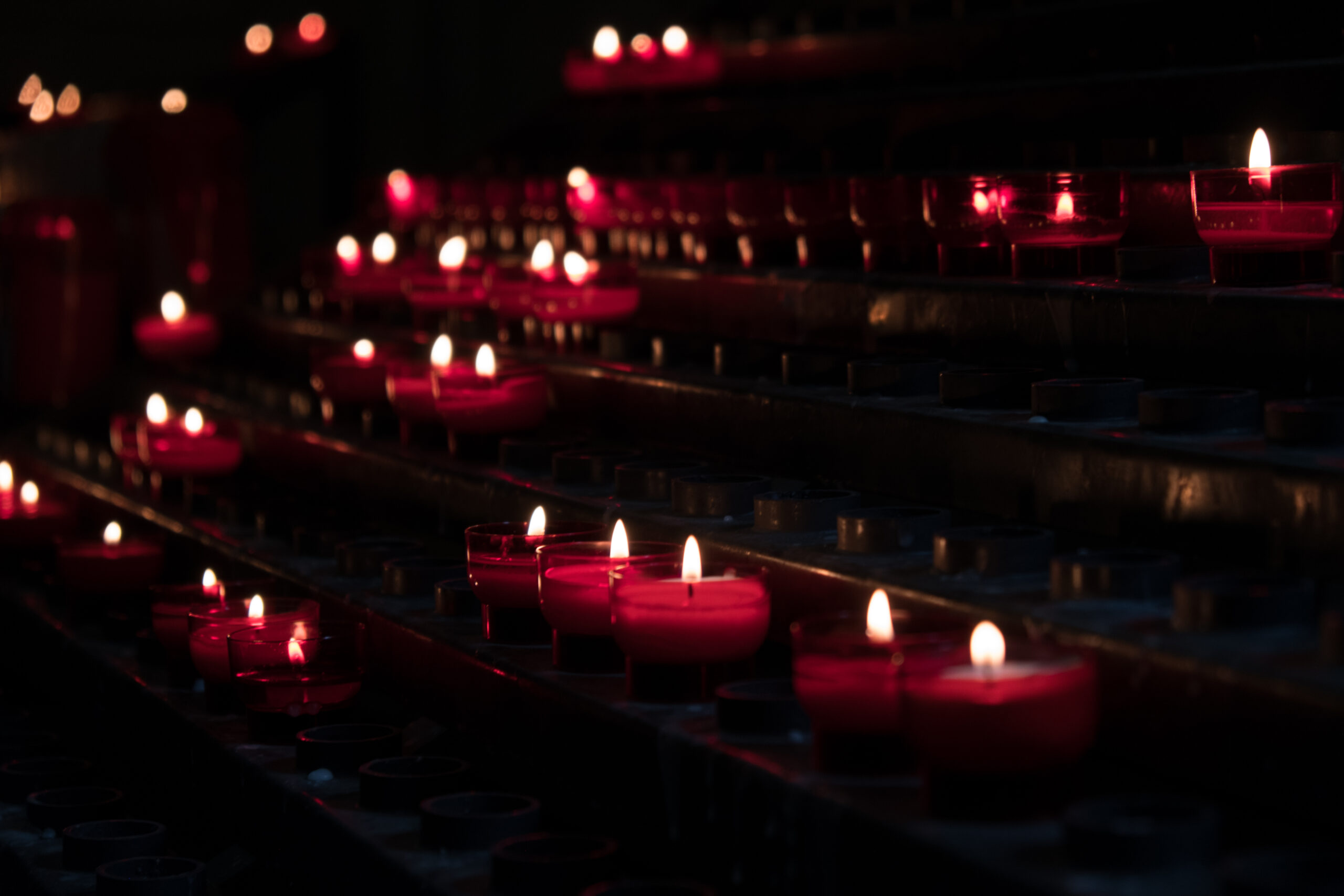


In the aftermath of last month’s church-school shooting at Annunciation Catholic Church in Minneapolis, public figures offered thoughts and prayers. The ensuing debate—now perennial, it seems—proceeded down well-worn dialectical paths. Religious conservatives defended the public place of prayer as a response to tragedy, while religious progressives and secularists argued that prayer wasn’t enough.
Jacob Frey, mayor of Minneapolis and a practicing Reformed Jew, denounced the notion that prayer was an appropriate political response. “Don’t just say this is about thoughts and prayers right now,” Frey told reporters, “these kids were literally praying.” Frey’s message echoed throw the Democratic mediasphere. Former Biden spokesperson Jen Psaki tool to X and posted “Prayer is not freaking enough. Prayers does not end school shootings. prayers do not make parents feel safe sending their kids to school. Prayer does not bring these kids back. Enough with the thoughts and prayers.” Responding to Psaki, Vice President J.D. Vance, a Charismatic Evangelical convert to Roman Catholicism, supported public affirmation of prayer “because our hearts are broken. We pray because we know God listens. We pray because we know that God works in mysterious ways, and can inspire us to further action.” Why, Vance asked “do you feel the need to attack other people for praying when kids were just killed praying?”
To make his position clear, Vance led a prayer at a public meeting in Wisconsin on September 3. There would be a time, Vance said, for politics, but in the immediate aftermath he believed the best thing for Americans to do was grieve their dead countrymen. Vance’s prayer, well-intentioned as it might have been, was extremely unusual and irregular. As such, it offers a glimpse in to the deep confusion over the relationship between religion, politics, and expressions of religion in the United States in the 21st Century.
Prayers by occupants of the highest executive offices in the United States federal government, are historically rare. Presidents were sometimes seen praying, usually in churches during divine service. Prayer led by presidents—or vice presidents—is so rare that you can count the times its happened on one hand. Thomas Jefferson argued that the federal government was cognizant of religious opinion, even though it was charged with protection the religious expression of its citizens. Samuel Miller, professor at Princeton Seminary from 1813 and 1849, believed that public prayer was a necessarily clerical action, meant to be done by the church. 19thCentury Americans were comfortable mixing Christianity with politics in their motives, rhetoric, and legislation. But they did not think that politicians should take on the role of ministers.
That is not to say that presidents avoided prayer altogether. What presidents usually did was not to pray themselves, but exhort citizens to use their religious liberty to pray for the country in times of hardship. Woodrow Wilson spoke in prayer like language, but demurred from actual invocations at public events. In 1944, Franklin D. Roosevelt asked the American people to join him in prayer during a radio address announcing the D-Day Invasion. But this was not his regular practice. Harry Truman enacted a federal day of prayer to be held on Memorial Day but chose to allow clergy—including Jewish clergy—to pray at official government events.
Fundamentally, presidents and vice presidents didn’t lead public prayers, because that’s not something presidents did. It was something ministers did. At the same time, it was considered perfectly appropriate for presidents to invite and participate in pray led by others. The old standard of separating political from “churchly” roles remained.
In an important sense, then, Jacob Frey and Jen Psaki were correct. Governments need to make policy to address violence, mental health, access to firearms, and a host of other issues that are tied up in school shootings. We do and should do disagree about what measures are appropriate. But religious expression—sincere or not—is not an adequate response.
Nonetheless, Americans in both parties have come to expect their presidents to be religious in a different way. Gone are the days when presidents like Dwight Eishenhower left prayer to prominent clergymen. It is not that Americans are more religious than they used to be—by most measures they are less so. But our understanding of what it means to be religious is no longer defined by the mainline Protestantism that dominated the middle of the 20th Century—or the precursors that were influential in the 19th Century.
More than any other socio-religious change, the rise of evangelical Protestantism reprogrammed the relationship between religious Americans, their politics, and expectations regarding public religiosity. Communism, believed Evangelicals, was not merely a political threat but a spiritual one. The National Association of Evangelicals argued that to fight worldwide communism the “church should endeavor to use this emphasis to call Christians to prayer and the rededication of their lives to God and the fulfillment of their Christian responsibilities.” DG Hart’s From Billy Graham to Sarah Palin explains that Evangelicals believed the church and nation needed spiritual revival to defeat satanic communism, and therefore the church and the nation needed to be praying together. If the nation wasn’t praying, it was allied with the forces of evil.
Evangelical Protestants never had much clout among the United States’ social and cultural elites. But their popular influence was considerable enough to push the boundaries of what was considered appropriate mixing of religion and politics across cultural, religious, and social boundaries. It is no surprise, then, that presidents who entered politics after Evangelicals reset the terms of church and state—George W. Bush and Barack Obama—were far more comfortable publicly praying than their precursors. In the aftermath of the September 11 attacks George W. Bush joined in prayer with ecumincal clergy who led a memorial service at the National Cathedral. Barack Obama even donned a clerical robe and eulogized slain worshipers at Emanuel African American Episcopal Church in Charleston, South Carolina.
But even they stopped short of leading prayer. Vance’s decision to personally lead an invocation was in many ways innovative; the vice president was transformed from a congregant citizen into an intercessor with the divine. For secular Americans, this is a bridge too far. Even for some conservative Christians, it is an uncomfortable development.
The distance between Vance’s behavior and older standards may have something to with his religious backgound. His Charismatic Evangelical upbringing did not expose him to Augustinian Two Kingdoms theology, the foundation of separation of church and state as its understood by Protestants historically. Nor are his Roman Catholic influences—particularly Integralists—committed to separation. Vance might also realize that praying in public is an easy way to score points against progressives, who have handed conservatives a rhetorical victory by allowing public prayer in the aftermath of tragedy to be coded as partisan.
The conservative Christian victory may be only rhetorical, though. Public prayer, as Hart notes, doesn’t necessarily lead to conservative politics. Not every politician who prays publicly, Hart notes, actually helps bring about policies favored by or helpful to nurturing healthy religiosity in the United States. Nor has the wedding of religion and the state historically been beneficial to religion.
There is no constitutional prohibition on politicians leading public prayer. Citizens have a right to religious expression, and the president and vice president remains citizens. Still, the American founding was not meant to wed the actions of the church to the state. 19th Century Americans were deeply religious and overwhelmingly Christian. Precisely because of that, they understood that public prayer was a deeply religious act that needed to be led by a religious actor, not by a representative of the state.
Whether out of sincere faith or in order to make a political point, Vance has abandoned that understanding. That the vice president believes prayer fits with the long tradition of American statesmen believing prayer is important. What’s new is the vice president thinking he should be the one praying. That’s nothing to be celebrated.
About The Author
