







Perhaps the universe was sending us all a sign by coupling Daniel Penny’s acquittal and the capture of United Health Care CEO Brian Thompson’s alleged murderer within a short time. Or maybe the rift in moral reasoning that responses to the two events revealed simply opened in early December as never before.
The rift is most clearly expressed in Americans’ shockingly variant answers to fundamental questions that strike at the heart of our shared existence. When is homicide justifiable? What counts as self-defense? What counts as a threat that deserves to be met with violence? How do we determine guilt and innocence–not in the procedural sense of trials and evidence, but in the substantive sense of concluding that certain behaviors amount to punishable conduct?
Without a broad consensus on how to answer these questions, social cooperation is impossible. How can I be sure no one will kill me for idiosyncratic reasons (or no reason at all), confident in being hailed as a hero and, eventually, not prosecuted—all because I have characteristics that the public believe disqualify me from legal protection? Confidence that our law and culture maintain stable conditions under which it is acceptable to engage in violence is prerequisite to everything else we do together. That goes beyond merely disapproving vigilantism and towards moral considerations that lead us to distinguish systematically between vigilante murder and justifiable self-defense.
But the answers that emerged in the days that followed that sign from the universe, in reactions from public figures and private citizens alike, did not reflect marginal differences in applying common basic principles. They reflected a culture that has drifted far from consensus. That shattered consensus is moving quickly from the realm of the theoretical to the concrete, as masses of people and prominent institutions have begun to put their money where their mouth is, deepening and entrenching the rift.
From Murderer to Folk Hero
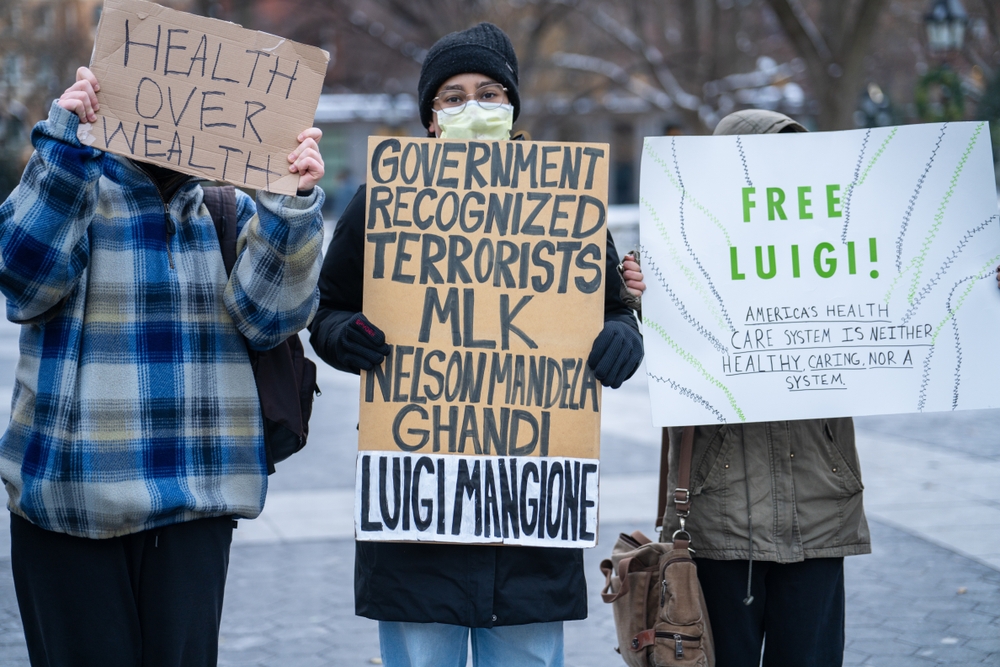
To put it mildly, the disturbed young man who now faces charges for executing Thompson on a Manhattan sidewalk has been hailed as a folk hero. Media figures and academics immediately campaigned to justify his violence against Thompson. A relatively anonymous executive with a wife and young children, Thompson was hardly on notice that millions of Americans had silently put a fatwa on his head. And even among progressives who despise capitalism and believe healthcare cannot be rationed, few if any had even heard of Thompson until the moment they rushed to his killer’s defense. Yet somehow they knew Thompson’s untimely death was cause for celebration.
Now Thompson’s alleged murderer has raised half a million dollars for his legal defense, largely from strangers. His popularity is not due to his perceived legal innocence, but precisely because his fans think he did what he is accused of doing. The night before his first court appearance, an image suggesting he is the messiah was projected onto a Manhattan building. Across the country, his face adorns t-shirts and concert backdrops. Thousands of social media posts offer humorous photoshopped alibis thanking him for being such a terrific guy.
Even among those who do not openly celebrate the murder, a whole language has cropped up to justify it. Health insurance executives are said to be greedy, rich, responsible for rationing a scarce resource that many consider a “human right.” Whatever Thompson got, on this view, he deserves, because in a sense he is the real threat to Americans. “People can only be pushed so far,” said Sen. Elizabeth Warren, as if it had long been understood that the health insurance industry was on the cusp of driving Americans to violent revolution. “I think for anyone who is confused or shocked or appalled,” explained Rep. Alexandria Ocasio Cortez, “they need to understand that people interpret and feel and experience denied [health insurance] claims as an act of violence.”
Whatever motivated the murderer to pull the trigger and shoot a defenseless man in the back is beside the point. He and his victim have evolved into avatars of good and evil, the righteous little guy exacting justice from the exploitative rich. It does not matter that this bears no resemblance to the facts of the case that drew this reaction. Here’s the reality: a young man raised in wealth and educated at Penn executed a man of working-class origins who rose through the ranks of his industry, made a lot of money for his efforts, and cared for children who will now grow up fatherless.
From Folk Hero to Murderer
The progressive response to the Penny case was remarkably different. Penny also probably committed a homicide in the technical sense. Yet a New York jury found him not guilty of committing a crime. That charges were even brought remains baffling to the same Americans “confused or shocked or appalled” by Thompson’s murder because descriptions of Jordan Neely’s erratic behavior lead them to conclude that Penny acted in legitimate defense of himself and others. Neely appeared to be on mind-altering substances, was shouting clear threats of imminent violence, and menacing subway riders when ex-Marine Penny took matters into his own hands and incapacitated Neely with a chokehold. Some Americans still consider that a heroic act; for his efforts or least his legal ordeal, Penny received a job offer from Andreesen Horowitz, the venture capital firm run by anti-woke entrepreneur Marc Andreesen.
But for many progressives, especially those aligned with Black Lives Matter and other groups that capitalize on these rare incidents, Penny did not neutralize a threat. To the contrary, he instigated racialized violence. Perhaps his sense of danger was clouded by implicit bias against black people. Or perhaps he used excessive force because he did not consider the homeless, mentally disturbed Neely an equal human. Whatever the mechanism, they argued, Penny had done something deeply wrong and was the villain of the story. His exoneration confirmed that white supremacy lives on, allowing vigilantism against a black man who, regardless of what he was doing just before his death, is inherently a victim, not an aggressor who deserved to be met with violence.
That Penny, too, may have “interpreted and felt and experienced” Neely’s threats “as an act of violence” seems immaterial – it does not even appear to have entered the progressive calculation. Rather, that story is framed as a chapter in a long story about racialized violence. This story altered the facts as much as the lionization of Thompson’s killer did. Neely, who had a lengthy criminal record and repeatedly refused mental-health treatment prior to the fateful subway encounter, was translated from “person threatening others with imminent harm” to “black person.” Penny went from “good Samaritan stepping up to protect vulnerable people from threats” to “white man.” In a by-now-familiar pattern, both actions and identities became conflated. To progressives, the calculus of right and wrong is less about what was done than by whom it was done.
This transformation of moral analysis is the thread connecting the seemingly inconsistent reactions among American progressives to these controversial killings. Both incidents are integrated into stories about classes of villains and heroes (or at least innocents). Those identities provide the raw material for an analysis of right and wrong. When a lunatic kills a CEO, it’s a noble act of self-defense against the “violence” of the system, which benefits rich executives. But traditional self-defense can be a mere facade for a lynching if tainted by the presence of race dynamics.
Proceduralism is Not Enough
Most conservative criticisms of the progressive approach to making sense of these stories have focused on the procedural elements of this story. Thompson’s killing was wrong, they contend, because he was never charged with or convicted of a crime. Penny’s actions, on the other hand, were acceptable because there are a few exceptions to the requirement that violence go through due process of law, and defense of self and others is one of them. The procedural criticism is correct but insufficient to appreciate the implications of the emerging progressive consensus about the role of identity in moral analysis.
The battle over moral basics is not about whether rules constraining violence still apply. Nearly everyone, including those who met news of an executed CEO with joy, agrees they do at some level. That much is evident from the ubiquitous language trying to “justify” and thereby legitimate Thompson’s killing. It’s not murder if Thompson deserved it. By contrast, what Penny did is murder if Neely didn’t deserve it. The rift is not about whether vigilantism is generally justified, but about which justifications for violence are legitimate. That debate, like nearly all arguments about political economy beneath the surface, implicates substantive questions about desert.
Who Deserves to Die?
You will notice that I did not use words like “innocent” to describe Thompson, Penny, or Neely. That is intentional. Calling someone innocent—in the moral sense, not the legal one that they have not been convicted of a crime—begs the question. What does it mean to have been an innocent victim of unjust violence?
It is a question worth asking because for so long it did not have to be answered. The fact that we can now identify two distinct answers means our moral consensus is cracking in a way that deserves urgent attention. It is worth asking, furthermore, even if you (like me) think Thompson and Penny were clearly innocent, and did not deserve to be deprived of life or liberty, because answering it helps make sense of the confusing, appalling, and shocking phenomena of Thompson’s murderer being lionized while Penny found himself one of the Manhattan District Attorney’s targets for prosecution.
Progressives who celebrate Thompson’s killer and revile Penny are not nihilists. They do not abhor violence categorically or celebrate it for its own sake. Nor are they the moral relativists we have been hearing about for decades. They are champions of a morality that seems shocking because it is alien, but which makes sense on its own terms. At its heart is a foreign but increasingly popular method of calculating innocence and guilt on the basis of one’s characteristics rather than one’s behaviors. It results in the view that people with characteristics associated with power deserve violence, even or especially if the law protects them, and regardless of what each particular individual has actually done. This goes beyond merely balancing out supposed “privilege” held by some on the basis of their unchosen characteristics.
To most Americans, though, executing a man on the street does not become justified merely because that man is rich, powerful, or had a job in a disfavored industry. That moral judgment goes beyond procedural concerns about vigilantism. It would be wrong for a jury to convict a health insurance executive for the crime of being rich. We believe that people should only be rewarded or punished for what they do. What makes someone deserving of violence is that they have engaged in antisocial behaviors, which make the free and cooperative functions of society impossible. Some of those behaviors, like announcing your intent to hurt bystanders on a subway car, are so imminently threatening as to warrant violence to stop them. The “threat” is literal, physical, immediate harm.
But to the morally inverted, this calculation makes no sense because individual actions are merely expressions of systems of power. In other words, who people are and what they do are inextricable. We have heard formulations of this axiom again and again from power-analysis true believers. Now we can see where such thinking leads: White people uphold white supremacy in all actions, unless they are fomenting revolution; rich people perpetuate exploitative capitalism; cisgender people engage in transphobia as long as they do not tear down all structures that treat cisgenderism as the norm. In other words, they are engaging in violent oppression whether they intend to or are even aware of it. For that reason, violence against them is inherently justified. Indeed, it is a form of self-defense even when there is no immediate personal threat.
This is a logic of anarchy, if not war. If humans are to flourish, we need to distinguish between the literal violence of that swinging fist and the “interpreted” violence stemming from the fact that rich people and scarcity exist. Incidents like these heighten the anti-human core of the moral inversion. They provide a ringing alarm about where the spread of abstract identity-based analysis leads. Failing to contain this erroneous moral reasoning will only deepen the moral rift into a crisis of social trust, the disappearance of cooperation, and eventual social disintegration. Put differently, the disappearing social consensus around calculating innocence threatens civilizational collapse.
Is there a way to heal the rift?
It won’t be easy to pursue, but I think there is a way out. Presenting the moral inversion of progressive moral reasoning clearly, pointing out its hollowness, and advancing the competing view of desert can allow people of good will to see that only one set of moral considerations is fit for use by human beings. It’s common—and perfectly understandable—to refer to that set of principles as “normal” or “traditional.” But they did not become normal or traditional by accident. They are expressions of the Biblical account of justice, which emphasizes that each individual is accountable for his own actions. “Each individual,” and not his clan or community; “his own actions,” and not his status or characteristics.
The Jews brought into the world an anti-pagan view of humans as agents in partnership with God. Christians universalized that view. Our Judeo-Christian inheritance came to comprise principles so basic to civilizational flourishing that we often forget that they have not always been taken for granted. Among them is a verse repeated in various forms throughout the Hebrew Bible emphasizing that characteristics like wealth are not relevant to the just resolution of a dispute: “Do not respect the person of the poor, nor favor the person mighty; but with justice shall you judge your neighbor” would become the oath recited by American federal judges taking office.
The individual, moreover, is the locus of accountability: “Fathers shall not be put to death for the sins of their children, nor children for the sins of their fathers,” says Deuteronomy, widely quoted by the Founding generation as the backbone of good government. “Each man for his own sin shall die.” Dozens of similar verses mark the Hebrew Bible’s unique treatment of justice. Even with the theological divisions that separated Jews and Christians, this conception shaped the West as Christianity conquered pagan Europe and began to develop its own systems of civil law.
The seeds of American culture were planted by a generation that knew its Hebrew Bible and considered its basic moral schema integral to civilization. Our Founders recognized that Biblical morality was conducive to human flourishing because it broke from the pagan practice of treating people as collective abstractions representing battling gods. That our cultural distance from Biblical familiarity grows in tandem with neo-pagan temptations of identity politics is no coincidence. Paganism is not an artifact of history. It is a temptation lurking in every human heart.
Having had no opportunity to explicate the principles we have long lived by but rarely articulate, most Americans lack the grounding to weigh the pros and cons of the water in which we swim. And they have likely embraced the alternative because it presents itself as progressive and humane. Showing that it is neither stands a chance, if we can find the language to describe the ongoing competition and the courage to advocate for our own heritage.
Unfortunately, showing may be the best we can do. Even if everything I have presented is persuasive, it does not lend itself well to policy prescriptions. There is no magic bullet to force Americans to face the crisis of moral reasoning, much less accept that one system deserves to win. It is impossible to enforce any system of moral reasoning in a constitutional republic that values freedom of conscience. That is precisely why maintaining norms by other means is so crucial. What do you do when the bottom drops out of those norms? The go-to answer is “education,” but that turns out to be thin gruel. Perhaps school boards can integrate examinations of biblical moral reasoning and contrasts to pagan and neo-pagan systems into curricula. Aside from legal hurdles such changes would face, there is no guarantee the normative lesson will get across – certainly not in the hands of administrators and teachers disinclined to advance the cause. Good parents and religious leaders can sustain a remnant, but by definition cannot reach the people who need to hear this most.
The bottom line is that there is no surefire way to tell people how they should make sense of the world. Americans are free to embrace ways of thinking that threaten to tear civilization apart. What we can do is commit to speaking about why they shouldn’t, frequently and specifically. Within our spheres of influence, we can emphasize that identity-driven analysis is not just wrongheadedly anti-human but truly threatening.
Sometimes calling a problem by its name is the first step towards solving it. Even without direct policy responses, we can name and explicate the competing moral systems and hope that our message finds receptive ears. That was the task of the Hebrew prophets who were persecuted for calling upon their own societies to correct their perversions of justice millennia ago, and it may be just as thankless a job today. But it is no less crucial to fending off the collapse of this great civilization.
About The Author
