





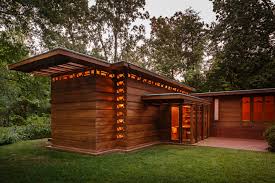


Two very different houses stand on the grounds of Woodlawn Plantation, a historic landmark just across the Potomac from Washington, DC. The larger building is a stately Georgian manor built in 1799 as a wedding gift from George Washington to Eleanor Parke Custis, Martha Washington’s daughter from a previous marriage. The smaller is the Pope-Leighey House, a compact, mid-century modern home built in 1941 by Frank Lloyd Wright for a local newspaperman. Strangely enough, the imposing colonial mansion has a much greater hold on our national imagination than the graceful, distinctively American house built for a family of modest means.
In late August, President Trump signed an executive order making “classical and traditional” architecture the preferred style for federal projects, a reasonable response to a spate of public buildings that seem bizarre, out of place, or intentionally alienating. Yet arguments over government construction projects, however heated, have little to say about the everyday spaces we inhabit. Despite our unprecedented wealth and rich architectural legacy, Americans seem to have lost interest in building affordable, beautiful homes. The result is an impoverishment of our private lives as well as our public spaces.
Like most of Wright’s designs, Pope-Leighey is elegantly integrated into the surrounding landscape. The artful blurring of lines between nature and home and the large, carefully-situated windows help conceal the fact that the building itself is quite small: a mere 1,200 square feet, little more than two bedrooms, a spacious living room, and a kitchen that many people might reasonably mistake for a broom closet. The house’s big windows and spare, geometric layout are characteristic of Wright’s “Usonian” homes, which combined innovative design, access to nature, and middle class affordability.
Usonia, a term coined by Wright to describe his architectural philosophy, is derived from United States. Wright was a fearless innovator and new forms and methods were part of his vision of America’s built environment. but his homes avoid many of the features laypeople find alienating in modern design.
Instead of towering above their surroundings, Wright’s houses are integrated into their environment, an approach he called “organic architecture.” The most famous example of this is Fallingwater, an audacious, cantilevered building that levitates over an actual waterfall. But Wright’s more modest projects were shaped by the same philosophy. Pope-Leighhey was built for a mere $7,000 after its original owner, Loren Pope, sent Wright an admiring letter asking him for a Usonian home on a budget.
It is possible to overstate the affordability of a house like Pope-Leighey. When construction began in 1939, the median American family income was just over $1,200. Pope had to finance the project through an unusual loan he obtained through his employer, The Washington Evening Star. Still, Pope-Leighey’s cost compares favorably to modern mortgage down payments, which are usually in the mid-five figures.
One reason Wright’s Usonian houses stand out, then, is that they were conceived with middle class families in mind. Another is their connection to the American landscape. Like many 20th century architects, Wright had a horror of excessive ornamentation, but he was interested in marrying his designs to their natural environment. New Yorker architecture critic Ada Louise Huxtable, whose short biography of Wright is appreciative of his gifts but appropriately critical of his excesses, wrote that “[u]nlike European buildings that maintained a cool aloofness from their surroundings, Wright’s slabs were tied to the earth, physically and symbolically, with rough local stone and natural textures and colors.”
Wright also built for Americans’ suburban aspirations. He was obsessed with driving, organizing annual cross country road trips from his summer headquarters in Wisconsin to a winter campus in Arizona well into his late career. “Broadacre City,” a planned community Wright first envisioned in the 1930s, is the polar opposite of the dense, vertical design trends beloved by mid-20th urban planners. It is spread out, private, and thick with vegetation and green spaces – a vision of American suburbia before the idea really existed.
Wright’s aesthetic sensibilities reflect Wright’s character, which was almost Ur-American in both its faults and its achievements. Wright grew up poor, a child of divorce, and never finished high school. As his career took off in early 20th century Chicago, he rejected an offer to join a more established firm and study in Paris and Rome. He ignored overtures from European luminaries like Walter Gropius of the Bauhaus School and Le Corbusier, whose spare, vertical, and centralized vision for 20th century living was the antithesis of Wright’s design philosophy. His meteoric rise inspired the character of Howard Roark, the uncompromising protagonist of The Fountainhead, Ayn Rand’s libertarian parable.
Like some other self-made Americans, Wright also lied all the time, about everything from cost estimates to his birth year. The lone, embattled genius, the charlatan with a gift for self-promotion, the Midwestern boy of humble origins who rose to greatness, the leader of a quasi-cultish architectural commune in the hills of Wisconsin – Wright’s varied career and kaleidoscopic personality embody the American experience.
For a time, Wright’s vision seemed poised to define suburbia. Until the very end of his career, he built private residences across the length and breadth of the country. In the 1950s, Alcoa sponsored a line of “care-free homes” in all 50 states designed by Charles Goodman, a Wright protege. In Florida, the Sarasota School emerged in the 1950s and 60s to adapt mid-century modernism to the state’s unique climatic conditions. The influence of Wright and his disciples persists in ranch-style homes, which are still common throughout suburbia but have steadily declined in popularity since the 1970s.
Postwar America saw an explosion of homebuilding for working and middle class families, much of it uninspired and lifeless. William Levitt, often called the father of modern suburbia, pioneered the use of assembly line techniques to rapidly build entire neighborhoods. Though affordable, a “Levittown” house in New York was almost indistinguishable from its counterparts in Pennsylvania or Virginia. Usonian homes, by contrast, were tailored to their natural surroundings.
Though Wright’s ideas have receded, the ghost of Woodlawn Plantation continues to exert a baleful influence on residential neighborhoods. American architecture is caught in a perverse trap: our most distinctive and beautiful buildings, from historic colonial townhomes to midcentury modern enclaves, tend to be located in blue states, where a thicket of rules and regulations preserve these structures at the expense of building for the next generation of homeowners. Red states, meanwhile, make it easier to build but new developments are dominated by ugly tract houses and garish McMansions. Too often, these homes clumsily ape historic styles without the necessary space, materials, and craftsmanship.
Outside of a few wealthy buyers, design enthusiasts, and historic preservationists, Wright’s vision for suburban living has also fallen out of favor. The fate of the Marden House, another Wright home just up the Potomac from Pope-Leighey, is a case in point. The original was built for a National Geographic photographer. Decades later, it was acquired by an America Online founder for a multi-million dollar price tag. Homes that were originally built for middle class families have become collectibles for wealthy aficionados.
Hollin Hills, the Northern Virginia neighborhood I grew up in, is another cautionary tale. Originally built by Wright’s student Goodman as an affordable suburban community for design enthusiasts, the neighborhood has transformed over the decades into a beautifully preserved but increasingly unaffordable midcentury modern enclave. Brochures from the 1950s list new houses for as low as $10,000. Today, listing prices routinely exceed one million dollars.
Meanwhile, Wright’s heirs seem uninterested in affordable, attractive homes for middle class families. When today’s architects turn their attention to residential areas, it’s almost entirely through the lens of large-scale development, which tends to be fixated on trendy concepts like walkable urbanism and mixed-use neighborhoods. However worthwhile, these ideas have little to say about the aesthetics of people’s living spaces. Indeed, the recent proliferation of new buildings that combine commercial and residential functions has coincided with the rise of a generic, boxy, and faux-modernist style that will be instantly recognizable to anyone who has visited a major American city in the last 20 years.
A certain subset of Americans are reliably embarrassed by the thought of buying a house in a cul-de-sac, but not everyone dreams of living in Brooklyn. Despite urban planners’ enthusiasm for density, people still like privacy, cars, and personal space. Thanks to his rural upbringing and love of driving, Wright intuitively understood the appeal of suburban homeownership. While other mid-20th century architects envisioned massive housing projects, Wright continued to build artful family homes until the end of his life.
Can America recapture the Usonian spirit? Critics have blamed uninspiring suburban developments on everything from building codes to local regulations to simple bad taste, but one solution is for architects to rediscover an interest in homebuilding. As a young draftsman, Wright “bootlegged” private residential designs outside of office hours for extra cash. Even after he became an international celebrity, he still designed individual homes for clients like Pope. Today’s architects design just 2% of all houses. According to the American Institute of Architects, institutional projects made up over half of architectural firms’ billings in 2020. Single–family residential projects, by contrast, were less than 8%. New suburban neighborhoods are filled with cookie cutter designs chosen mostly by developers.
It seems strange to blame lack of ambition for the dearth of affordable and attractive new housing stock, but how else to explain pervasive ugliness in an era of cheap construction methods, fast transportation, and easy, AI-enabled design? Architects, to borrow a popular social media exhortation, can just do things. Americans are inheritors of a distinct aesthetic tradition that readily accommodates our love of privacy, cars, and space. The symmetry and grandeur of colonial mansions are hard to adapt to suburban neighborhoods, with their medley of garages, sheds, and haphazard additions. Wright’s homes, by contrast, were modular (appropriate for “palace or cottage,” in the words Huxtable) and eminently suitable for a wide range of environments.
Young architects need not slavishly copy Wright to be inspired by his Usonian vision, which was, in the words of one critic, “an architecture that seeks to express the uniqueness of a culture or the spirit of a place.” They should also take heart from Wright’s career, which recovered dramatically after a fallow middle period to produce iconic buildings like Fallingwater and the Guggenheim Museum in New York. Like Wright himself, American residential architecture can recover its sense of proportion, aesthetics, and place. All it takes is a little ambition.
About The Author
