





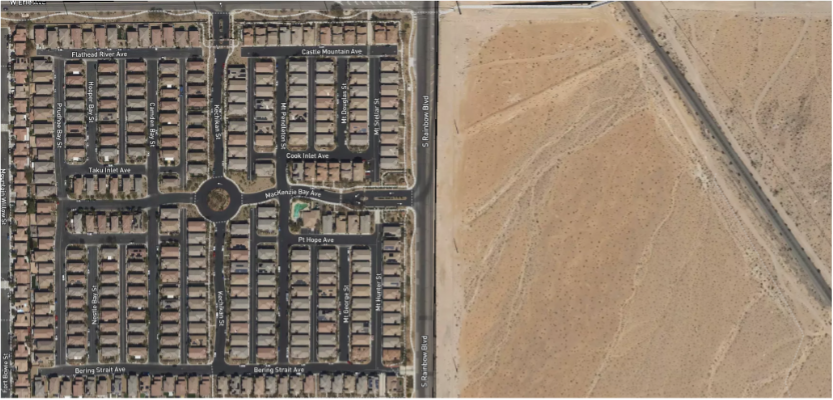


The United States faces a housing shortage of 4 to 8 million homes. This is a crisis for the nation, driving home prices higher, pricing people out of homeownership, and driving many people out of homes entirely. Simultaneously, our federal government is in possession of over half of the 12 westernmost states and Alaska. The sale of a minute fraction of that land – less than 0.1 percent – would be enough to build over 3 million homes over the next 40 years, and 1.5 million in the next 10. In a country starved for housing options, returning to our homesteading roots is a vital part of the solution.
The massive scope of the opportunity presented by Homesteading 2.0 – a proposal from AEI Housing Center scholars Edward Pinto, Tobias Peter, and myself to build 3 million homes on what is currently federal land – is only made greater by the modesty of the cost. Not only is the 800 square miles involved in such a proposal a vanishingly small proportion of federal land, it targets the land least valuable for preservation goals. Homesteading 2.0 isolates land under the jurisdiction of the Bureau of Land Management (BLM), and avoids lands critical to conservationists like national parks and monuments, areas of critical environmental concern, and even nebulous categories like “Wilderness Study Areas.” The 0.1 percent of federal land isolated here lies closer to where people live – to the demand for homes.
Homesteading 2.0 covers two ideas proposed by prominent political figures over the past two years. The first, Home Sweet Starter Home, mirrors Mike Lee’s proposal to sell federal lands for housing in the One Big Beautiful Bill Act, which was ultimately struck from the text in the final hours of its legislation. That proposal would have directed the BLM to sell land for the purposes of housing, isolating the land around population centers – the areas where people are living and want to live. Research by AEI indicates that, of that land, roughly 230 square miles would be developed over the next decade – the land immediately next to current neighborhoods would be developed first. At ten homes per acre – single-family residential densities – that would create 1.5 million homes. Though this particular effort failed, it marked a turn: for the first time in decades, Congress weighed converting a narrow slice of federal land into private ownership for a plainly public purpose.
Freedom Cities, the second Homesteading 2.0 policy, were proposed by President Trump in his 2023 presidential campaign. BLM’s landholdings are vast enough to build 1.5 million more homes in new municipalities within existing metros and near clean water. Freedom Cities offer the United States a rare opportunity to reimagine and reinvigorate itself, unencumbered by the bureaucracies that have stalled development in so many existing cities. Starting with clean charters would let Freedom Cities adopt light-touch, rules-based governance that allows flexible, market-driven growth to create prosperity. That is classical liberalism in the practical sense: minimal and predictable rules that enable prosperity without the restraints of protectionism.

Why Homesteading Has Stalled
Walter Donway’s essay, “Challenging 50 Years of Environmentalist Public Land Policy,” adroitly explores some of the philosophical foundations lying underneath the modern debate on public land sales, many of which can trace their roots back to the Enlightenment. I don’t disagree with his analysis, but the degree here matters for the analysis. This isn’t simply a case where two sides with different ideas disagree on the nature of federal lands, although they certainly do. It’s a case where the benefits – 3 million homes for a nation in the midst of a housing crisis – clearly outweigh the cost of the least environmentally significant 0.1 percent of federal lands. The proposed tracts are of lower environmental value, near existing communities, and Lee’s bill already carved out parks, monuments, wilderness, and other iconic categories. And yet, so far, the 0.1 percent has soundly defeated the 3 million in the political arena. Why?
The answer lies in a classic problem of collective action: the concentrated beneficiaries of the status quo against diffuse beneficiaries of change. In a market, this problem is resolved through compensation – if families need land more than the entity that owns it, they buy it from them, or an intermediary like a developer or bank emerges to do so. This is a typical transaction, and such reallocations are a core mechanism by which markets create wealth.
In government, the problem becomes harder to solve. The federal government receives the revenue from the sale, but the politics of doing so are complicated by ardent protesters and lobbying groups. In this case, environmental and wildlife groups, including the Wildlife Society, issued a letter with 40 co-signers opposing Senator Lee’s provision. These groups have an intense interest in the status quo of federal lands, and there is no reason for them to support any federal land sale, absent compensation. The aforementioned letter states as much, citing as one of its primary concerns the inability “to collect receipts from appropriate BLM land sales and reinvest those dollars into projects that expand access and conserve habitat.”
Those diffuse beneficiaries of homes enabled by federal land sales, on the other hand, are many and scattered. They include the families who would occupy these homes over the next 40 years, the builders and workers that would construct them, households across the country who would pay less as supply rises, local governments that would collect property and sales tax, and the U.S. Treasury, which would receive land-sale proceeds. Each would gain something real, but relative to their broader interests the gain is modest, so they mobilize weakly. Meanwhile, organized opponents defend a regime central to their identity, funding, and mission.
However, the difficulty of action needn’t necessitate a stalemate. The federal government owns the land and the receipts, which gives it leverage to turn a diffuse-benefit reform into a coalition. A narrow, screened program can dedicate a defined share of proceeds to priorities conservation advocates value: habitat restoration near growth areas, access and trail improvements, wildfire risk reduction, and long-term stewardship funds. Another share can support local infrastructure that makes compact growth work: water reuse, arterial upgrades, emergency services. States and cities that adopt by-right small-lot codes and digital permitting can receive performance grants that vest only when homes are delivered. Each batch of sales would get one broad environmental review, short parcel checks for local issues, early Historic and Tribal consultation, and a public BLM timeline for the key steps. The bargain is clear: sell a trivial fraction of federal land, reinvest part of the proceeds in landscapes and communities people value, and use the rest to unlock housing at scale.

| Left: New Residential Subdivision, built in 2010s. Right: BLM land, unavailable for housing |
A Microcosm of a Larger Fight
This fight mirrors the broader YIMBY–NIMBY conflict, in that it exposes a deep tension between conservationism and classical liberalism that runs through both political parties. In NIMBYism, conservationism appears in the literal sense of protecting what exists, in one’s own “back yard.” In YIMBYism, the liberal impulse is to permit greater freedom of action and embrace change. These threads don’t cleanly run through either party – progressive Democrats in California have fought against liberalizing housing laws tooth-and-nail, while Republicans in Texas have liberalized their zoning laws.
This long, drawn-out fight over how we think about housing, property rights, and neighborhood character often frustrates people on both sides for the debate, but this is exactly the type of fight we should hope for. Liberals advance and conservationists protect, and we cannot know in advance which impulse will be right in a particular case. In housing, the YIMBY movement has grown in political power only after a century of unopposed and growing conservationism in local housing policy began to produce unsustainable home prices. The debate over selling unencumbered federal land may follow the same path. It took years to craft pro-housing policies that were both effective and politically feasible – that allowed growth while assuaging the fears of NIMBYs. The same could happen here.
Mr. Donway treats the tension between liberalism and conservationism in Senator Lee’s proposal as a flaw, a muddle of market sale with government conditions. He has a point, and the federal government has not covered itself in glory in setting housing policy nor in selling its land – a Nevada land-sale program launched in 1998 remains in progress, with nearly half the targeted land still unsold. And I sympathize with his desire for rhetorical purity. But two ideas in tension aren’t necessarily irreconcilable – a better goal here is to create synthesis.
The federal government does own this land, giving it bargaining power. It should use that power up front, then let markets operate. Incentivize jurisdictions to allow lots small enough to deliver starter homes, and require impartial, digital permitting with firm response timelines. Use land-sale receipts as incentives and side-payments, both to ease local and lobbying resistance where appropriate and to reward cities and states that commit to fast approvals and market-rate production targets. Freedom City incorporations can be conditioned on charters that entrench light-touch, rules-based governance so these places stay liberal in practice as they grow. If experience from past federal land sales is a guide, the proceeds could run well over $100 billion. That is enough to finance a grand bargain without new taxes.
Homesteading 2.0 asks very little of the federal estate and offers a great deal in return. Selling less than 0.1 percent of lower-value BLM land, screened to exclude parks, monuments, wilderness, and valid rights, would place housing where people have shown they want to live. It is an immense opportunity for our country to return to our roots: the classical liberalism of the 1780s, the frontierism of the 1880s, and the homebuilding of the 1950s, all in one shot. To paraphrase Abraham Lincoln, the wild lands of the country should be distributed so that every family should have the means and opportunity of benefiting their conditions.
About The Author
