





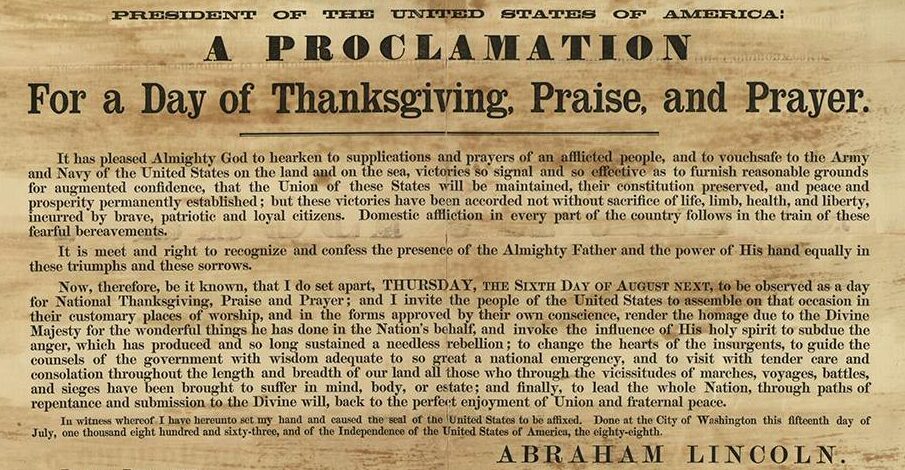


When Abraham Lincoln issued his Thanksgiving proclamation in 1863, he offered the previously regional holiday as a feast of national gratitude in counterpoint to the ongoing horrors of the Civil War. Celebrating the vast resources and opportunities of the United States, Lincoln declared that those boons “should be solemnly, reverently, and gratefully acknowledged as with one heart and one voice by the whole American people.”
Today’s indulgence in resentment risks drowning out what should be a season of gratitude. In testament to the divides of contemporary American politics, the Thanksgiving table has been recast as an arena, where Trumpy uncles or cat-lady aunts can brawl about the latest disposable controversy in between passing the gravy.
Fourscore years before Lincoln’s proclamation, Immanuel Kant penned a famous essay responding to the question, “What is Enlightenment?” Kant’s answer was that “Enlightenment is man’s emergence from his self-imposed immaturity.” The transformative potential of the Age of Reason seemed to be cresting. Across the ocean, a new republic had just been founded upon the basis of “self-evident” truths. Five years after Kant’s essay, a revolution stirred in France that would topple king and church and erect a blood-stained Temple of Reason in their place. The Enlightenment’s revolution could not be confined to the dry pages of scholarship.
We now live amid the churn of revolutionary resentment rather than the gratitude that Lincoln counseled. If the Enlightenment harnessed the disruptive energies of print technologies, the engine of resentment has leveraged digital technologies’ ability to undercut human connection as well as long-standing institutions. Following Kant, we might consider the answer to a different question: What is resentment?
Resentment is mankind’s descent into self-incurred inferiority. This inferiority is the lowering of the self and the splintering of reason. This inferiority is self-incurred because it arises from embracing the habits of grievance. Odisse aude! (Dare to nurse your own enmity!) is thus the motto of resentment.
Resentment feeds its enmity against others and the world with a feast of grievances. These grievances can derive from some injury, whether real or imagined, but grievance is not limited to injury. The successes of others can also become fodder for grievance. After all, one can resent without even being wronged. Someone who loses a footrace might resent the winner, even if the winner did not cheat.
Nor is resentment tied to competitions narrowly conceived. Resenting a stranger’s wealth, beauty, or other source of prestige is a common vice of the shriveled heart. That stranger’s prosperity or good fortune or ability does not take from the person who resents him. In fact, that stranger’s action may even enrich the resenter’s life. For instance, someone could resent the founder of a company that produces a product that he finds useful. Yet that founder’s wealth and fame are a slap to the resentful face.
The habits of resentment are tied to a diminution of spirit, a retreat from the affirmation of the world and of oneself. A strong character meets the injuries of the world and does not begrudge the successes of others. Aspiring toward virtue, the happy person resists the appetites of grievance. The joys of another reinforce rather than steal the happy person’s own joy, and the wrongs of another are a challenge to be addressed and perhaps a thing to be forgiven—not a seed for resentment. The briars of resentment feed on the heart’s blood. As they multiply, they drain our spirit.
The pretenses of enlightenment called for the openness of debate in the written word. Resentment resists the legibility of discursive writing to tend instead toward the performative. Sound and visual spectacle offer a more compelling testimony of grievance and can more easily provoke grievance in others. Resentment has catapulted from radio and television to podcasts and streaming media. The medium reinforces the message. The fragmentary nature of resentment (lurching from one slight to the next) finds an apt partner in the wandering diffusion of the digital age.
Because resentment uses grievance as a justification, the resentful have an extraordinary motive to find grievance. Resentment’s imagination for wrongs is a distorted reflection of introspection. While introspection attempts to see truly, the aim of resentment’s imagination is to envision some grievance in the details of experience. Could a pause in a sentence be read as a cause for trauma—some hidden slight, some veiled insult? That man lounging in a subway car—doesn’t the way he sits reveal some affront to me, some deep injustice in the world? “Have a nice day” reminds me of the relentless ablism of our world, and the middle-class privilege that emphasizes being nice. Resentment’s explanations posit vast, shadowy enemies: the patriarchy, capitalism, neoliberal elites, globalization, foreign governments, or any other enemies. Resentful invention blows the smoke of grievance over all the world.
Digital-media platforms can become a global stage for resentment, turning users into both spectators and actors. Performative demonization—the dismissive chortle, the wide-eyed denunciation, the flail of profanity—creates viral resentment. The continued onslaught of content and the incessant demands for reaction in the digital era promote the fragmentation of thinking that is essential for resentment as a thoroughgoing worldview.
The dominion of resentment is the rule of re: remembering, reacting, reckoning, and rebuking. Because of the withering of the spirit, resentment is fundamentally reactive. It searches for grievances and takes its bearing from opposing what is around it. Resentment is in that sense fundamentally critical, even if its judgements are distorted by spite. Resentment is tireless in its quest for grievance, always hunting for some object for venom. It calls for a reckoning, in which the targets of resentment will at last receive their rebuke.
Resentment seeks power but not the rule of reason. Resentment has use only for a degraded form of reason that exploits calculation as a way of justifying calumny. Reason in its full sense is guided by the good and toward a comprehensive vision. It aims to understand the particular within the context of some greater whole, even if that whole is only partly understood. It is a task of reason to inquire after human flourishing and then to understand what advances it. Reason might, for instance, take into account the importance of close human bonds for our own development and then consider how a social or political order can help support those important connections. In addressing human flourishing, it might consider how law might be used to promote the common good.
If the exercise of reason in its full sense draws us toward the whole and the good, resentment fixates on the fragmentary and the bad. Like its memory, resentment’s calculations are partial and best suited for nurturing grudges. In order to justify hitting someone, the resentful person might remember when he was hit by that person’s brother. That remembered slight offers an incentive for harming another. If politics has been called the “systematic organization of hatreds,” resentment breaks free from the rigor of the system. Resentful politics is a haphazard succession of expressions of enmity.
Resentment offers a Copernican revolution for political liberties. Reason’s defenses of political liberties attend to questions of enduring human value and political prudence. One might argue that something like freedom of speech is a “natural right of the person” within certain limits or claim that such freedoms are an important vehicle for managing political conflict. For resentment, however, freedoms function either as a source for grievance (when one’s own “freedoms” are trespassed) or as an annoyance to be appropriated from a foe (in which case the foe’s “freedoms” are themselves trespasses). Freedom for resentment is fundamentally a question of status. When one’s adversaries turn the powers of the state to hurt one’s friends (through prosecutions, tax penalties, state-backed censorship, and so forth), that exercise of power is an assault on freedom. However, you reserve for your own faction the right to use such powers against your adversaries—against your enemies. What matter are not rules or laws but who/whom.
Reason aims toward the truth, but resentment is guided by status. The resentful take any good thing not their own as an affront. It is unsurprising, then, that educational institutions that have founded their identity on conferring status should themselves be among the principal engines of resentment today. A citadel of status-seeking, Washington is a seething capital of resentment.
Resentment has a conflicted relationship with democracy. The mobilization of animosities has been an essential element of democratic politics. Democratic contests welcome civic resentments into the public square and become a vehicle for the unavoidable struggle between groups. With l’etat c’est moi, Louis XIV apocryphally claimed to embody the whole of the polity, but the democratic process is at odds with royal synthesis. Instead, it channels the conflicts within a community.
Grievance can be both necessary and salutary for a democratic regime. Democratic competition involves the airing of grievances, and the risk of grievance can inspire discipline in a political coalition. A dissatisfied electorate can punish a reigning party for its policy follies, economic fiascos, and ethical failings, so the threat of public grievance is a meaningful political guardrail for a democratic governing celite. The First Amendment explicitly protects the people’s right to “petition Government for the redress of grievances.”
Yet resentment can also cause such a society to fracture. The dangers of faction warned about in past centuries were tied to the danger of resentment. Statesmen feared that organized parties would come to fixate not on the public good but their scorn of others. And one of the most cunning feints of faction is the purported appeal to ethical principles. The wickedness of one’s foes demands that they should not be accorded legal protections, and venom is an apt camouflage for hypocrisy.
Often, partisans accuse their opponents of behaviors they once practiced or views they once held. An attack on a government building is a “mostly peaceful” protest or an existential threat to democracy—depending on who does the storming. For the resentful, the cause is secondary to the status of those enlisted on behalf of that cause. The escalation of resentment can lead to civil war or constitutional decay, and it can also enable political stagnation in the short and medium terms. If a party in power fears public grievance for its failures, it will be tempted to govern instead by redirecting resentment toward its political foes. A politics of blame will not fill people’s plates, but it can temporarily distract them from the grumblings of their stomach or cause them to blame someone else for their hunger.
The way resentment avoids fulfilment reveals how distraction and incoherence enable our age of resentment at the levels of both the individual and society. Resentment fundamentally splinters us. It cuts off the person from the world and dissipates his inner life in the frantic pursuit of grievance. Rather than climbing the mountain of duty, the person instead retreats to the familiar desert of spite. Resentment also divides us against each other, turning other people into mere quintains. Resentment does allow for a kind of collective mobilization, but the bonds it forges are those of enmity rather than friendship. In this respect, this age is the age of resentment or the century of…of scissor statements.
“Free thinking” has long been a slogan for glib transgression. Few have been more mediocre than the self-styled “free thinkers” of the past—or more susceptible to resentment. Yet free thinking rightly understood demands habits of thought that prepare us for freedom, and realizing free thinking to some extent requires a certain character. Free thinking requires intellectual credibility and charity—a rigor of thinking that is also open to correction. Guided by reason, free thinking does not nullify authority but instead can make authority responsive to reality.
A further paradox arises. Kant hoped that the age of enlightenment would be guided by the courage to use one’s own reason. No question would be settled. Everything would be up for grabs. While at first seeming opposed to it, the age of resentment might be a twisted fulfillment of that project of supposed enlightenment. Absent tradition and institutions, the seemingly enlightened use of “reason” could in fact become a vehicle of annihilating grievance and a cognitive fracturing that undermines the exercise of reason. Who uses his own “reason” more than a conspiracy theorist, and whose reason is often more debilitated by a paranoia masked as rationality? The tutelage of tradition might thus help liberate reason from partiality and self-deception, while a radical unmooring from tradition might simply emancipate spite. Political freedom is apt to stumble without free thinking and the character it requires. Yet endless and endlessly cunning resentment confines a body politic to reactive fragmentation. Repairing a character fit for reason is an important task for conserving the blessings of freedom.
In his Thanksgiving proclamation, Lincoln appealed to a power beyond human agency. This was not “gratitude” in the abstract but instead dedicated to “the Most High God, who while dealing with us in anger for our sins, hath nevertheless remembered mercy.” If resentment traps us in the muck, gratitude in the deepest sense can help us glimpse a horizon at once mightier and gentler than we can fully know.
About The Author
