





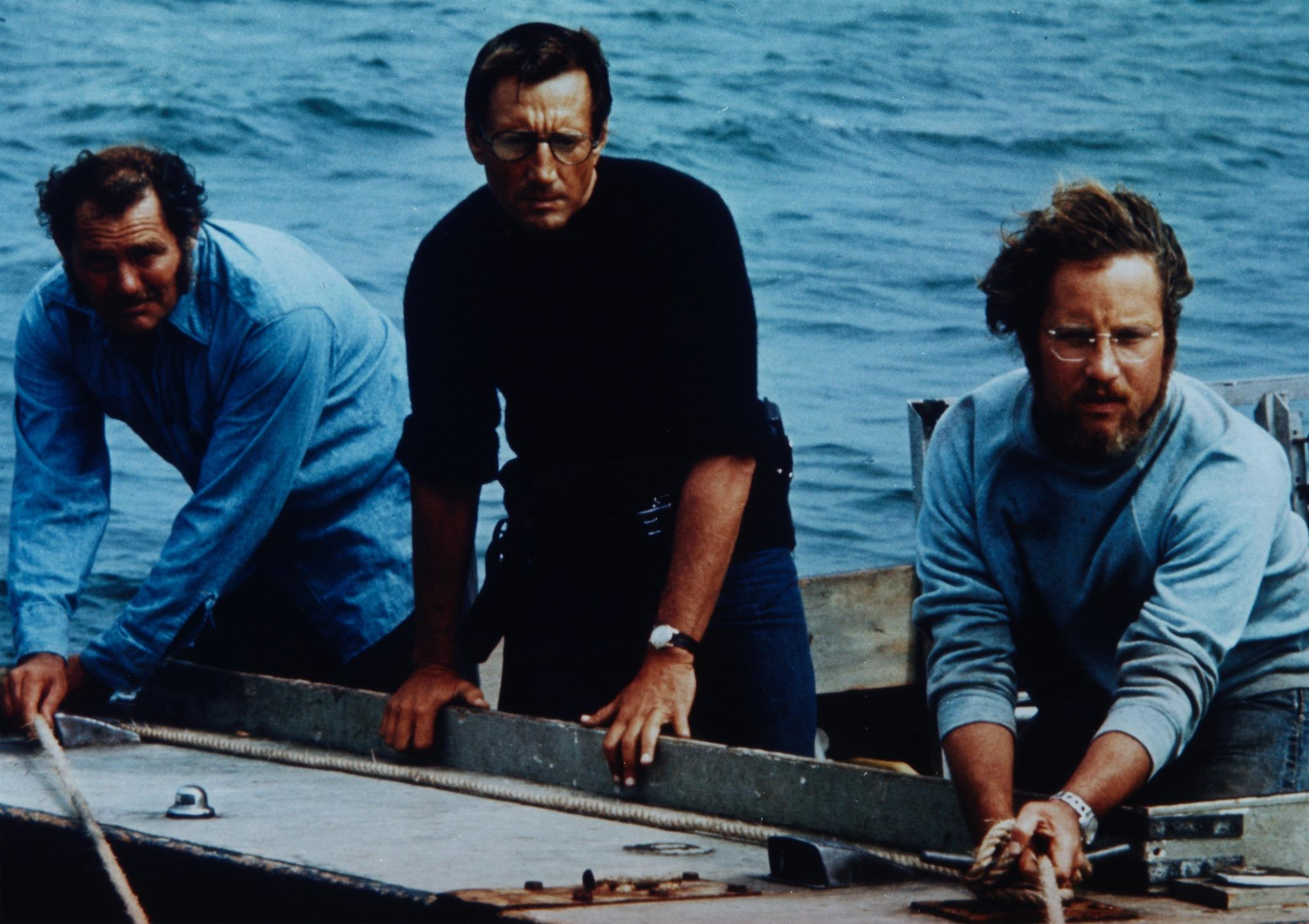


The Fourth of July is all about the fireworks, and that’s true of the Star-Spangled Banner as well as of Jaws, a movie about the holiday that is credited with launching the era of the blockbuster when it was released in 1975. Following the example of Jaws, many blockbusters have been released around the Fourth. It’s a fitting occasion to celebrate America, to reflect on American history and take stock of American life, and to dramatize national conflicts on the largest scale available to us, and to look with hope to the future.
Jaws, now on it’s 50th anniversary, was Spielberg’s first major success and prepared him to become America’s favorite wizard, enchanting his audience with scientific fantasies and transforming the national memory through his lengthy career. But if we return to that first moment of triumph, we don’t find the aliens or dinosaurs, the robots or heroes of World War II that feature in his subsequent films. Instead, we find middle-class Americans at their most drab, going through the crisis of the ‘70s.
Crisis is a strong word, often overused. But remember the problems of that time, from the collapse of American confidence in the Vietnam War leading to the fall of Saigon in April 1975, to the Watergate scandal and the unprecedented resignation of President Nixon in August 1974. Crime skyrocketed, there were race riots, domestic terrorism rocked the nation with thousands of bombings, the economy was in trouble and energy prices shot up after the Oil Shock of 1973. Somewhere in all this, a flight to suburbia that began in the 1950s as accelerating. That’s the context of Jaws.
Our protagonist, Chief Brody (Roy Scheider) is a fugitive from the violence of NYC who has taken up a police job on Amity Island (filmed on location in Martha’s Vineyard), where it doesn’t look as though anyone will need him and where his wife, kids, and dog will be safe. Amity sounds like the kind of name Puritans liked to use—Concord, Providence, Salem—and it looks like the white-picket fence small town of America’s agricultural past. It’s quaint, reassuring, and seems old-fashioned but is actually very modern. Amity doesn’t live off fishing or a naval base, there’s nothing active or manly left, it’s a tourist spot now. And while such resorts were once limited to the rich, Amity hopes to attract crowds of daytrippers who have enough money to make the journey and buy souvenirs but not enough to use “summer” as a verb. Come one, come all!
The risk of decadence, even impotence that pervades the story is somehow tied up with men who cannot satisfy women or protect them. We first see Brody in bed with a wife whose female charms he cannot face. The first shark victim, a young woman, is killed because she is in the water alone after a party, while her young man is passed out drunk on the sand. These characters hold masculine roles—cop, husband, boyfriend. But they’re unwilling or unable to exercise any authority.
Brody cannot stand up to the mayor’s desire for business or the tourists’ desire to enjoy themselves on the beach. He only stiffens his resolve when a woman who lost her child to the shark slaps him in the face in public for failing as a man. The same woman initiates the hunt for the beast when she puts hard cash down as a reward. Amity, like America, is out of control because its men no longer how to lead.
The most startling scene in the movie reveals the public form this problem takes. In a parody of Tocqueville’s account of the New England township, America’s school of democracy, we see the people of Amity, their business leaders, their mayor and his new Cadillac, the fresh memory of the victims on their minds. Everything conspires to bring these citizens to deliberation and collective decision, yet instead we only get illusions, hesitations, and cowardice.
Only after a shark attack in view of the entire population, local and tourist, are people finally ready to act. Yet a failed mass fishing expedition shows that only an experienced shark hunter can get the job done. So they delegate the mission to an Ahab-like avenger, Quint (Robert Shaw, in an amazing performance that somehow benefits from entirely lacking plausibility, starting with his bizarre accent). Fear and greed drive Amity into Quint’s arms, but Chief Brody and his new friend Matt Hooper (Richard Dreyfus) supply a corrective to his tragic or mad greatness, as the conservative policeman who believes in rules and the liberal scientist, who studies nature rather than seeking to kill it.
All this drama is necessary to bring us to a simple situation, three men on a boat, fighting a great white shark, day and night, until the fearful end. It’s petty and at the same time cosmic, like Hemingway’s The Old Man and The Sea. We’re not talking about billionaires or presidents, or even modestly successful people (although Hooper inherited a fortune that he uses to fund his oceanographic research). These are eccentrics, not to say losers. Yet they must bear the burden of American principles in a situation where they cannot call on any outside help.
We watch and wonder whether the America they embody will endure or retain sanity. That’s the meaning of the suspense for which Jaws is famous. The transformation of social drama into a cosmic struggle finally gives us a clue about the strong feelings associated with the Fourth. The Declaration of Independence speaks of natural rights to life, liberty, and the pursuit of happiness. But is nature really good at all? The sea isn’t simply a setting for swimming or recreational fishing. What if it is deadly instead? We begin to see that Americans have to fight for their way of life and can’t count on it simply being given to them.
The haunting conclusion of the movie, a sheriff and a scientist on a makeshift raft, paddling in a seemingly infinite sea trying to get to shore—typical of Spielberg’s art—suggests that for us to rise to the occasion we have to reject reassurance and become willing to take danger seriously, but also to avoid madness.
In other words, we need an all-American liberalism, manly yet not without humor—that’s the duo of Brody and Hooper. They’re able to act decisively in dangerous situations, but are also able to sit around the dinner table with the wife and kids and the dog and enjoy a peaceful life. That’s the promise of the blockbuster, that some of the wonder and thrills of life outside suburbia are still possible and, in a way, good for us—but also that we can go back home when they’re over. That’s the assertion of independence that we need, modest, not quite revolutionary, but perhaps enough to reverse decadence.
Obviously, our times are in many ways similar to the ‘70s. But also many things have changed and one of them is the end of the era of the blockbuster. We lack the ability to imagine the right kind of characters—Spielberg pioneered cinema without stars—and we lack the national audience. Triumph over catastrophe in two hours, between sips of the soda and chewing on popcorn, all that is gone.
We’ll have to look elsewhere for our reassurance as well as our thrills. But as we do, we would do well to remember what a great service Spielberg did America through such middlebrow hits. A popular art was raised to national dignity, no mean achievement—that’s why we still remember Jaws. Enjoy the thrills, and even the nostalgia, of the shark hunt this Fourth, and welcome that poetic inspiration and guidance into real life—America can make it through great challenges.
About The Author
