





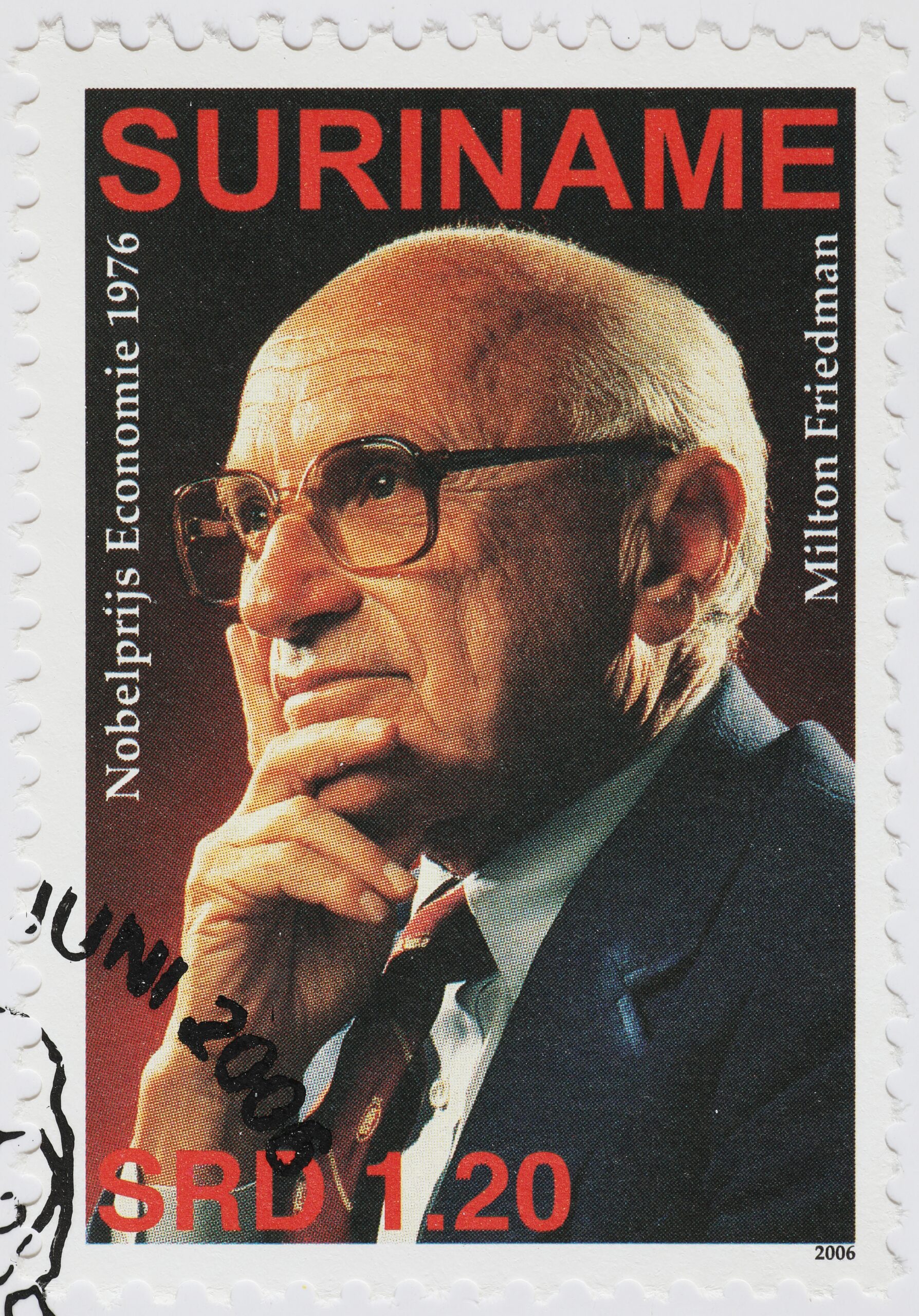


Since at least the 1791 publication of the Life of Samuel Johnson, a pioneering biography of the English man of letters, scholars have debated the value of biography as a genre of history. Many writers and readers like the chronological order and narrative focus that biography usually imposes. Yet historians sometimes criticize biography for emphasizing individual character at the expense of broader networks of association, formal institutions, and broader social conditions. Analysis, so they say, gives way to hagiography.
Stanford historian Jennifer Burns has published remarkable biographies that largely belie critiques of the genre. As Burns shows in both her bestselling life of Ayn Rand and new study of Milton Friedman, biography is a powerful tool for understanding how politics and ideas shape individual lives—and how those individuals, in turn, shape history. According to Burns, tracing the arcs in Friedman’s life uncovers “skeleton keys” to the economic and political development of the twentieth-century U.S.
I recently spoke with Burns about these “keys”, and the understanding they unlock. The following conversation has been edited and condensed for clarity.
Bruggeman: Who is the Milton Friedman readers encounter in The Last Conservative? How is he different from the Friedman that readers might know from his TV appearances, including the documentary series Free to Choose?
Burns: Most people today know about the person I call “YouTube Friedman,” or “decadent Friedman.” They have seen videos of Friedman in his later years, as a public intellectual and pugilist. Admittedly, this Friedman is fascinating; indeed, his skill at popularizing economic ideas is what first drew me in. However, I then became fascinated by the other dimensions of Friedman that aren’t so evident in the public eye, including his student years at the University of Chicago, his efforts to conceptualize a “new liberalism” suited to the twentieth century, and the slow and painstaking work of building up a monetarism into a school to rival Keynesian economics.
If Friedman was a “new liberal”, why dub him “the last conservative”?
Although Friedman didn’t like to consider himself a conservative, he was firmly aligned with the political movement that called itself conservatism. Unlike the conservative traditions of other countries, in the United States in the twentieth century, conservatives generally embraced and even celebrated free market capitalism. This synthesis allowed Friedman to become a central intellectual figure in the conservative movement. Today, this synthesis has come undone, and for that reason I believe Friedman symbolizes a cultural and intellectual moment that has passed from the scene. That doesn’t mean Friedman’s influence has diminished! In fact, the less he is linked to a political movement, the more his ideas can permeate society. We see some of this happening today, as progressive movements integrate Friedman’s ideas about a universal basic income and regulatory capture into their thinking.
Some critics, largely on the left, allege that your biography doesn’t make a full account of Friedman’s controversial actions or opinions, such as his praise of economic policies adopted by the Pinochet regime in Chile. How did you balance the historian’s mandate to present an accurate picture of Friedman’s politics in his time with the shifting pressures of political life in our present?
It’s a tricky balance. On the one hand, I believe it is the essential work of the historian to explain the context in which ideas seemed plausible to their authors. This is even more important if these are ideas with which you disagree. After all, no one consciously holds ideas they think are wrong. So if you want to combat bad ideas, a first step is understanding why some people think they are good ideas. Particularly in today’s climate, however, there is a risk that explaining ideas will be taken as justifying them. Nonetheless, it is important to resist the trend towards denunciation and strive instead for knowledge.
As a genre of history, biographies offer the historian distinct advantages. In this book and in general, what do biographies allow historians to see that they might otherwise miss?
It’s a good thing that biography has retained its stature within intellectual history, because it’s a genre that is not going away! It is critical that formally trained historians continue to work in popular genres, like biography, that are one of the main ways non specialists learn about the past. Biography endures because it satisfies a fundamental human urge to know how others have lived, and it feeds our need for heroes and villains. That said, biography within the academy is challenging because we aren’t in the business of producing heroes and villians; there will always be some tension there. There is also a tension between focusing on individual actors and broader structural forces. What I tried to do is make my book a blend of both, using Friedman as a lens through which we can trace larger economic and social change. I think biography is particularly valuable for the examination of complex ideas, because it allows you to leaven analytic exposition with narrative and drama.
Friedman was such an important and prolific figure that many today make claims to his legacy. Where is Friedman’s legacy wielded most powerfully today? Where might we be surprised to see his influence?
Friedman’s influence is most palpable today in central banking and the inflation debates. While there are a few neo-monetarists out there, it’s more important to understand that many of our basic assumptions about inflation, from the importance of expectations to the idea that inflation may accelerate once started, have their origins in Friedman’s work. Additionally, the widespread use of inflation targets derives from Friedman’s emphasis on rules over discretion. In terms of surprises, Friedman’s ideas about globalization and markets were pivotal for Democrats immediately after the fall of the Berlin Wall, and in many ways came to define the political center that emerged in the 1990s and through the financial crisis of 2008. Today, I see Friedmans’ influence in supply side progressivism, which follows Friedman’s central insight that regulatory regimes can be captured by powerful players, locking out smaller competitors. This is most evident in debates over housing policy and NIMBY, but it is also an element in renewed questioning of occupational licensure, which makes it harder and more expensive to enter many occupations. At present, Friedman has plenty of critics among national conservatives who favor more interventionist economic policies. Should these policies turn out to be less effective than hoped, I’m sure Friedman will be cited in the arguments that follow!
Can you imagine “another Friedman” today? If not, why might this be the case?
There are a few contenders alone one or two of these lines, but I don’t think anyone dominates in all three realms to the degree Friedman did. This was in large part a function of the media environment; Friedman was able to command a public following in a way that is difficult, if not impossible in today’s fragmented landscape. Additionally, both the conservative movement and the Republican Party were more stable and hierarchical, meaning that Friedman’s long presence eventually meant he was personally close to many important policymakers, from Ronald Reagan to George Shultz to Arthur Burns. Another reason for Friedman’s reach is the many women economists who collaborated with him during the course of his career. All of his major books, from A Monetary History of the United States to A Theory of the Consumption Function to Capitalism and Freedom benefitted from his collaborations with women. Some like Anna Schwartz or Rose Director Friedman were listed as co-authors, but his informal collaborators were equally important. Today, these women would have their own independent professional reputations. Friedman’s ability to take them seriously as thinkers paid great dividends to his work and reputation.
About The Author
