





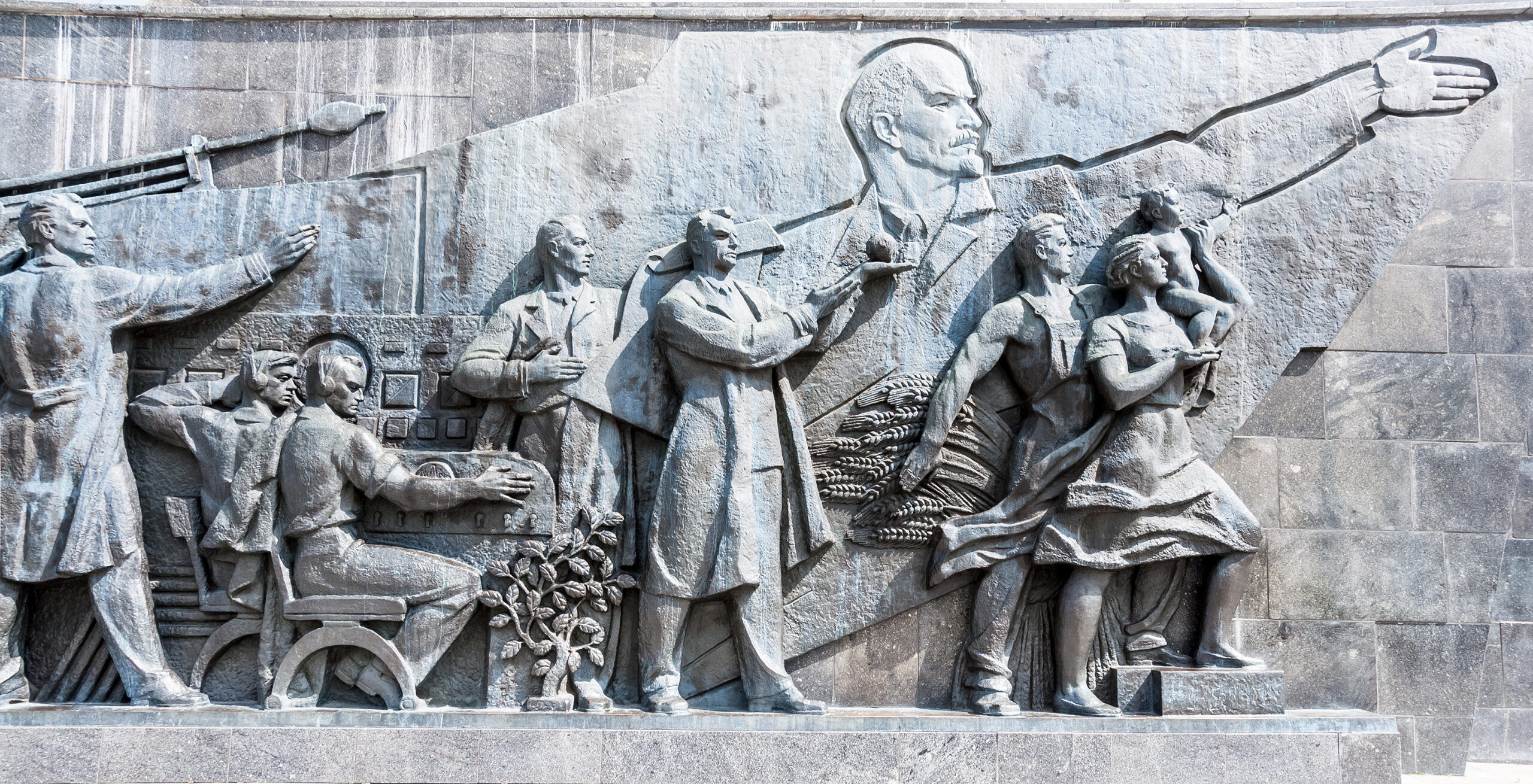


It has been a century since Vladimir Lenin, the father of the Soviet State, died in 1924 at the age of fifty-three, a victim of poor health and multiple strokes. He was once considered by Communists everywhere as a theoretician of the rank of Karl Marx, a philosopher and ideologist of the first order. But as the French political thinker Raymond Aron aptly noted, Lenin’s writings are of little philosophical interest, since hate and ideological fiat motivate them from beginning to end.
A narodnik or populist supporter of revolutionary violence turned Marxist doctrinaire, Lenin never ceased to ask the question “Kto-kogo”?,” “Who/Whom?,” that is, who would benefit from any particular choice or maneuver? Struggle was everything. Compromise or coalition building was completely alien to his conception of human and political life. He despised what he derided as economism, the view that working people and trade unions could promote their interests through participation in normal political and economic activity. He hated “social democracy,” or any effort to accommodate socialism to free politics or parliamentary procedures.
By 1905, more decent and humane Marxist activists and theoreticians such as Rosa Luxembourg already discerned in Lenin a crude totalitarian at the level of both theory and practice. In his early work What is to be Done? (1902), Lenin had already articulated the pernicious principle of “democratic centralism” — in which the substantive devoured the adjective –which eliminated the possibility of any serious debate or dissent within the Communist party. It became the official doctrine of the Soviet Communist party in 1921 and paved the way for the party becoming an instrument of coercive group-think and totalitarian domination. It rang the death-knell of intra-party politics and even any residual respect for individual conscience. Ideology and respect for conscience are antithetical.
Lenin’s theoretical writings defended crude materialism, a caricatural scientism, and vicious, anti-religious, atheism. They blamed the failure of capitalism to self-destruct (as Marx had prophesized) on an imperialism that extended the death throes of “monopoly capitalism,” as he called it. As Robert Conquest has written, Lenin’s theory of imperialism is at odds with the facts—Western capitalists and bankers generally opposed imperial adventures as a distraction and European powers invested more in their colonies than they took out. And as Raymond Aron added, the causes of the Great War were rooted in power political rivalries and the search for national prestige, not in reductive economic motives.
To the historical determinism central to the Marxism of Marx, Lenin added a penchant for revolutionary conspiracies and a criminal preference for clandestine activities, including robbery. He had no love for Russia whatsoever. And he loathed the European working class (and sundry social democratic parties) for siding with their respective countries over ideological criteria at the outset of World War I. A master tactician, expert conspirator, and ruthless Machiavellian, Lenin plotted with the Germans to return to Russia in a sealed train in April 1917, in time to inflict the coup de grace on a weak and ineffectual Provisional government dominated by feckless liberals and socialists. He was amply funded by a Germany that aggressively sought to undermine what was left of the Russian empire. Any self-respecting government would have arrested him for treason. While peasant mobs looted and set fire to landed estates, and the revolutionary Soviets systematically undermined the integrity and cohesion of the Russian armed forces, Lenin prepared the final blow, a coup d’état (not a popular “revolution”) to seize control of a vast nation for what was by then called the Bolshevik party. A first coup failed in July 1917. A second succeeded in October 1917. Lenin now had his opportunity to achieve utopia-in-power. But what utopia did he have in mind?
Lenin’s first instinct was to establish a dictatorship of the party in the name of the workers and peasants of what would soon be called the Soviet Union. By December 1917, he established the Cheka, a cruel, fanatical, and efficient secret police that he conceived as the “sword and shield of the party.” Red Terror long preceded the Russian Civil War and in important respects precipitated it. On January 5, 1918, Red Guards and agents of the newly formed Cheka disbanded the newly elected Constituent Assembly, murdering members of the liberal Kadet party (Constitutional Democrats) along the way.
At the time, the independent socialist writer Maxim Gorky wrote that Lenin disdained actual flesh-and-blood human beings since they were invariably resistant to his murderous ideological schemes and abstractions (lamentably, Gorky would later make a deal with the devil, returning to the Soviet Union in 1928 and writing shameless paeans to the gulag archipelago and the deadly slave labor project that was the White Sea-Belomor Canal). Five to six million peasants would die in the Volga Region and other grain-rich areas of Russia as a result of the “War Communism” marked by the forced requisitioning of grain and a near genocide would be inflicted on the fiercely independent Don Cossacks. Lenin was the architect of all these crimes. They are nearly unknown in the West today, although they are expertly described by the French historian Nicolas Werth in his superb chapter, “A State Against Its People,” in The Black Book of Communism.
As Aleksandr Solzhenitsyn established beyond a reasonable doubt in The Gulag Archipelago, it was Lenin, not Stalin, who created the infrastructure and ideological rationale for the totalitarian state in the U.S.S.R., and elsewhere. The concentration camps—as a vehicle for repressing “enemies of the people”—were Lenin’s ‘contribution’ to the twentieth century’s catalogue of horrors. Lenin’s role as the architect of totalitarianism is well documented, if, alas, typically ignored, and completely unknown to the young. He transformed the beautiful monasteries on the Solovetsky Islands in the Arctic North—noble places of pilgrimage and penitence for centuries on end—into the first instantiation of what would become the gulag system of forced labor camps. With fanatical zeal, Lenin encouraged the taking of “bourgeois hostages” who were put on barges in the old imperial capital of St. Petersburg, then sunk in the Neva river.
Lenin’s enthusiasm for such “methods” is well documented in writing from the Communist party’s “Secret Archive” collected by the historian Richard Pipes in The Unknown Lenin, published in English in the Annals of Communism series by Yale University in 1996. The interested reader should, in particular, read Document 24. There, Lenin calls for kulaks—relatively prosperous or ideologically-suspect peasants—in the Penza region to be “mercilessly suppressed” with no fewer than 100 to be immediately taken hostage and hanged and all their grain confiscated. No wonder that over two hundred peasant revolts occurred in the early years of the Soviet regime, the largest in the Tambov province of Russia. Lenin declared ruthless war on the independent peasantry and could see in their self-defense nothing but perfidy. These poor souls were for him nothing more than “bloodsucker kulaks” to be destroyed.
Lenin lived and breathed venom and hate. And his war on the churches in particular, and religion in general, was equally ruthless and murderous. It stemmed from Marxist position of ruthless atheism, pure and simple. To war on Orthodoxy, as Lenin did with zeal, was to take aim at the heart and soul of historic Russia. The key document in this regard is Document 94 in the Pipes volume, dated March 19, 1922. It clearly lays out Lenin’s “Machiavellian” scheme (in it, he makes a reference to chapter 8 of the Prince) for confiscating sacred “Church valuables” during the famine induced by War Communism. His purpose was to create sympathy among “the broad peasant masses” (whom he otherwise disdained), by directing antipathy towards the Church which had nothing to do with creating the famine and that did its best to alleviate its effects. Lenin simply wanted the Church’s resources and to blame the Church as he confiscated them. Decent priests became “Black Hundred clergy” in Lenin’s incendiary rhetoric. Patriarch Tikhon, who ably defended the rights of the Church and criticized the inhumanity of the Bolsheviks, was targeted for enhanced surveillance and “exposure” and later brought to trial. Lenin called for a campaign to execute, as quickly as possible, “the greatest […] number of representatives of the reactionary clergy and the reactionary bourgeoisie.” The more “the better,” Lenin coldly suggested.
Academic Marxists of various stripes still appeal to Lenin’s 1917 pamphlet The State and Revolution in an effort to find a more “libertarian” Lenin. But this is at once a chimera and a bad joke. Like Marx himself, but even more intensely and ferociously, Lenin combines a Jacobin defense of terror and tyranny with a confidence that once the bourgeois “machinery” of domination is “suppressed,” the state will quickly “wither away.” In 1918, Max Weber had already exposed the absurd logic, and the ignorance of human nature, underlying such a claim. On some level, as Solzhenitsyn points out to great effect in The Gulag Archipelago, Lenin was a fabulist. He had persuaded himself, in words quoted by Solzhenitsyn, that “’the suppression of the minority of exploiters by the majority of the hired slaves of yesterday is a matter so comparatively easy, simple and natural, that is going to cost much less in blood […] will be much cheaper for humanity’ than the preceding suppression of the minority.” The result of this delusory expectation was that millions, even tens of millions, would perish under Lenin and Stalin. Declaring war to the death on established customs, private property, religion, sundry “class enemies” and “enemies of the people,” and on political liberty and human nature itself, was never going to be simple or easy affair.
Less than a year after writing The State and Revolution, Lenin wrote an extended essay to himself (“How to Organize Competition,” January 1918) to clarify his thoughts on these matters. This revealing text vitriolically calls for continual war on “the lackeys of the moneybags, the lickspittles of the exploiters—Messieurs the bourgeois intellectuals.” Opponents of totalitarian socialism are identified as “the rich, the crooks, the idlers and hooligans” who are “dregs of humanity,” nothing more than “hopelessly decayed and atrophied limbs,” “contagion” and plague” that must be wiped off the face of the earth. “No mercy to the enemies of the people, the enemies of socialism, the enemies of the toilers,” Lenin proclaims. They are, he tells us, not human beings at all.
Lenin next resorts to macabre and bone-chilling irony: he recommends endless “variety” and “competition” in “methods of approach, in methods of exercising control, in ways of exterminating and rendering harmless the parasites (the rich and the crooks, slovenly and hysterical intellectuals, etc. etc.)”. Lenin ends his darkly clarifying reflection with a call for Bolsheviks to find a “variety” of means or methods “in achieving the single common aim—to cleanse the land of Russia of all sorts of harmful insects, of crook-fleas, of bedbugs—the rich, and so on and so forth.” The systematic dehumanization of imagined “enemies of the people” provided an imitable model for all later totalitarian efforts to deny the humanity of suspect groups and classes who are guilty more for who they are than what they have done. There is more than a residue of this ideological Manicheism in the West today, a localization of evil that, paradoxically, massively amplifies evil, which logically leads to totalitarianism not only in theory but in practice. The now dominant ideology of post-colonialism (at least in activist and academic circles) is not such a distant relative of Lenin’s misplaced theory of capitalist “imperialism” as the root of all evil.
Where do Lenin and Leninism stand today? Revealingly, Robert C. Tucker’s authoritative The Lenin Anthology is long out of print, even if his The Marx-Engels Reader remains readily available. In contemporary Russia, Lenin is a figure of contempt more than admiration. His cult is in retreat, and his role in establishing the totalitarian state, his persecution of religion, his treasonous conduct during the First World War, and his transfer of historic areas of historic Russia to the Ukrainian SSR are widely denounced. Conversely, Stalin is in comparative (if qualified) ascent, not the Stalin who presided over collectivization and the Great Terror, not the morally insane ideological tyrant, but the military/political leader who paved the way to victory in the Great Patriotic War. But this is a new ideological Lie since Stalin’s assault on the officer corps before World War II, his blindness to the threat posed by Hitler, his intensification of political repression in the camps and elsewhere during the War, and his reckless disregard for the lives of ordinary soldiers, greatly hindered rather than aided the cause of victory. These truths need to be told in Russia today.
In the West today, many hate Russia more than the criminal enterprise that was Soviet Communism. As a result, Communist ideology is in danger of getting a free pass. A celebrity intellectual such as Slavoj Žižek still turns to Lenin, lauding both “the kernel of truth” in his defense of emancipatory Terror and the “pragmatism” he eventually showed in abandoning War Communism and allowing small-scale capitalist enterprises during NEP, the New Economic Policy that he inaugurated. Yet, in his book Lenin 2017, Zizek defends “democratic centralism” and the brutal suppression of non-Communist socialist parties, a process of repression that intensified as NEP took effect. Zizek attacks “Stalinism,” while defending its “kernel of truth,” too. What clever obfuscations tailor made by and for the clever woke—and the ignorant—among us.
Lenin and Leninism remain a vivid reminder of the murderous inhumanity inherent in ideological abstractions and revolutionary movements that put “Humanity” in the abstract before concrete human beings. But, one must ask today, are we still capable of absorbing these lessons and passing them on to the next generations? I have my doubts. But the survival of what is left of liberal and Christian civilization depends upon it.
About The Author
