





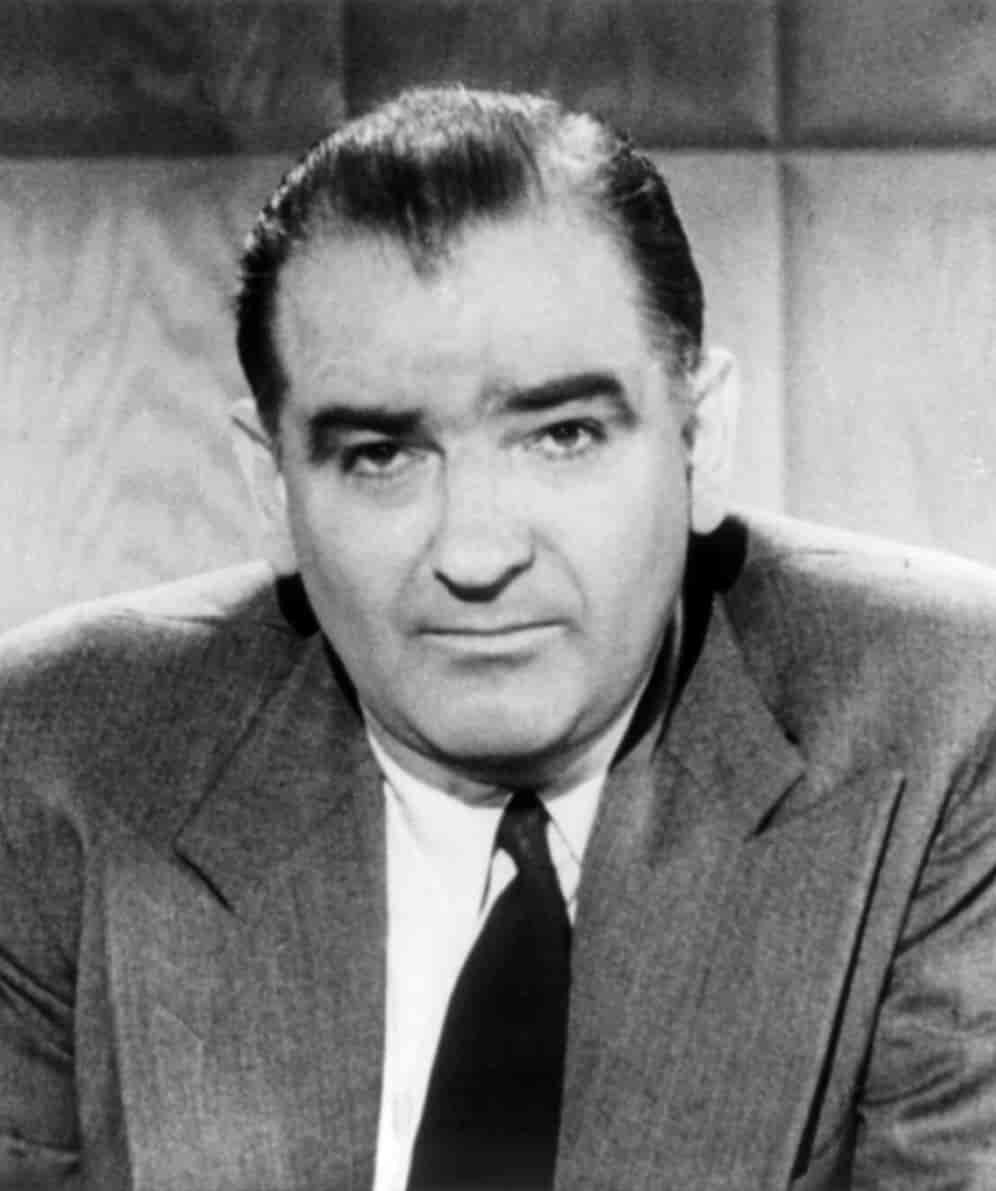


Nicholas Mosvick published an interesting essay in Fusion reassessing the legacy of Wisconsin senator Joseph McCarthy and the anticommunist movement more broadly. While McCarthy’s efforts to unveil the genuine threat of communism and the Soviet Union ought to be appreciated by any American conservative, Mosvick unfortunately goes too far in his defense of the period’s populist style. Even at the time, leaders within the conservative movement had plenty of doubts about “Tail-Gunner Joe” and his politics of fear. There are better anticommunists to admire and promote today.
Strangely, Mosvick does not cite the most important conservative anticommunist of the twentieth century: Whittaker Chambers. Originally a revolutionary who joined the Soviet underground to commit acts of espionage against the United States, Chambers became disillusioned with the USSR as it committed acts of increasingly horrific mass-murder and allied with Nazi Germany to partition Poland. He turned informer and became a cause célèbre among postwar conservatives. Chambers dedicated much of his life to exposing the full extent to which communists had infiltrated the American government. His 1952 memoir Witness—one of the greatest American autobiographies—became a rallying cry for anticommunists across the country.
Nevertheless, Chambers rejected McCarthy and all his works. In his biography of Chambers, Sam Tanenhaus recounts that, when the two men met in 1950, the writer initially supported McCarthy’s anticommunist crusade. By 1952, however, Chambers grew wary of McCarthy’s populism. While he supported investigations of communist infiltration of the government and academia, he became convinced that McCarthy was being altogether too reckless. Rather than addressing the real security concerns Chambers and his ex-communist allies earnestly raised, McCarthy used his congressional perch to chase popularity and votes.
Chambers even worried that McCarthyism would undermine a legitimate anticommunist movement in the United States. In a letter to his young admirer William F. Buckley, Jr., explaining why he could not endorse his book defending the Wisconsinite, Chambers warned that McCarthy’s style of demagoguery spelled doom for a sensible right-wing politics. “His flair for the sensational, his inaccuracies and distortions, his tendency to sacrifice the greater objectivity for the momentary effect, will lead him and us into trouble,” he wrote. “Senator McCarthy will one day make some irreparable blunder which will play directly into the hands of our common enemy and discredit the whole anti-Communist effort for a long while to come.”
Chambers’s correspondence with Buckley is laden with similar condemnations of McCarthy and McCarthyism. To the communists, he wrote in one 1954 letter, “Senator McCarthy is a godsend” both because he divided the American Right within itself and eroded its legitimacy with the broader public. In 1955, he told Buckley that McCarthy was guilty of “bilious ineptitude” and that his approach was “clumsy, stupid, [and] self-defeating.” He even asserted that “For the Right to tie itself in any way to Senator McCarthy is suicide.”
After some years had passed and McCarthy’s career imploded, Chambers became more reflective but remained altogether critical. “The Senator never understood Communism or the war on Communism,” he wrote to Buckley after McCarthy’s death in May 1957, “he never evolved a strategy, but only a tactic which consisted exclusively in the impulse: Attack. That could never be enough, could end only as it did, or in some similar way.” And the following year, he told Buckley that he “deplored the whole McCarthy ruckus” and that National Review should drop his cause:
You cannot defend a man who was, basically, not defensible. You only weaken your position when you do; you weaken your future power to defend others. The Senator, in my opinion, did the Right more mischief than he ever did the Left; and he keeps right on doing it. It does no good to plead (or prove) that the Left was (is) mean to him. What did he really accomplish? I would say: very close to nothing but noise.
Chambers understood the terrifyingly real danger of communist infiltration, and the difficult steps the American government would have to take to free itself from Soviet influence and oppose global revolution. But he also knew those immense tasks could only be undertaken with widespread popular support. The high-profile status of McCarthy’s extremism and paranoia made it seem like all conservatives and anticommunists trucked in his brand of lunacy. Only by distancing the movement from his populism could it hope to sway public opinion.
Another superior anticommunist model Mosvick could learn from is the traditionalist sage Russell Kirk. Mosvick quotes his insightful analysis of our First Amendment rights, but makes no mention of his uneasiness with McCarthy and his tactics. As Bradley Birzer notes in his magisterial biography Russell Kirk: American Conservative, the “McCarthy Era” was mostly over by the time Kirk became a well-known public figure—but even still, Kirk found time and energy to condemn the rabid populism McCarthy came to represent.
Take, for instance, his 1953 essay “Conformity and Legislative Committees.” Writing in the wake of Soviet agent Alger Hiss’s exposure by Chambers, Kirk certainly acknowledged the importance role of the federal government stamping out political radicalism and foreign interference. “A nation so ‘liberal’ that it cannot bring itself to repress the fanatic and the energumen under any circumstances soon will be reduced to a condition thoroughly illiberal,” he remarked. Certain actions of the House Committee on Un-American Activities, and even Senator McCarthy, could be defended and possibly even supported on those grounds. And yet Kirk also understood that democracy has a dark side, and that a mob spirit would inevitably trample on the actual rights of real people. The example of this democratic despotism Kirk most often cited, including in this essay, was Franklin Roosevelt’s horrific internment of Japanese Americans during World War II.
Ultimately, Kirk knew that American patriotism had to rest on a firmer ground than law and terror. “Loyalty cannot be forced, any more than love. The patriotism which is the product of fear or of self-interest is truly the last refuge of the scoundrel,” he wrote. “We may prosecute for perjury a man who swears fidelity to the state, and then breaks his oath; but positive law cannot create loyalty.” The problem of disloyalty could never be solved by federal law or congressional investigations, let alone the slogans of populist politicians. Nor could vague liberal platitudes about an “open society” induce citizens to defend their country. Only a conservatism motivated by a love for the country as it was actually constituted would inspire Kirk, his allies, and the American people as a whole.
After McCarthy’s death, still wilder groups and figures rose up to claim his extremist mantle. Kirk made a point of working to distance the young conservative movement from these fringe elements. In the lead-up to Barry Goldwater’s 1964 presidential campaign, he joined forces with the Arizona senator and the onetime McCarthy-defender Buckley. Together, they sought to ensure that anyone who claimed the McCarthyite mantle, such as the John Birch Society, and other demagogues in his vein, such as Utah governor J. Bracken Lee, would not have a major influence in the Republican party or conservative politics.
In a 1962 essay published in America magazine, reprinted a year later in his collection Confessions of a Bohemian Tory, Kirk labelled the most paranoid elements of anticommunism as “political fantastics.” In their unyielding devotion to ideology and their willingness to label their fellow-citizens as traitors or enemies, these right-wingers seemed to Kirk little different than their left-wing counterparts. Allowing them to exercise any level of control in the nascent conservative movement would lead to disaster, he argued:
We cannot afford the venomous political fantastic in this time of trouble; we cannot afford even the silly, well-meaning political ignoramus. To act intelligently, the conservative interest in this country must free itself from even the peripheral influence of intellectual freaks like Ayn Rand, from profiteers who thrive upon confusion and hatred, and from the absurd simplifiers who fancy that calling everyone in Washington a Communist will make all things hunky-dory. It is even more imperative for conservatives to repudiate political fantasy than for liberals to do this: for ours happens to be a time for genuinely conservative action, and certainly the American public is drifting in a direction vaguely conservative.
Of course, Kirk knew that not every anticommunist was a political fanatic. “To set one’s face resolutely against the Communist domination is one thing,” he concluded, “to cry havoc at every breath of liberal or radical opinion is quite another.” Even ordinary Americans can get swept up in the rush of demagoguery. But what Kirk called the “conservative interest” should work to channel legitimate anger at or fear of America’s feckless elites into a constructive movement.
Sadly, neither the Republican party nor the broader conservative movement seem terribly interested in that mission at the moment. Rather than conduct a campaign on the old conservative verities, “rising stars” such as Arizona Senate candidate Kari Lake court the QAnon conspiracy theorists who have inherited the John Birch Society’s populism. Disgraced former Fox News personality Tucker Carlson, widely hailed as the “voice of the New Right,” indulges crypto-fascist historical revisionism on the show he livestreams on the internet. Even the GOP’s presidential nominee, Donald Trump, has promoted an array of conspiracy theories that might even make McCarthy himself blush.
It is not the populist McCarthy who needs vindication today, then, but rather the movement conservatives who rejected his paranoid style. Progressive ideology at home and enemy regimes abroad certainly threaten American order—but conservatives fighting back need to stay smart. Chambers and Kirk would warn us not to trust “political fantastics” or the radical demagogues they support. We can defend the Constitution and secure the common good without resorting to the failed tactics and strategies that proved ineffective the last time they were deployed.
About The Author
